The Italian Sparkling Wine That Isn’t Trying to Be Prosecco
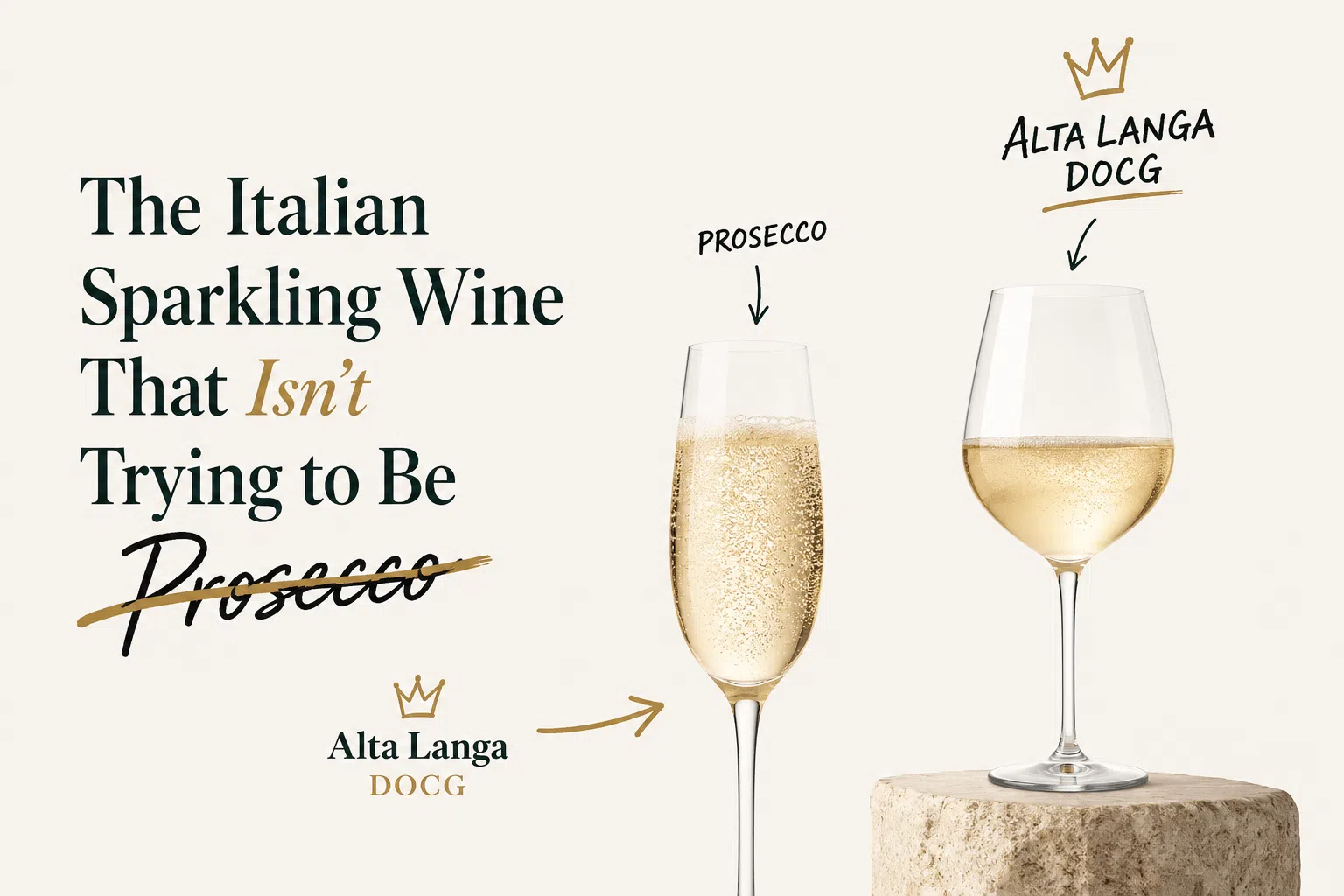
There’s an Italian sparkling wine that, by law, has to sit on its own spent yeast for a minimum of 30 months. Only then is anyone allowed to sell it. That’s two and a half years spent quietly getting better, in cellars in Piedmont, before a single bottle reaches a shelf.
Ask most people to name it and you’ll get silence. Ask them to name an Italian sparkling wine at all and you’ll get one answer: Prosecco. That gap has nothing to do with quality. Alta Langa isn’t obscure because it’s worse. It’s obscure because nobody’s ever bothered to make its case the way Prosecco’s marketing machine has made Prosecco’s.
Let’s make the case.
It’s Not Prosecco’s Cousin. It’s Not Related at All.
Here’s the whole confusion in one sentence: Prosecco and Alta Langa are both Italian, both sparkling. That’s the entire overlap.
Prosecco comes from Veneto and Friuli. It uses mostly Glera grapes, and gets its fizz from the Charmat method — a second fermentation in large steel tanks. Fast, efficient, built for freshness. Alta Langa comes from the hills of Piedmont and uses only Pinot Nero and Chardonnay. It ferments a second time inside each individual bottle — the same traditional method Champagne uses, and the reason that 30-month minimum exists at all. It’s not a stylistic choice. It’s the law, written into the DOCG’s own production rules.
Prosecco can go from harvest to your glass in about a month. Alta Langa spends longer resting on dead yeast cells than most relationships last before either side admits it isn’t working.
Why the Extra Time Isn’t Just Patience for Its Own Sake
The traditional method isn’t a slower, fussier way of doing what Prosecco does. It builds a different wine entirely.
While Alta Langa sits on its lees for those 30-plus months, the spent yeast slowly breaks down. It releases compounds that build texture, add bread-and-pastry aromas, and create finer, more persistent bubbles than tank fermentation produces. This is the same chemistry that makes Champagne taste like Champagne instead of sparkling grape juice with a fancier label. Alta Langa gets that exact treatment, just under a Piedmontese roof instead of a French one. I go into more of that comparison when I write about Champagne versus sparkling wine generally.
The Altitude Isn’t a Marketing Detail
Vineyards growing Alta Langa’s grapes have to sit above 250 meters, and most producers plant well past that minimum.
Cooler nights at altitude slow ripening and protect acidity. That matters enormously for a wine that needs enough natural structure to survive nearly three years of aging without collapsing into something flat and tired. There’s a second layer of irony here too: Pinot Nero and Chardonnay aren’t grapes anyone associates with Piedmont. This is Nebbiolo and Barbera country. Alta Langa is the region quietly proving it can do something completely different, using grapes better known for growing in Champagne and Burgundy, several hundred kilometers away.
What Lands in the Glass
Citrus, green apple, white flowers up front. Toasted, brioche-like notes underneath, courtesy of all that time on the lees. Some cuvées lean toward hazelnut. Straw-yellow color, fine bubbles, more structure on the palate than something this pale has any business having.
It shifts by producer and blend the way any serious wine does. Pinot Nero–heavy bottles run richer and more structured. Chardonnay-forward versions stay leaner and more citrus-driven. But the throughline holds across nearly every bottle: it tastes unhurried, because it was.
When You’d Reach for This Instead of Prosecco
Prosecco is the bottle you open because the evening just started and people are still arriving. I’ve written before about how Prosecco wins on exactly that kind of usefulness, even while losing the prestige argument to Champagne. Alta Langa is the wine that flips the equation. You open it when you want people to slow down and pay attention to what’s in their glass.
It holds up better with food, too — richer dishes, seafood with real weight, aged cheese, even the white truffle that happens to grow in the same hills the grapes come from. It’s also the obvious next move for anyone who already knows Prosecco well. They get to see what Italian sparkling wine looks like when nobody’s optimizing it for speed or price.
Two and a half years of tank space, bottle aging, and hand-riddling isn’t free. Nobody making Alta Langa is pretending otherwise.
Reading the Label Without Guessing
Alta Langa DOCG on its own means the standard minimum: 30 months on the lees. Riserva means the producer pushed further. The rules require at least 36 months for that designation, and some go well beyond it. Every bottle carries a vintage year; unlike Prosecco, there’s no non-vintage version, because the DOCG doesn’t allow one. You’ll also see Pas Dosé or Extra Brut on drier bottlings, and occasionally Blanc de Blancs or Blanc de Noirs. Those mark a wine made entirely from Chardonnay or entirely from Pinot Nero rather than a blend.
Quick Answers
Is Alta Langa better than Prosecco? Not better — different. Prosecco is built for immediacy and freshness. Alta Langa is built for structure and complexity through extended aging. They’re solving different problems, not competing for the same job.
Why haven’t I heard of Alta Langa if it’s this good? Mostly branding and scale. The DOCG was only formally recognized in 2011. Production stays small and deliberately controlled, and nobody’s ever run a global marketing campaign for it the way Prosecco has had for decades.
Is Alta Langa the same as Franciacorta? No, though they’re often compared. Both use the traditional method and similar grapes. But Franciacorta comes from Lombardy, not Piedmont, and the two denominations have separate production rules and identities.
What should I expect to pay? Meaningfully more than Prosecco — generally in line with mid-tier Champagne or Franciacorta, given the aging time and hand labor involved.
The Trade-Off
Prosecco is the wine that starts the party. Alta Langa is the wine that makes people stop mid-conversation and ask what they’re drinking.
Neither is the upgrade. They’re doing different jobs, and Piedmont is good enough at winemaking to do both properly. One happens in a steel tank inside a month. The other happens in a bottle for the better part of three years, in the same hills where Barolo has been getting away with taking its time for a lot longer than that.
Continue Exploring
- The Complete Guide to Prosecco — Italy’s Most Joyful Wine
- Stop Calling Prosecco “Italian Champagne” — Here’s What It Actually Is
- Why Prosecco Keeps Losing to Champagne… Even When It Wins
- The Difference Between Sparkling Wine and Champagne
- Asti Was Never Trying to Be Champagne
Enjoy wine without the snobbery?
Make The Finest Italian Wine one of your Preferred Sources on Google.
Add The Finest Italian Wine to Preferred SourcesDiscover more from The Finest Italian Wine
Subscribe to get the latest posts sent to your email.