Asti Was Never Trying to Be Champagne
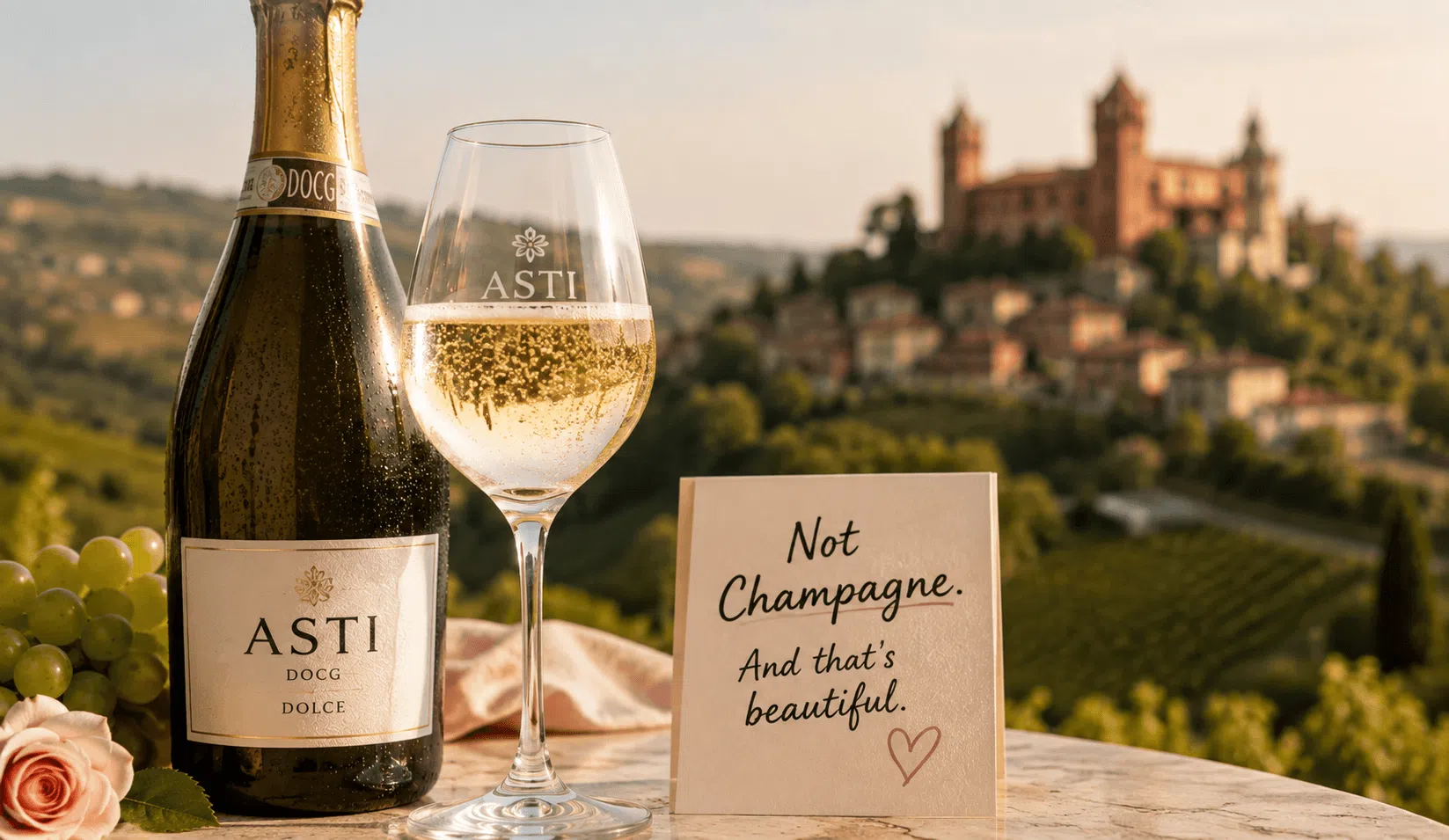
The wine your uncle brings to Thanksgiving because it’s cheap and nobody will complain is fermented and aged in a UNESCO World Heritage Site. Actual underground cathedrals, carved into rock, holding bottles at a constant twelve degrees.
I’m not exaggerating for effect. It’s called that officially. Cathedrals.
And for a solid chunk of the 20th century, this same wine wasn’t even legally allowed to be called wine in the United States. The alcohol was too low. The government’s own definition required at least 7%, and Asti’s lighter style comes in under that on purpose.
So which is it? A serious wine with a UNESCO address, or a joke that couldn’t clear the legal bar for “wine”? Neither, and both at once. It’s a wine that got a lot of things right a hundred and fifty years before anyone noticed. It’s still shaking off the reputation it paid for that.
The Wine That Was Built to Not Be Champagne
Here’s what most people get backward about Asti immediately. It didn’t fail to become Champagne. It never tried to be Champagne in the first place.
Carlo Gancia, a young Piedmontese winemaker, spent time in France in the mid-1800s studying exactly how Champagne got its bubbles. He came home to Canelli with the technique in his head and the local Moscato Bianco grape in front of him. Then he made a choice most guides skip over entirely. He didn’t copy the French method. He couldn’t, not without ruining the wine.
Champagne gets its complexity from months or years of extended contact with dead yeast cells in the bottle. That process builds toast, brioche, that whole savory dimension people pay a fortune for. It also flattens delicate fruit character right out of a wine. Moscato Bianco’s entire appeal is fresh peach, orange blossom, and honeysuckle aromatics. Put it through Champagne’s method and you’d murder the one thing that makes it worth drinking.
So Gancia used a single fermentation in a sealed, pressurized tank instead. Fast, clean, and built to protect exactly the aromatics Champagne’s method would have destroyed. That’s not a cheap shortcut. That’s the correct tool for this specific grape.
Then America Discovered It, and Ruined the Story a Little
Asti’s reputation problem didn’t start with Gancia. It started decades later. American soldiers returned from Italy after World War II with a taste for something sweet, fizzy, and easy to drink, and they brought it home with them.
Demand exploded. Producers responded the way producers always respond to sudden demand: they scaled up, and quality slid along the way. The wine critic Karen MacNeil later described those exports as “a noxiously sweet poor man’s Champagne.” That’s a brutal line. It’s also not an unfair one for what was actually landing on American shelves by the 1970s and 80s.
Martini & Rossi commercials did the rest. An entire generation associated Asti with mass-market, supermarket-shelf sweetness, and that association calcified into the reputation that’s still hanging around today.
The Name Change That Was Basically a Confession
In 1993, Asti earned DOCG status, Italy’s highest classification. Quality producers did something telling with that moment. They dropped “Spumante” from the label entirely.
Think about what that actually means. The wine didn’t change its name for style reasons. Producers dropped the word specifically because “Spumante” had become shorthand for cheap, and they wanted daylight between their bottle and that reputation. You don’t rebrand away from a word unless that word is actively costing you sales.
Sit with that for a second. That’s not a rebrand. That’s a wine category quietly confessing to a PR problem by editing its own label.
Everyone Else Is Only Now Catching Up
Asti Spumante typically sits around 7 to 9% alcohol. Moscato d’Asti, made in the same region from the same grape, is legally capped at 5.5%. That’s so low it wasn’t even recognized as wine under old US regulations.
Low-alcohol wine is having a real moment right now. People treat it like a clever new discovery for drinkers who want the ritual without the hangover. Asti’s been sitting at 5.5% since before most of those drinkers were born. Nobody’s calling it visionary. They’re mostly still calling it grandma’s wine.
Nobody’s calling it visionary. They’re mostly still calling it grandma’s wine, which tells you everything about who gets credit for arriving first and who just gets there quietly. The wine got the sweet spot right this whole time. It just didn’t have anyone marketing it as smart instead of quaint.
The Cathedrals Underneath All of This
Back to those tunnels. Canelli’s underground cellars are called the Cattedrali Sotterranee. They run about 20 kilometers under the town, carved as deep as 32 meters into the rock roughly 200 years ago. UNESCO listed them as a World Heritage Site in 2014, part of the Piedmont vineyard landscape, alongside the hills of Langhe and Monferrato.
Wineries like Gancia, Contratto, Coppo, and Bosca still age wine down there today, at a steady twelve to fourteen degrees, in vaulted brick chambers. They really do look like something out of a cathedral rather than a wine cellar. It’s one of the more surreal contrasts in Italian wine. A category people associate with brunch and regret, resting in a space serious enough to earn a spot next to actual architectural monuments.
So next time someone hands you a cheap bottle at a holiday dinner, you can hand them back a fact. The same wine, made properly, ages in an actual cathedral. Your uncle’s bottle just didn’t get invited.
How to Actually Buy It
Skip generic “Asti Spumante” from a supermarket shelf if you want to understand what this wine can actually do. Look for Moscato d’Asti instead. Most serious tasters consider it the more refined of the two styles, gently fizzy rather than fully sparkling, and it’s where the best producers put their attention.
If you see “Canelli” on the label, that’s a good sign. It’s an official sub-zone, and wines using that name have to be 100% Moscato Bianco from that specific area.
Producers worth trusting: Paolo Saracco, widely considered the benchmark and sometimes called the Master of Moscato. G.D. Vajra and Ceretto, both better known for serious Barolo, also make excellent Moscato d’Asti on the side. Vietti and Coppo round out a solid buying list, and Coppo’s own cellars sit right inside those UNESCO tunnels. Expect to pay $15 to $30 for something actually worth your attention, and drink it young. This isn’t a wine built for the cellar.
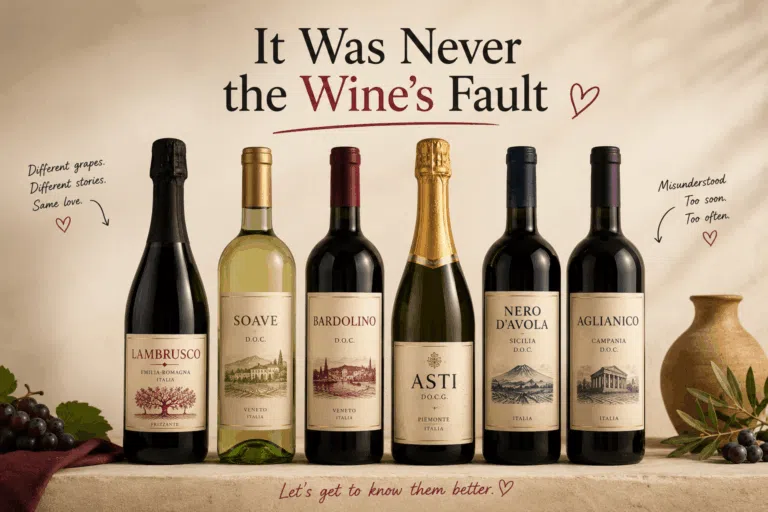
If this story sounds familiar, it should. I promised you a version of it back when I wrote about Lambrusco, and it holds up here too. Add Soave and Bardolino to the pile. Italy makes a lot of wine that got cheap by accident of history, not by nature, and Asti might be the clearest example of the bunch.
Quick Answers
What’s the difference between Asti and Moscato d’Asti? Both come from the same Moscato Bianco grape in the same region of Piedmont. Asti Spumante is fully sparkling and typically 7 to 9% alcohol. Moscato d’Asti is gently fizzy rather than fully sparkling, capped at 5.5% alcohol, and generally considered the more refined style by serious tasters.
Why does Asti have a cheap reputation? A post-World War II export boom to the US flooded the market with mass-produced, sweetened bottles built for volume rather than quality. That era’s reputation stuck around long after quality producers moved on from it, and heavy advertising in the 1970s and 80s cemented the association.
Is Asti actually a DOCG wine? Yes. Asti earned DOCG status, Italy’s highest classification, in 1993. Quality producers dropped “Spumante” from their labels around the same time specifically to distance themselves from the cheap reputation that word had picked up.
Is Asti sweet because of added sugar? No. Fermentation is deliberately stopped early through chilling and filtration, which preserves the grape’s own natural sugar rather than adding sweetness afterward the way some other styles do.
Enjoy wine without the snobbery?
Make The Finest Italian Wine one of your Preferred Sources on Google.
Add The Finest Italian Wine to Preferred SourcesDiscover more from The Finest Italian Wine
Subscribe to get the latest posts sent to your email.