Alcohol-Free Italian Wine Just Won Gold. Is It Good Now?
For years, alcohol-free wine had exactly one hard problem, and it wasn’t the alcohol.
It was the wine.
You could remove the alcohol easily enough. Design a nice label, print 0.0% somewhere reassuringly large, and tell everyone this was the future of drinking. Then somebody tasted it. Too sweet, too thin, too much like expensive grape juice wearing a wine label and hoping nobody asked follow-up questions.
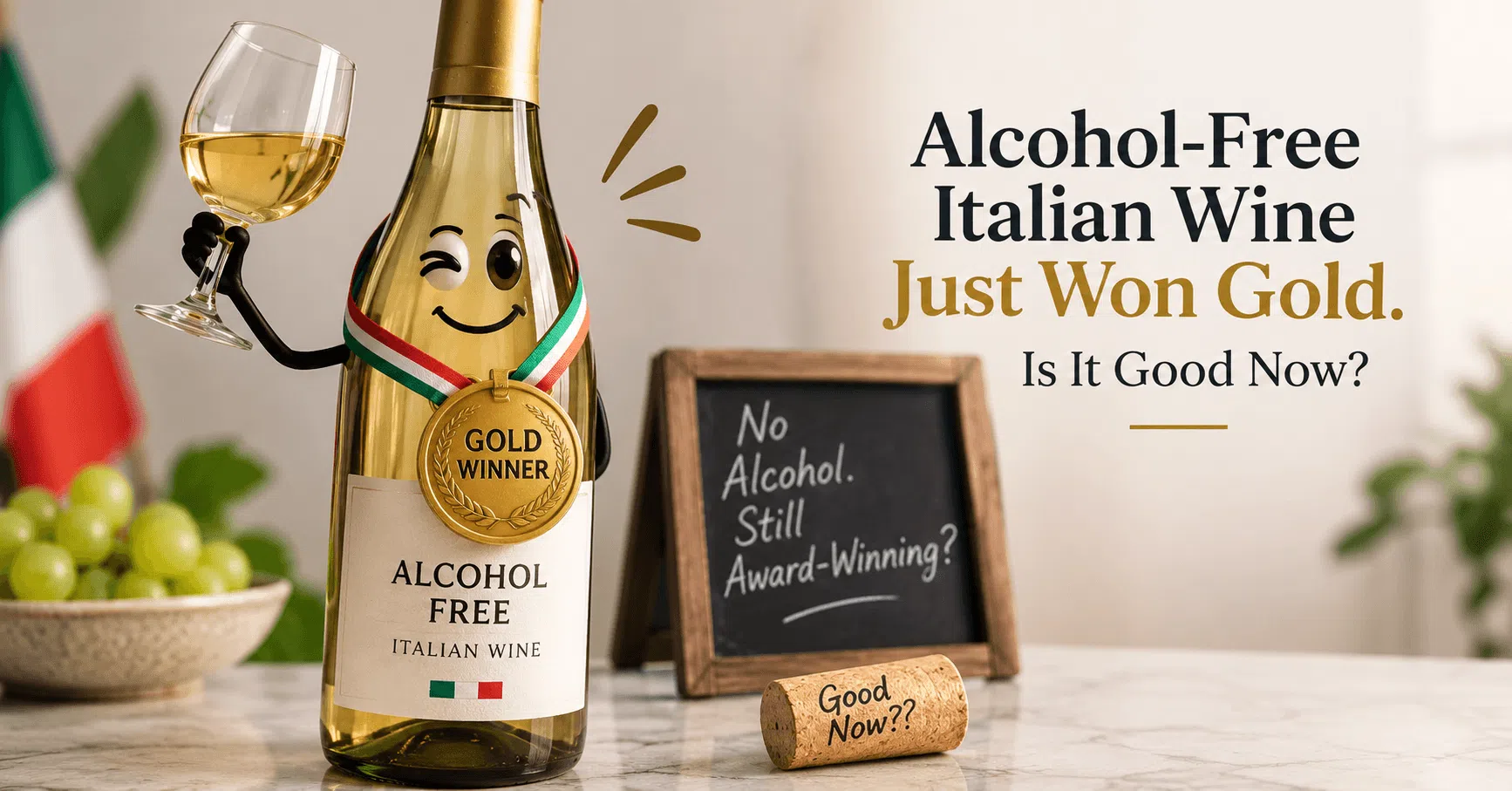
Something just shifted, though. At the latest 2026 Mundus Vini Non-Alcoholic tasting, 71 dealcoholized products won medals, 28 of them Gold. Italian bottles weren’t just present on that list. Doppio Passo’s Alternativa Sparkling 0.0% took Best of Show Sparkling Italy. Poderi di Lea’s Spumante Rosé Dealcoholised Wine 0% took Best of Show Sparkling Rosé outright. It beat every other rosé in the category, alcoholic or not. Valdo and Caviro picked up Gold too.
So here’s the question I didn’t expect to be asking quite this soon: is alcohol-free Italian wine getting good?
Italy Showed Up Late to Its Own Party
Italy’s relationship with alcohol-free wine has been a little absurd, honestly. This is one of the great wine-producing countries on earth. Barolo, Brunello, Amarone, Chianti, Prosecco. Enough regional wines to make memorizing them feel like studying for a civil service exam.
Yet for years, Italy made it extraordinarily difficult to dealcoholize wine domestically. It could grow the grapes, make the wine, and bottle the wine without any trouble. But the actual step of removing the alcohol? Please take that part elsewhere.
That changed once Italy finally built a proper legal framework for domestic dealcoholization. I went into exactly how that regulatory shift played out, Barolo’s own strange exception included, in a piece of its own. And almost immediately after the door opened, Italian alcohol-free wines aren’t just showing up. They’re winning. That’s a genuinely fast turn. From “can Italy even make this properly” to “somebody would like to hand it a Gold medal,” in barely any time at all.
What Won, and Why the Details Matter
Mundus Vini’s international panel handed out 28 Gold and 43 Silver medals across this non-alcoholic tasting. Germany, Italy, and Spain together took more than 80% of every medal awarded.
Valdo’s PURØ Alcohol Free Blanc de Blancs Demi-Sec picked up Gold. Caviro won Gold for two separate Tavernello 0% sparkling wines. Poderi di Lea’s rosé and Doppio Passo’s Alternativa didn’t just win Gold, they won their entire categories outright.
A medal isn’t scripture. However, judges have preferences, and your own palate is allowed to disagree with all of them. Gold does not mean alcohol-free wine now tastes exactly like Champagne.
What it does mean is something more specific. An international panel tasted these bottles directly against their non-alcoholic peers and decided they were genuinely good. Not just impressive for a category still finding its feet. That distinction is worth sitting with.
The Problem Was Never Really the Alcohol
Making wine without alcohol sounds simple until you remember alcohol isn’t just the part responsible for a slightly embarrassing text the next morning. It carries real weight in the glass, body, warmth, texture, and how everything else you taste gets perceived. Remove it and the wine doesn’t just carry on unaffected.
I’ve gone deep into how that removal process works, and separately into whether the result still genuinely tastes like wine. My answer hasn’t changed: yes, just not exactly. But I’ve come to think exactly was always the wrong target to aim at.
I don’t need an alcohol-free sparkling wine to trick me into believing it’s Champagne. I need it delicious enough that I stop counting what’s missing. These medals suggest a handful of producers are finally getting close to that bar. Not just clearing the much lower one of “acceptable for a health-conscious substitute.”
Notice What Nearly Every Italian Winner Has in Common
Bubbles. Every single one.
That’s not a coincidence. In fact, it’s the most useful thing this whole story reveals. Sparkling wine gets a real structural advantage once alcohol disappears. Carbonation supplies its own texture and energy. Acidity keeps things fresh. Your palate has something else to focus on while alcohol isn’t there doing its usual job. A big, structured still red gets none of that help. Meanwhile, pull the alcohol out of it and everyone at the table immediately notices who left the room.
Which is exactly why I’ve argued Italy’s smartest alcohol-free move was never going to be engineering some miracle 0.0% Amarone that tastes indistinguishable from the real thing. Please leave Amarone alone until further notice.
The real opportunity was always sparkling. Italy happens to know more about sparkling wine than almost anywhere else on earth, including the quieter, more serious side of that story that has nothing to do with Prosecco at all.
Prosecco’s Real Lesson Applies Here Too
Think about what made Italian sparkling wine a global success in the first place. It wasn’t only prestige. Prosecco got enormous because it understood wine could also just be easy.
Open it, pour it, have an aperitivo. Mix it into a cocktail if you feel like it. Drink it with people who’ve never said the words secondary fermentation out loud and are living perfectly happy lives regardless.
That exact philosophy fits alcohol-free sparkling wine unusually well. Someone reaching for a 0.0% bottle isn’t necessarily hunting for a forensic replica of vintage Champagne. They’re driving home, having lunch before an afternoon of work, or cutting back. Or they simply don’t want alcohol tonight but still want to sit at dinner holding a proper glass of something, not a sad seltzer with a lemon wedge while everyone else discusses the real wine. If Italian producers can make something genuinely good for that specific person, 0.0% stops being a niche punishment. It starts being an actual choice.
Winning Gold Doesn’t Settle the Real Question
There are two separate questions hiding inside this story, and they keep getting confused with each other. Is this a good alcohol-free drink? And does this taste exactly like conventional wine? Those aren’t the same question, and for years the category kept trying to answer with the second one. You won’t even know the difference. I never bought that pitch. You fermented a real wine, removed one of its major structural components, and you’re telling me absolutely nothing changed? The wine just shrugged?
I’d rather producers stopped selling alcohol-free wine as an invisible impersonation and just made something genuinely good instead. That’s the whole bar. If I finish the glass because I want another sip, the category has already won the argument that matters.
The Real Test Isn’t the First Bottle
Curiosity sells a bottle once. It cannot sell bottle number six.
The first phase of the alcohol-free wine boom was entirely about availability. Can we make it, can we remove the alcohol without wrecking everything else, can we legally sell it, can we get it onto a supermarket shelf or a restaurant list? That phase is basically finished. The next one is far less forgiving, because the only question left is whether you’d genuinely buy it again. That’s the question that turns a trend into an actual market. It’s exactly why these medals matter more than a simple count suggests. Nobody’s declaring alcohol-free wine officially delicious. But we’re finally discussing these bottles in terms of quality instead of just their absence of alcohol. That shift is bigger than it sounds.
So, Is It Finally Getting Good?
Some of it, clearly. That’s as far as I’ll go without sitting down with these specific bottles myself.
Competition medals don’t prove every alcohol-free Italian wine is suddenly wonderful. They certainly don’t guarantee your own palate will agree with the judges either. Still, I think we’ve crossed a real line here. Alcohol-free wine stopped being interesting purely because it exists. Now it has to compete on taste, the same way everything else in a wine glass does. That’s exactly how it should be. Italy spent a long time deciding whether it was even ready to make wine without alcohol. Now its producers have the considerably harder job of making bottles people genuinely want to drink again.
A handful of Gold medals won’t settle that argument on their own. But they’re a genuinely interesting way to start it. The moment the conversation shifts from “that’s surprisingly good for something alcohol-free” to just “that’s good,” full stop, the category has already won.
Quick Answers
Are Italian alcohol-free wines winning real awards? Yes. At the 2026 Mundus Vini Non-Alcoholic tasting, Italian sparkling wines took Gold medals and two Best of Show titles, judged directly against non-alcoholic entries from around the world.
Which Italian alcohol-free wines won? Doppio Passo’s Alternativa Sparkling 0.0% took Best of Show Sparkling Italy. Poderi di Lea’s Spumante Rosé Dealcoholised Wine 0% took Best of Show Sparkling Rosé. Valdo and Caviro both picked up Gold medals in the same tasting.
Does alcohol-free wine taste exactly like regular wine? Usually not. Removing alcohol changes body, texture, and how flavor comes across. The more useful question isn’t whether it’s identical, it’s whether the finished wine is genuinely enjoyable on its own terms.
Why do alcohol-free sparkling wines tend to do better than reds? Carbonation and acidity provide texture and freshness that help make up for the body alcohol usually supplies. Big structured reds don’t have that same built-in advantage, which is why sparkling remains the strongest lane for this category right now.
Salute.
Continue Exploring
- Non-Alcoholic Wine Is Finally Legal to Make in Italy. Barolo Still Can’t Join.
- How Do They Take the Alcohol Out of Wine?
- Non-Alcoholic Wine Tastes Like Wine. Just Not Exactly Like It.
- Non-Alcoholic Wine Explained: What Exactly Are We Drinking?
- The Italian Sparkling Wine That Isn’t Trying to Be Prosecco
Sources
Mundus Vini Non-Alcoholic 2026, results reported by WineMag.it, September 2026.
Enjoy wine without the snobbery?
Make The Finest Italian Wine one of your Preferred Sources on Google.
Add The Finest Italian Wine to Preferred SourcesDiscover more from The Finest Italian Wine
Subscribe to get the latest posts sent to your email.