Green Harvesting: Why Would Anyone Destroy Perfectly Good Wine Grapes Before They’re Even Ripe?
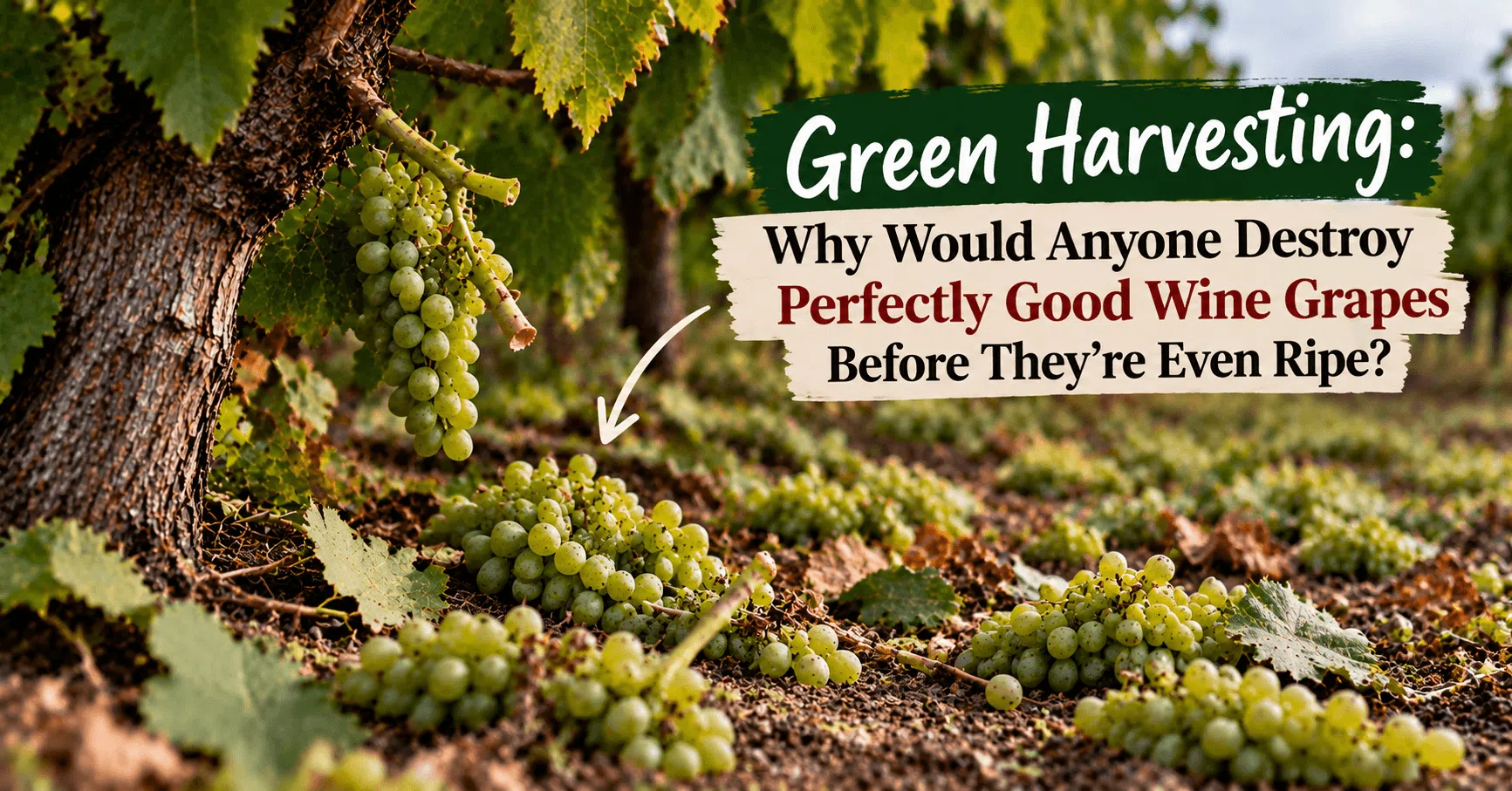
I watched a vineyard crew do something last August that looked a lot like vandalism. Entire rows of grape bunches, still small, still green, still weeks away from anything you’d want in a glass, got stripped off the vine by hand and left to rot between the rows. My first thought was hail damage. My second thought was that somebody had made an extremely expensive mistake. It turns out I was watching green harvesting, and it was neither.
What I was watching has an official name, a legal definition, and its own line item in the EU’s budget. In Italy, people call it vendemmia verde. Europe doesn’t just tolerate this. Europe pays for it.
Quick Facts
- Green harvesting means completely destroying grape bunches while they’re still unripe, cutting that plot’s yield to zero. It isn’t the same as simply leaving ripe grapes unpicked (Regulation (EU) No 1308/2013, Article 47)
- Under the EU’s newest crisis rules, Regulation (EU) 2026/2093, growers can claim the cost of destruction plus up to 50% of their average grape value from the previous three harvests, with a 20% bonus on top of that
- Italy activated green harvesting nationally for the 2025/26 season through a Ministry of Agriculture decree issued in March 2026
- Green harvesting is the mildest of three EU tools for a wine glut. The other two are crisis distillation and pulling vines out of the ground for good
What Counts as Green Harvesting (and What Doesn’t)
Brussels is oddly precise about this, which I appreciate. Under Article 47 of the EU’s wine regulation, green harvesting is defined as the total destruction or removal of grape bunches while they’re still immature. That reduces the yield of that plot to zero for the year. Half measures don’t qualify, either. A grower can’t thin out a third of the bunches and call it a day.
There’s a distinction buried in there that trips people up, myself included until I checked. Letting ripe, perfectly marketable grapes hang on the vine because nobody wants to buy them doesn’t count as green harvesting at all. The grapes have to go while they’re still green, before they’ve become the thing anyone would actually drink. Timing is the entire point.
So Why Would Anyone Want Fewer Grapes?
This is where it stops sounding ridiculous. Global wine consumption fell to around 208 million hectolitres in 2025, down 2.7% from the year before, according to the International Organisation of Vine and Wine. Production sat at 227 million hectolitres over the same period. On paper that still looks balanced, and the OIV’s own director general, John Barker, has described the global market in exactly those terms.
Balanced globally doesn’t mean balanced everywhere. I’ve written before about the strange split happening across Europe right now. Italy was sitting on 42.6 million hectolitres of unsold stock while France headed into its smallest harvest since 1957. Green harvesting exists for exactly that gap. When a region has produced far more of a style than anyone is buying, trimming next year’s harvest before it ripens just makes sense. It’s cheaper than storing wine nobody wants, or dumping it on the market at a loss.
Getting Paid to Destroy Your Own Crop
Here’s the part that still makes me laugh a little. Regulation (EU) 2026/2093 entered into force in September 2026. A grower who green harvests under it doesn’t just avoid the cost of farming grapes nobody will buy. They get compensated for the destruction itself.
The formula is where Brussels really shows its homework. Member states cover the direct cost of removing the bunches, then tack on up to 50% of the plot’s average grape value from the preceding three marketing campaigns, adjusted for the harvest costs the grower just avoided paying. On top of that, there’s an additional incentive of up to 20%, as if the policy itself needed a loyalty bonus to feel complete.
None of it pays out automatically, which seems fair given the sums involved. A grower first has to prove, with real numbers, that a genuine market crisis is underway, shown through rising stock levels, production outpacing sales in at least three of the last five campaigns, or margins that have been quietly collapsing. Only then does the European Commission sign off. It is, as far as I can tell, the only form of gardening on the planet that comes with a dossier.
The Other Two Buttons Europe Can Push
Green harvesting is the gentlest option on the shelf, which tells you something about how uncomfortable the alternatives are. Crisis distillation takes existing, already-bottled-or-ready wine and distills it down into raw industrial alcohol at a minimum of 92% ABV. Compensation there runs up to 50% of the average market price over the preceding six months, plus a 20% bonus. The wine itself is gone for good, though, turned into something closer to hand sanitizer than a vintage anyone will remember.
This isn’t even a new trick. I’ve written before about the time surplus European wine ended up fueling Prince Charles’s Aston Martin, back when the EU had 18.5 million hectolitres of low-grade wine with nowhere to go. Turning unwanted wine into fuel or industrial alcohol has been Europe’s pressure-release valve for decades. Crisis distillation just gives the idea a proper budget line and a form to fill out.
Grubbing up is the nuclear option. A grower rips the vines out of the ground entirely, and the compensation reflects that permanence: up to 100% of the annual income loss per hectare, plus direct costs. The Commission’s approval is required before a cent changes hands. The catch is brutal, too. Replant on that same land, and you’re banned from receiving support payments on it for ten years. Nobody reaches for that tool lightly, which is exactly why green harvesting exists.
Why Italy Pulled the Trigger This Year
Italy didn’t sit this one out. MASAF, the country’s Ministry of Agriculture, activated green harvesting nationally for the 2025/26 campaign through Decree DD n. 146346, signed on 26 March 2026. It operates inside Italy’s broader CAP Strategic Plan, which in practice means the money is real, but exactly how much of it a grower sees still depends on regional and provincial funding. Naturally, that varies depending on where in Italy you’re farming. This is still Italy, after all.
Italy was carrying 42.6 million hectolitres of stock as of July, so this wasn’t a hard call. Letting next year’s surplus ripen into an even bigger problem would have made the eventual reckoning worse, not better. Trimming the crop before it ever reaches harvest is, somewhat counterintuitively, the cautious move here. If I had that much unsold wine sitting in a cellar somewhere, I’d rather trim next year’s crop on purpose too, instead of watching the pile grow by accident.
Does Any of This Actually Affect the Wine You Drink?
Indirectly, and mostly for the better. A region that manages its own oversupply through tools like green harvesting isn’t flooding the market with desperate, bargain-bin bottles just to recoup costs. It’s also more likely to stay financially healthy enough to keep making good wine five years from now. Climate has made this harder to plan around, too. I’ve looked separately at how rising temperatures are reshaping ripening schedules across Europe. A shorter, hotter growing season only adds to the guesswork a grower has to do months before anyone picks a single grape.
None of it shows up on a label. You won’t see “green harvested” printed anywhere near the back of a bottle, and you’re not meant to notice it at all. That’s rather the point. A healthy wine region behind the scenes is what keeps your bottle good and reasonably priced. Getting there occasionally means a vineyard looking, for one strange afternoon in August, like it’s under attack from its own crew.
Frequently Asked Questions
What is green harvesting in wine, exactly? It’s the complete destruction or removal of grape bunches while they’re still immature. That reduces that plot’s yield to zero for the season. The EU defines it precisely this way, under Regulation (EU) No 1308/2013, Article 47.
Is green harvesting the same as just not picking your grapes? No, and the EU is explicit about this. Leaving ripe, marketable grapes unpicked at the end of a normal season doesn’t qualify as green harvesting. The grapes have to be destroyed while they’re still unripe.
How much money do growers get for green harvesting? Under Regulation (EU) 2026/2093, growers can claim the direct cost of destruction, plus up to 50% of their average grape value from the previous three harvests. There’s an additional incentive of up to 20% on top of that. Approval requires showing a genuine market crisis.
What is crisis distillation? It’s a separate EU tool that turns existing wine into raw industrial alcohol at a minimum of 92% ABV. Compensation runs up to 50% of the average market price from the preceding six months, plus a 20% bonus.
Why did Italy activate green harvesting for 2025/26? Italy was sitting on roughly 42.6 million hectolitres of unsold wine stock as of July. MASAF activated the measure nationally through a decree issued in March 2026, to help growers manage next year’s yield before it added to that pile.
Does green harvesting affect the price or quality of the wine I buy? Only indirectly. It helps keep producers in regions with real oversupply financially stable, which tends to protect quality and pricing over time, even though you’ll never see it mentioned on a label.
I still think about that vineyard crew, stripping green bunches off the vine while I stood there assuming the worst. I know better now. What looked like someone ruining a harvest was actually someone protecting the next one, with the European Commission’s paperwork to prove it. Supply and demand doesn’t care how pretty a grape bunch looks in July. Sometimes protecting a wine region means making sure fewer grapes ever get the chance to become a bottle nobody wanted in the first place, and that crew in the vineyard clearly understood that long before I did.
— Kelly 🍷
#ItalianWine #WineIndustry #EUWineRegulations #WineProduction
Continue Reading
- Europe Has Too Much Wine. So Why Is France Running Out?
- A Car That Is Powered by Wine
- The Uncorked Consequences: How Global Warming is Transforming Europe’s Wine Industry
Enjoy wine without the snobbery?
Make The Finest Italian Wine one of your Preferred Sources on Google.
Add The Finest Italian Wine to Preferred SourcesDiscover more from The Finest Italian Wine
Subscribe to get the latest posts sent to your email.