Europe Has Too Much Wine. So Why Is France Running Out?
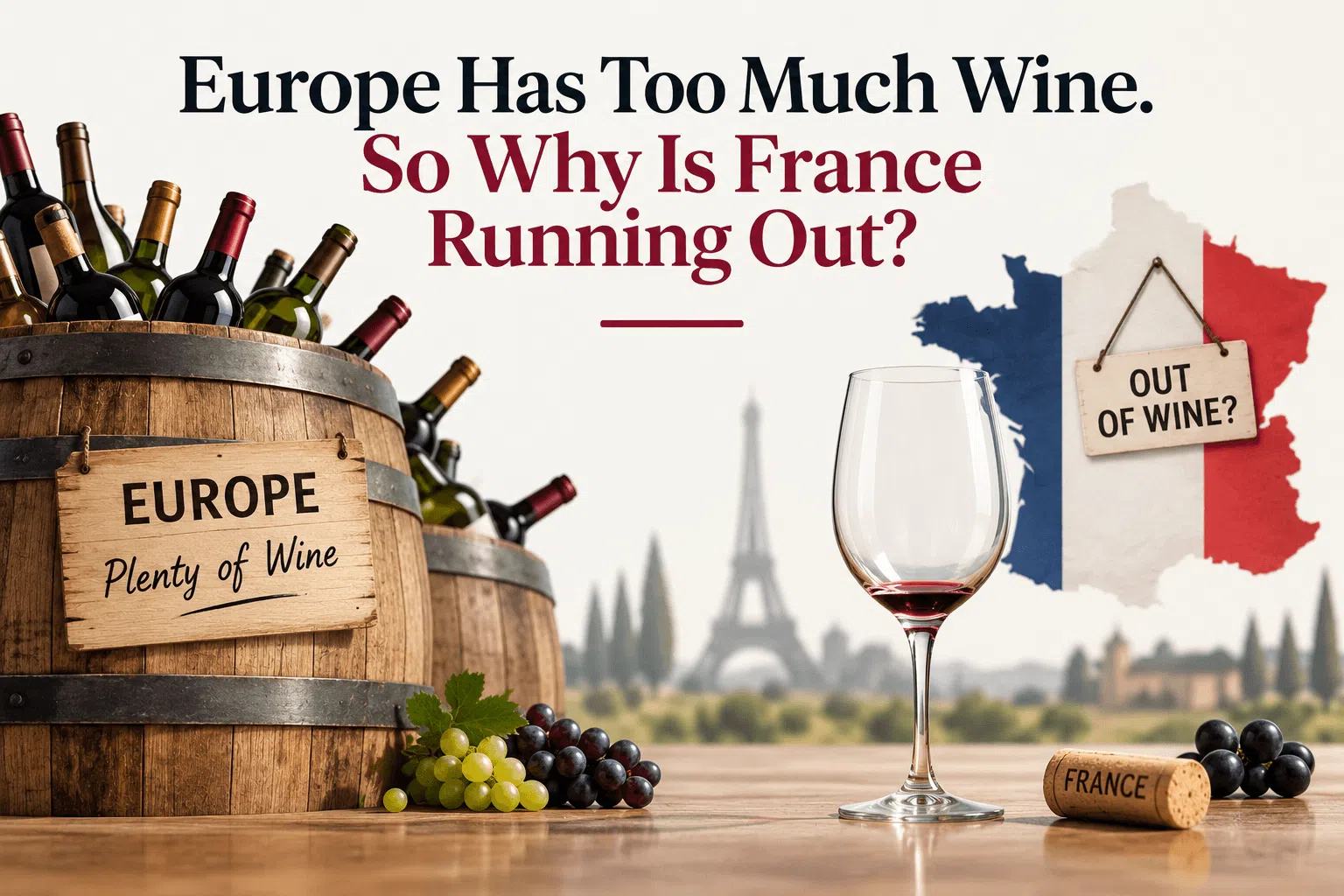
Europe has a genuinely strange wine problem this year.
Some cellars have too much wine. Some vineyards barely have enough grapes to fill a bottle. Italy is looking at storage tanks it doesn’t know what to do with. France is heading into its smallest harvest since 1957. And somewhere in the middle of all that, perfectly drinkable wine can end up distilled into industrial alcohol, not anyone’s glass.
I had questions too. When someone says “Europe has too much wine,” my first instinct isn’t crisis. My first instinct is that nobody’s invited me to the right cellar yet.
But the more I looked at what’s genuinely happening in Italy, France, and Champagne this year, the stranger it got. This isn’t simply a story about Europe making too much wine. Europe has a matching problem. It has wine, and it has drinkers. Increasingly, those two things don’t want the same wine, in the same quantities, at the same price, at the same time.
Vineyards, it turns out, are not great at reading market research.
Italy Still Has a Lot of Wine Sitting Downstairs
As of July 31, Italian cellars held about 42.6 million hectoliters of wine. That’s up 6.9% from the same point last year. Before anyone imagines the country drowning in unwanted Pinot Grigio, that figure needs context. Wine belongs in cellars for a while. Some ages there on purpose. Producers are still waiting to bottle some of it. Most of it is just moving through a completely normal commercial cycle.
So 42.6 million hectoliters in storage doesn’t automatically mean 42.6 million hectoliters nobody wants. The problem starts when stocks are climbing, sales are sluggish, and another harvest is already knocking on the door.
Puglia shows exactly what that looks like in practice. The region entered the 2026 harvest with roughly 4.29 million hectoliters still sitting in its cellars from previous years. Growers expect this year’s crop to run about 10% larger than 2025’s.
Producer groups there are now asking regional authorities for storage support and tighter production controls. They’re also asking for something with a genuinely alarming name: crisis distillation. We’ll get back to that.
The Real Reason Cellars Are Full
First, it’s worth understanding how a country famous for selling wine ends up with too much of it sitting around. The answer isn’t simply that wineries got carried away. The real problem is happening on the other side of the bottle. People are drinking less wine. Not everywhere, and not every kind, but consumption has been sliding across enough mature markets that the effect adds up fast. Moderation matters more than it used to. Low and no-alcohol wine keeps growing. Some drinkers would rather buy one great bottle than three ordinary ones. Younger drinkers don’t treat wine as the automatic thing that shows up with dinner the way their parents did.
The vineyard has received none of these emails. You cannot walk outside in April and tell a row of Corvina that red wine is having a rough quarter. It doesn’t get to take the summer off. The grapes grow regardless. The harvest arrives regardless. Growers still need paying. If last year’s wine hasn’t sold through fast enough, this year’s harvest stops being a celebration and starts being a storage problem.
What Happens to Wine Nobody’s Buying
This is the part I found genuinely fascinating. There are several real answers, and none of them is throwing an enormous party.
The simplest option is waiting. Wine can sit until the market improves, which works especially well if aging was already the plan. But tanks take up finite space, and storage isn’t free. Money tied up in unsold wine is money that isn’t doing anything else. Eventually next year’s harvest shows up needing the same tank.
Producers can also make less to begin with. Regions can lower permitted yields, hold part of a harvest back, or redirect grapes into different categories entirely. I’ve already gone into exactly how that plays out in Valpolicella, which is deliberately holding back a fifth of its 2026 harvest rather than push every possible bottle into a market that isn’t ready for it.
There’s also green harvesting, which sounds pleasant until you learn what it means: cutting grape bunches off the vine before they even ripen. Picture defending those grapes all season against frost, hail, heat, and disease. Then look at the survivors and decide the smartest move is removing them anyway. It sounds absurd until you weigh the alternative. Spending even more money turning grapes into wine the market already has plenty of isn’t much better.
The Nuclear Option: Crisis Distillation
Then there’s crisis distillation. This isn’t wineries pouring wine down a drain. It’s a formal market intervention that removes excess wine from the drinking market by distilling it into alcohol. Under EU crisis measures, that intervention redirects the alcohol toward industrial uses instead, pharmaceuticals, disinfectants, energy, rather than letting it quietly find its way back into a glass. A wine that started life imagining a nice plate of pasta can, in unlucky circumstances, end its career considerably closer to hand sanitizer. Career changes happen to the best of us.
Puglia’s producers are asking for measures including crisis distillation, and that distinction genuinely matters. Nobody’s fired up the world’s largest still on those 4.29 million hectoliters yet. The whole point of removing some wine from circulation is relieving pressure on everything that remains. Too much wine chasing too few buyers can push prices low enough to hurt growers who were already working on thin margins.
And if trimming one season’s production isn’t enough, there’s a final, much heavier option: pulling out the vineyard entirely. France has already been doing this in areas suffering from structural oversupply. Once a vine comes out, production doesn’t just dip for a vintage. It’s gone. That’s the point where this stops being purely a business story. Vineyards shape landscapes, villages, jobs, and entire family histories in a way you don’t casually undo like changing a restaurant menu.
Now Here’s Where It Gets Genuinely Confusing: France Doesn’t Have Enough
France’s 2026 harvest is forecast at around 33.9 million hectoliters, its smallest since 1957, nearly seventy years. That’s roughly 17% below its own recent five-year average. Heat and drought did real damage across the country, but Champagne took it worst of all. Current estimates put the region’s 2026 production down 49% year over year. Essentially half its usual output is gone in a single season.
So after everything above, the obvious question is: didn’t we just establish that Europe has too much wine? It does. And it doesn’t. There’s no giant continental pool marked WINE where every region deposits its surplus and withdraws whatever it needs later. Puglia’s unsold wine cannot become Champagne just because Champagne had a terrible year. A struggling red from southern Italy cannot transform itself into the specific sparkling wine people currently want. Different wines have different grapes, different rules, different prices, and completely different customers.
Which brings us to the real shape of the problem. Europe doesn’t simply have too much wine. It has too much of certain wines for the demand that currently exists, and not enough of others.
Champagne makes that contradiction almost funny. Champagne houses hold reserve wines from previous, more generous harvests specifically to smooth over a thin vintage like this one. That’s exactly why non-vintage Champagne supply should stay largely protected even with production down by half. In Puglia, wine sitting in the cellar is the problem. In Champagne, wine sitting in the cellar is the solution. Same basic product, completely different headache.
The Real Problem Isn’t in the Vineyard. It’s at the Table.
For decades, European wine production grew up around a specific drinking culture. Wine belonged on the table, and people drank it often. Certain markets absorbed enormous volumes year after year without much question. That drinker is changing.
One person drinks less overall while spending more per bottle. Another swaps a Tuesday glass for something alcohol-free. Someone else reaches for sparkling instead of a heavy red, or a cocktail instead of either. Someone who used to open wine four nights a week is down to two. None of that looks catastrophic in isolation. Multiply it across millions of people and there’s suddenly a lot of wine sitting downstairs with nowhere obvious to go.
That’s exactly why the numbers look contradictory at first glance. Fine wine and alcohol-free wine can both grow at the same time that ordinary bottles are struggling to move. One category can quietly expand while its most famous neighbor holds steady or dips. That’s the same pattern I found looking at why Asti grew 35% in export value while Prosecco itself slipped. One region can deliberately shrink its own output while another loses half its harvest to weather it never saw coming. This isn’t one wine crisis. It’s a wholesale reshuffling of what people want to drink, how often, and what they’re willing to pay for it. That’s a far harder problem to solve than a single bad summer.
So What Happens to the Wine Nobody Drinks?
Some of it waits. Some gets sold later, sometimes at a lower price than anyone hoped. Regions sometimes restrict production before the wine is even made, and some grapes never make it to harvest at all. In the more severe cases, authorities distill some wine out of the drinking market entirely. And if the imbalance holds long enough, some vineyards disappear for good.
I don’t think the fix is simply telling Europe to make less wine and call the problem solved. Wine still has to earn a reason to be chosen. Not by chasing every fleeting trend until a serious red shows up in a neon can promising hydration and inner peace, please, some standards, but by recognizing that today’s drinker genuinely has more competing options than any generation before them.
Maybe the future does hold less wine. Fewer bottles, fewer hectares under vine, fewer glasses poured automatically just because dinner happened to be on the table. That doesn’t have to mean a worse future for the industry. It could mean people drink less but care considerably more about what’s genuinely in the glass. Producers make less, but sell what they do make more thoughtfully. Regions stop chasing raw volume and start protecting identity and the specific occasions where their wine genuinely still makes sense.
Because after sitting with all these numbers, I don’t think Europe’s real problem is running out of people who like wine. It’s spent years making wine for drinking habits that are changing considerably faster than any vineyard can keep up with.
And you still can’t send a vine a memo.
Quick Answers
Why does Europe have too much wine right now? Consumption has declined across several major markets faster than vineyards can adjust production. The surplus is concentrated in specific regions and categories rather than spread evenly, which is why some parts of Europe are overflowing while others are running short.
What is crisis distillation? A market intervention that removes excess wine by distilling it into alcohol, which EU crisis measures then direct toward industrial uses like pharmaceuticals or energy rather than back into the drinks market. It’s currently being requested in places like Puglia, not applied to every surplus bottle.
Why don’t wineries just keep unsold wine until someone buys it? Some do, but storage isn’t free. It ties up tank space and working capital, and another harvest arrives every single year needing somewhere to go.
If Europe has too much wine, how can Champagne be running short? Because wine isn’t interchangeable between regions. Champagne has its own grapes, rules, and specific demand, and surplus wine elsewhere can’t simply become it. Champagne producers can lean on reserve wines from stronger past harvests during a thin year like this one, which is exactly why non-vintage supply should hold up even with 2026 production cut nearly in half.
Salute.
Continue Exploring
- Why Is Valpolicella Holding Back Its Own Wine?
- Italian Wine Exports Are Falling. Asti Just Grew 35% Anyway.
- Alcohol-Free Italian Wine Just Won Gold. Is It Good Now?
Sources
Italian wine stock figures are drawn from the ICQRF’s Cantina Italia report as of July 31, 2026, reported by WineNews. Puglia’s stock and harvest figures come from Coldiretti Puglia, reported by Vinetur. French 2026 harvest and Champagne production figures are drawn from the French Ministry of Agriculture’s Agreste forecast, published September 7, 2026, and reported by multiple outlets including Reuters.
Enjoy wine without the snobbery?
Make The Finest Italian Wine one of your Preferred Sources on Google.
Add The Finest Italian Wine to Preferred SourcesDiscover more from The Finest Italian Wine
Subscribe to get the latest posts sent to your email.