Why Is Valpolicella Holding Back Its Own Wine?
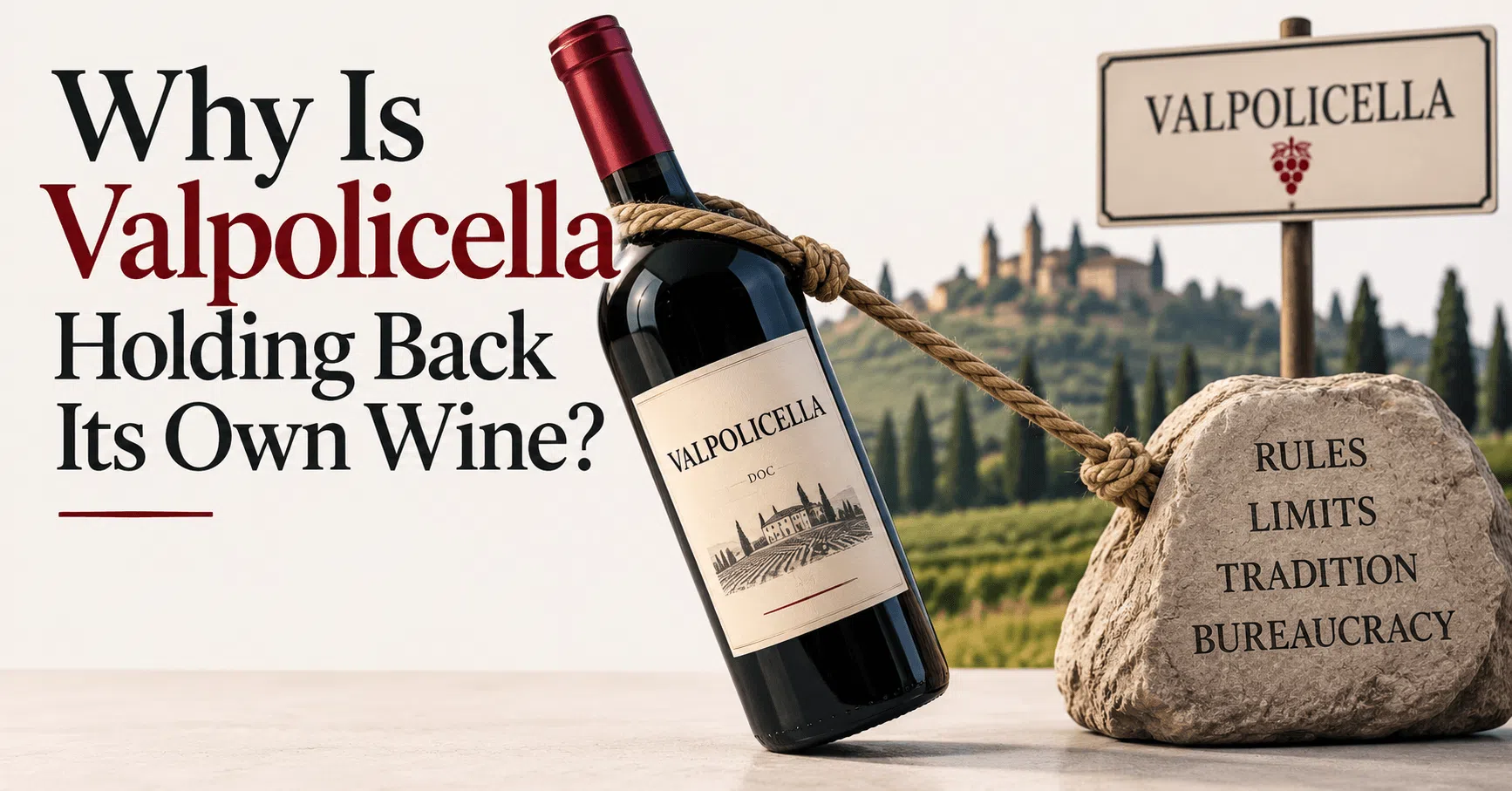
Imagine having a genuinely good harvest and being told: excellent, now don’t sell all of it.
That’s more or less what’s happening in Valpolicella this year.
The 2026 harvest started early, nearly two weeks ahead of the historical average. Corvina is already in. Corvinone and Rondinella are close behind. Despite a hot, dry summer, some of the oldest vineyards handled the stress better than expected. The ones on traditional pergola trellises in particular. The Consorzio Vini Valpolicella expects just over 861,000 quintals of grapes, roughly in line with last year.
Normally, that’s where the good news ends the story.
Except Valpolicella has a second number sitting right next to the first one: 172,280 quintals. That’s 20% of this year’s expected harvest, and it’s being placed into storage rather than sold.
The grapes aren’t the problem. Nobody’s suddenly decided Amarone tastes bad. Nothing is getting poured down a drain in Verona. The actual problem is smaller and stranger than that: Valpolicella can clearly make the wine. What’s genuinely uncertain is whether the world still wants quite this much of it.
The Vineyard Did Its Job. Now Comes the Hard Part.
For most of wine’s history, a winemaker’s entire anxiety lived in the sky. Too much rain, not enough rain, frost in April, hail in July. Rain five days before harvest, right when everyone finally relaxed.
This year, nature mostly cooperated. The problem showed up somewhere else entirely, at the other end of the bottle.
Back in April, the Consorzio agreed to a containment measure with the Veneto Region: only 80% of the grapes Valpolicella producers are legally allowed to grow can go to market this year. The rest gets held in storage. That’s not a quality-driven yield cut. It’s deliberately timing supply to match demand, with the Consorzio free to release some or all of that stored wine later if the market looks ready for it.
Amarone and Recioto alone account for nearly 38% of this year’s harvest, all of it destined for the appassimento drying process. That’s a lot of grapes riding on one open question: will there be enough demand waiting for them once they’re ready to sell?
Someone Still Has to Drink It
Wine has one deeply inconvenient flaw as a business. You can grow it beautifully, dry it patiently, age it in expensive oak. You can convince three critics it smells faintly of dried violets after rain. Eventually, somebody still has to buy the bottle. Preferably drink it, too.
That part has gotten harder almost everywhere. Consumption has been sliding in established markets for years now. I went deep into that shift specifically for Italy, and the surprising twist inside it. Here’s why Italians are drinking less wine overall. Younger drinkers aren’t replacing older ones bottle for bottle. Moderation stopped being a January thing and became a year-round habit for plenty of people. And everything simply costs more now, dinner, the bottle, life in general. So a couple who used to order wine with dinner orders two glasses instead.
None of that sounds dramatic on its own. That’s exactly the problem. Wine markets rarely collapse because people wake up and swear off a region entirely. They shrink because millions of people quietly drink a little less, for a while. Until somebody finally checks the cellar and realizes how much is still sitting there.
Amarone Was Built to Be Big. That’s Now a Complication.
Here’s where it gets genuinely interesting. Valpolicella’s international calling card is Amarone, and Amarone has never been shy about anything.
The grapes dry through appassimento, losing water and concentrating everything, sugar, flavor, intensity, into something rich and powerful. A great Amarone doesn’t arrive at the table quietly. It makes an entrance. It also commonly lands around 15% alcohol. That puts one of the region’s greatest strengths directly in the path of a much bigger conversation about lighter drinking.
I don’t think Amarone is in trouble, exactly. Wine has a long, stubborn habit of surviving its own obituaries. But the volume numbers deserve a look regardless. Bottled output across the Valpolicella denominations moved from roughly 61 million bottles in 2023 to 59 million in 2024 to about 57.5 million in 2025. That’s not collapse. It’s three years walking in the same direction. The Consorzio’s own 2026 Annual Report frames the 2025 dip as deliberate, closer to a 3% planned reduction than an accident.
There’s a real twist worth sitting with here, and it’s one most coverage of this story misses entirely. The same research showing Italians drinking less overall also found something else: the younger drinkers who remain are disproportionately reaching for exactly this kind of wine. Serious, structured reds like Amarone, over the lighter styles everyone assumed Gen Z preferred. Valpolicella’s oversupply problem and its most promising new audience may be sitting in the same data set.
Then There Are the Fifty-Cent Grapes
A storage quota sounds like something only a wine bureaucrat could get excited about. The price of a raw Valpolicella grape makes the story click instantly. Early quotations have been running around €0.50 per kilogram, with some offers reportedly as low as €0.40.
Fifty cents. If you’ve ever priced a serious bottle of Amarone, you’re probably rereading that sentence.
Before anyone starts fantasizing about buying grapes at fifty cents and retiring on Amarone margins, remember one thing. There’s a lot sitting between a vineyard and a €60 bottle. Grapes destined for Amarone get selected by hand and deliberately dried, losing a meaningful share of their weight on purpose. Read that sentence again. You spend a year growing grapes, then intentionally make them weigh less, and this is considered good business. After that comes years of fermentation, aging, and everything else a serious wine needs before it can be sold. Cheap grapes don’t mean cheap Amarone. They mean the pressure is building at the very start of a very long chain, and vineyards don’t run on romance.
Maybe Valpolicella Simply Got Too Good at This
There’s a genuine irony sitting underneath all of it. Valpolicella isn’t struggling because nobody’s heard of it. It succeeded, loudly. Amarone became one of Italy’s genuinely famous reds. Restaurants wanted it, collectors wanted it, export markets wanted it, and producers kept meeting that demand, year after year. All on the entirely reasonable assumption that if people wanted this much last year, they’d want a little more next year.
Until, at some point nobody can quite date precisely, they didn’t.
This isn’t unique to Valpolicella, either. Veneto’s 2026 harvest controls also touch Soave and the Pinot Grigio delle Venezie appellation behind a huge share of Prosecco-adjacent production. Similar yield cuts are underway this same year in Chianti, Brunello di Montalcino, and parts of Piedmont. Italy hasn’t forgotten how to make good wine. It may simply be making wine for a consumer who’s changing faster than a vineyard, which operates in years and decades, can realistically track. Nobody can ask Corvina to take a season off because Gen Z is moderating.
Maybe the Answer Is Just… Valpolicella
Here’s the part I find most useful in all of this. Ask most international drinkers what they know from this region and one word comes back: Amarone. But Valpolicella isn’t only Amarone.
Regular Valpolicella, and Valpolicella Classico especially, is bright, cherry-driven, food-friendly, and genuinely uncomplicated. It’s lighter, fresher, more affordable, and usually sits at a friendlier alcohol level. Read that list again. It’s almost exactly the checklist the wine industry keeps reciting when it describes what today’s drinker supposedly wants.
Amarone was such a successful ambassador for this region that it quietly overshadowed everything else the family makes. That’s not Amarone’s fault, it’s just what happens when one sibling gets famous. But the other siblings might be exactly what this specific moment needs. A younger drinker who isn’t ready to spend fifty euros on Amarone could happily land on Valpolicella Classico instead. Someone hunting for a fresher, lighter Italian red might find precisely what they wanted, sitting one shelf below the bottle they assumed was the whole story.
So Is Amarone Really in Trouble
I wouldn’t write its obituary. People drinking less overall doesn’t automatically mean they stop buying serious wine, and “less but better” could genuinely suit Amarone rather well. If you only open something special occasionally, that’s often exactly when you reach for something memorable.
What a famous name doesn’t guarantee anymore is endless volume growth. It buys attention, it buys a bit of pricing power, but the bottle still has to physically leave the cellar eventually. That’s what makes Valpolicella’s decision to manage supply more interesting than a routine yield cut. It’s an acknowledgment that making excellent wine faster than the market can absorb it isn’t a strategy just because the wine happens to be excellent.
The Strangest Harvest Problem Going
There’s something almost backwards about this year. The harvest came in early because of heat and drought, exactly the conditions that usually make a winemaker nervous. The quality outlook turned out encouraging anyway. So the real question this year was never “will the grapes be good enough.” It became “will we want enough of them.”
Valpolicella can control yields. It can store wine and release it later if conditions improve. It can lean harder into Valpolicella Classico while Amarone gets a breather. What it can’t control is how often someone in London, Berlin, or Milan decides to open a bottle on an ordinary Tuesday. For generations, wine regions learned to live with unpredictable weather. Now they’re learning to live with us, and we may turn out to be even less predictable than rain.
Quick Answers
Why is Valpolicella holding back wine in 2026? The Consorzio and the Veneto Region are using yield limits and storage measures to keep supply closer to current demand, after several years of falling bottled volumes across the denomination.
Does this mean the 2026 harvest is poor quality? No, the opposite. Early reports describe favorable grape quality despite a hot, dry summer and a harvest roughly two weeks earlier than average.
Is the stored wine being destroyed? No. It’s held back rather than sold immediately, and the Consorzio can review conditions and authorize partial or full release later if the market can absorb it.
Is Amarone the same wine as Valpolicella? No. Amarone della Valpolicella is one specific wine from the region, made from partially dried grapes. The same area also produces lighter styles simply labeled Valpolicella and Valpolicella Classico, along with Valpolicella Ripasso and Recioto della Valpolicella.
Salute.
Continue Exploring
- Italy Has Fewer Wine Drinkers. They Got More Interesting.
- Decoding the Italian Wine Label: What DOCG, DOC, and IGT Actually Mean
Sources
Harvest volume and storage figures are drawn from Consorzio Vini Valpolicella reporting via Il Nordest Quotidiano and De-Gustare, both published August 2026. Bottled volume trends and the 2025 figure of 57.5 million bottles come from the Consorzio’s own 2026 Annual Report, as reported by Wine Travel Awards. Broader context on 2026 yield reductions across Veneto, Tuscany, and Piedmont is drawn from WineNews.
Enjoy wine without the snobbery?
Make The Finest Italian Wine one of your Preferred Sources on Google.
Add The Finest Italian Wine to Preferred SourcesDiscover more from The Finest Italian Wine
Subscribe to get the latest posts sent to your email.