The Complete Guide to Amarone — The Wine That Was Never Supposed to Exist
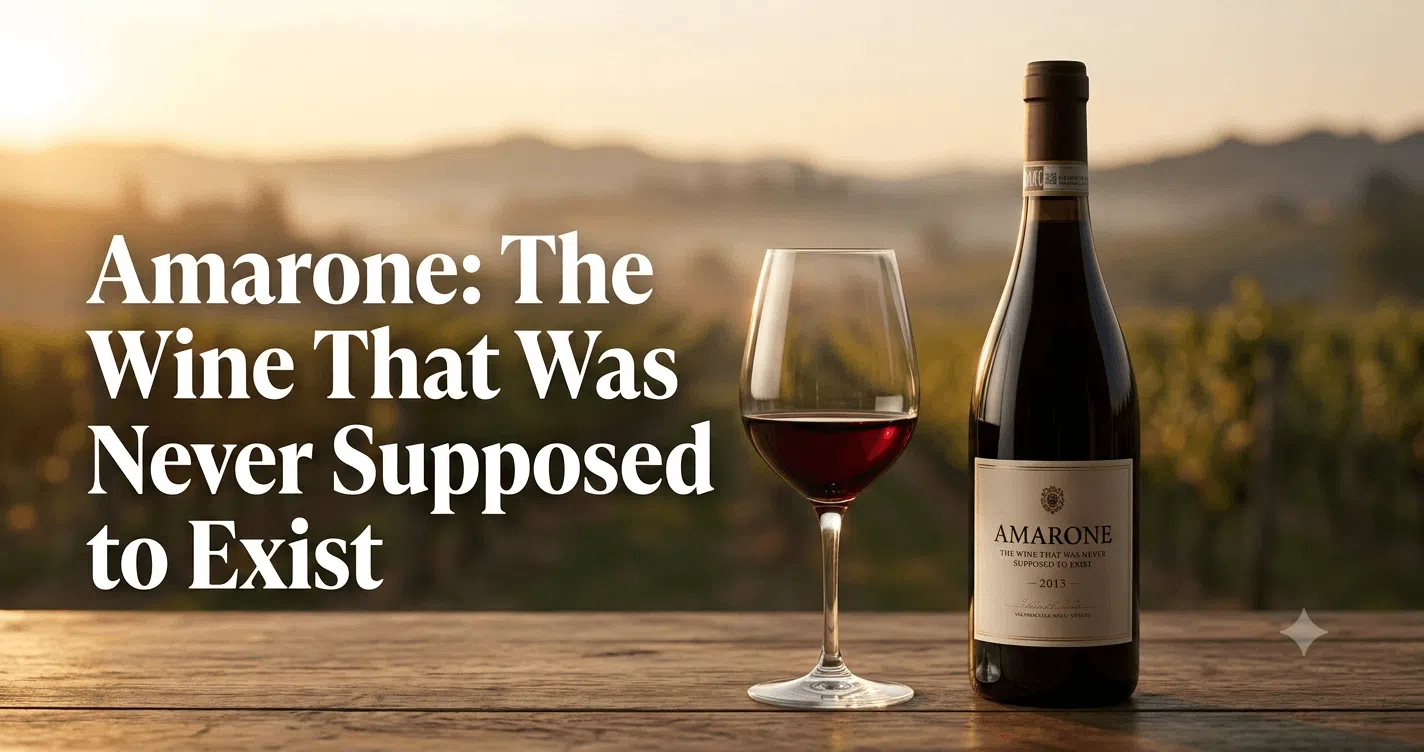
Quick Guide — Amarone della Valpolicella
- Where: Valpolicella hills, northwest of Verona, Veneto
- Grapes: Primarily Corvina, plus Corvinone and Rondinella
- Production method: Appassimento, grapes dried for roughly 100–120 days before fermentation
- Classification: DOCG since 2010, minimum 14% ABV, minimum 2 years aging (4 for Riserva)
- Key sub-zone: Classico, the historic heart of Valpolicella near Lake Garda.
I need to tell you something I only properly understood recently, even though I’ve lived twenty minutes from the source for years now.
Amarone was never supposed to exist. It’s a mistake. A genuinely accidental wine. Sometime in the 1930s, a producer left a barrel of Recioto, a sweet, dried-grape wine that’s been made in this valley for centuries, sitting for too long. The fermentation should have stopped while there was still plenty of sugar left. Instead it just kept going. And going. Every last bit of that sugar converted, and what remained in the barrel wasn’t the sweet wine anyone expected at all.
It was dry. Powerful. Strange. Nothing like Recioto, and honestly, nothing quite like anything else in Italy at the time.
Locals gave the new wine a name that still makes me smile every time I say it out loud. Amarone, “the Great Bitter.” People tell the story now as the Miracle of Amarone. That’s a slightly grand way of describing what was probably just a very annoyed winemaker, staring at a ruined batch of sweet wine, wondering what on earth to do with it.
What he did, eventually, was drink it. And realise it was extraordinary.
What Is Amarone della Valpolicella?
Amarone della Valpolicella is a powerful, fully dry red wine from the Valpolicella hills northwest of Verona. Producers partially dry the grapes before fermentation rather than pressing them straight after harvest.
That drying process is the whole story of this wine, and we’ll get into exactly how it works in a moment. The short version: drying the grapes concentrates everything inside them, sugar, flavour, colour, before fermentation even begins. The result typically lands at 15 to 16% alcohol. Full-bodied, intensely flavoured, and built to age for years rather than opened the week you bought it.
It genuinely doesn’t taste like most other Italian reds. Once you’ve had a properly made one, you’ll understand immediately why Amarone commands the reputation it does.
How Is Amarone Actually Made? What Is Appassimento?
This is the technique that makes Amarone Amarone, and it’s worth understanding properly rather than glossing over.
After harvest, selected grape bunches go straight to drying instead of the press. Traditionally this happened on straw mats in the warmest room of the house, which is where the whole “straw wine” family gets its name. These days, most producers use plastic crates or wooden racks in carefully ventilated lofts, though the principle hasn’t changed in decades.
The grapes dry for roughly 100 to 120 days. They slowly lose water while everything else inside them, sugar, flavour compounds, colour, becomes more concentrated. The DOCG rules are strict about how this has to happen. Drying must take place within the designated production zone, in genuinely suitable conditions. Producers can’t speed things up using heated dehumidification either. There’s also a hard rule that fermentation can’t begin before December 1st, unless the Veneto region grants special permission during an unusual year.
Once drying finishes, producers finally press and ferment the concentrated grapes, slowly and completely, all the way to dry. That’s the step that makes Amarone what it is, rather than a repeat of the sweet Recioto that accidentally produced it all those decades ago.
What Grapes Go Into Amarone?
Primarily Corvina, a native Venetian grape that has to make up somewhere between 45 and 95% of the blend. Corvinone, a related variety, can stand in for up to half of that Corvina requirement. Rondinella fills out most of the rest, generally between 5 and 30%, with a small allowance for other local black grapes grown around Verona.
I love that the rules allow for such a wide range on Corvina specifically. Forty-five to ninety-five percent is less a recipe and more a shrug from the DOCG committee that says “look, just make sure it’s mostly this one.” Corvina does the heavy lifting either way. It brings bright acidity and a distinctive cherry character that survives the drying process and shows up clearly in the finished wine. Internationally, it’s a genuinely underrated grape, mostly because it rarely gets the attention Sangiovese or Nebbiolo commands, despite arguably being just as capable of producing something extraordinary when winemakers treat it properly. Corvina is the reliable middle child of Italian grapes. Everyone’s too busy talking about its more famous siblings to notice it’s actually been carrying the family business this whole time.
Understanding Amarone’s Classification and Aging Rules
Amarone spent longer than you’d expect working its way up Italy’s classification ladder, and honestly, the timeline still surprises me a little every time I think about it.
It first received DOC status back in 1968. It stayed there for over four decades before finally reaching DOCG, Italy’s highest classification, only in 2009, with the new rules applying from the 2010 vintage onward. Forty-one years between DOC and DOCG. For a wine that had already been quietly astonishing people since the 1950s, that’s Italy taking its time in a way that only Italy really can.
Standard Amarone della Valpolicella must reach a minimum of 14% alcohol by volume. It also needs at least two years of aging, counted from the January following harvest. Riserva steps that up considerably, requiring a minimum of four years aging from November of the harvest vintage. This wine already carries so much structure and concentration from the appassimento process. That extra aging tends to produce something genuinely built for the cellar rather than the table tonight. If Annata Amarone is a serious wine, Riserva is that same wine after several more years of deciding it has absolutely nothing left to prove.
Within the wider Valpolicella zone, two sub-areas carry particular prestige. Classico sits at the western end near Lake Garda. Most people consider it the historic heart of the whole region, though that reputation doesn’t mean every excellent Amarone comes from inside its boundaries. Valpantena is the other recognised sub-zone worth knowing. Some of the most celebrated producers working today, Romano dal Forno among them, actually work outside the Classico area entirely. They still produce some of the most highly regarded Amarone in Italy. The zone matters, but it’s not the only thing that matters, and I find that oddly reassuring. Even wine geography sometimes admits the rulebook isn’t the whole story.
Does Amarone Have a History Older Than the 1930s Miracle?
This is where the story gets genuinely a little mysterious, and I like it more for that reason rather than less.
Amarone’s own official production specification claims roots reaching back much further than the 20th century accident that created the wine as we know it today. Cassiodorus, an official serving the Ostrogothic Kingdom that once ruled this part of Italy, wrote a letter requesting bottles of a wine called Acinatico, considered Amarone’s likely ancestor, for the royal cellar. Later still, the Edict of Rotari set out serious penalties for anyone who damaged vines or grape bunches destined for this same wine. It treated the wine as valuable enough to function almost like currency for settling feudal obligations.
I genuinely can’t tell you with certainty whether Acinatico is a direct ancestor of the wine sitting in your glass today, or simply a loosely connected predecessor from centuries earlier. I’ll be honest about that rather than presenting it as settled fact. But there’s something rather wonderful about a wine with a documented modern accident behind it in the 1930s, and a much older, hazier legend stretching back well over a thousand years before that. Not many wines get to claim both.
Is Amarone Changing Style Right Now?
If you tried Amarone a decade ago and haven’t revisited it since, you might be surprised by what’s happening in the region today.
For years, the wine leaned toward a big, dark-fruited, almost blockbuster style. High alcohol, heavy concentration, built to impress rather than necessarily to refresh. That style still exists and plenty of people love it. But a meaningful group of producers, including names like Speri, Terre d’Orti, and Musella, part of a collective called Famiglie Storiche, have been deliberately steering toward something more graceful. More freshness. More restraint. Alcohol that doesn’t dominate quite so completely. This isn’t a rejection of the traditional appassimento method. It’s just a different, more measured interpretation of what that method can produce.
I find this genuinely encouraging as someone who drinks this wine regularly rather than occasionally. Amarone isn’t stuck being one single, unchanging idea of itself. This region has room for both the powerful, traditional style and something a little lighter on its feet. Honestly, that range is part of what makes Valpolicella worth paying proper attention to right now.
Who Are the Producers Worth Knowing?
If you’re building any kind of mental map of serious Amarone producers, a handful of names come up again and again for good reason. Honestly, half the fun of this region is watching the same names keep turning up no matter who you ask.
Giuseppe Quintarelli took over his family’s Negrar estate in the 1950s. Alongside Masi and Bertani, people widely credit him with building Amarone’s international reputation through the second half of the last century. Quintarelli in particular is the name serious Amarone people say slightly more reverently than the rest — the wine world’s version of dropping your voice half an octave. Allegrini and Masi remain two of the most respected names working the Valpolicella hills today. We’ve mentioned both before, if you’ve read our piece on staying at Villa Quaranta in the heart of this same valley. Romano dal Forno continues to produce some of the most highly scored Amarone in the region, working from outside the Classico zone. He proves, rather usefully, that geography alone doesn’t guarantee greatness, no matter how many times a marketing brochure tries to tell you otherwise.
If you want a genuinely comprehensive introduction, look for a bottle from any of these names before branching out further into the smaller, family-run estates scattered across the hills. Consider it your training wheels before you start making your own opinionated recommendations at dinner parties, the way I clearly now do.
How Should You Drink Amarone?
Slowly, and with food that can actually stand up to it.
Decant it if you can, particularly a younger bottle. The wine benefits enormously from air before it fully opens up. Serve it a little cooler than room temperature, somewhere around 16 to 18 degrees, so the alcohol doesn’t dominate the aromatics.
Food-wise, this is a wine built for rich, slow-cooked dishes. Braised beef, aged hard cheeses, game, the kind of Sunday lunch that takes hours rather than minutes. It’s also, somewhat famously, wonderful alongside risotto all’Amarone, a regional dish that uses the wine itself in the cooking. If you ever find it on a menu here in the Veneto, order it without hesitation.
Frequently Asked Questions — Amarone della Valpolicella
What does Amarone mean? Amarone means “the Great Bitter” in Italian. The name distinguishes this fully dry wine from Recioto, the sweeter wine made using the same grapes and drying method.
How is Amarone different from regular Valpolicella wine? Producers make Amarone using the appassimento method, drying grapes for around 100 to 120 days before fermentation to concentrate sugar and flavour. Standard Valpolicella uses freshly harvested, undried grapes, resulting in a lighter, easier-drinking wine.
How long does Amarone need to age? Standard Amarone della Valpolicella needs a minimum of two years aging before release. Riserva requires at least four years, and many serious examples keep improving well beyond that.
Why did Amarone only become DOCG in 2010? Amarone received DOC status in 1968, but Italy didn’t promote it to the top DOCG classification until a decree signed in December 2009, taking effect from the 2010 vintage. The delay reflects how gradually Italy’s classification system tends to evolve, even for wines with a strong existing reputation.
What food pairs best with Amarone? Rich, slow-cooked dishes suit Amarone best — braised meats, aged cheeses, game, and risotto all’Amarone, a Veneto dish that uses the wine itself.
One Last Thing
I think about the accident more than I probably should. Somewhere in the 1930s, in a cellar not far from where I live now, a barrel of sweet wine simply refused to stop fermenting. Instead of pouring it away as a mistake, someone tasted it and recognised something worth keeping.
That’s most of what I love about wine from this region generally. Very little of it announces itself loudly. It just sits quietly in a cellar, or a hillside, or a barrel that went slightly wrong, waiting for someone paying enough attention to notice.
Amarone got noticed. Ninety years later, it’s one of the most respected wines Italy makes, and it started life as a problem nobody was trying to solve.
Go deeper into Veneto wine: The Complete Guide to Prosecco, and if you want to actually stay in Amarone country, Wine Vacation in Amarone Country — Villa Quaranta Tommasi. For the rest of Italy’s great reds, our guides to Barolo and Chianti round things out nicely.
— Kelly 🍷
#Amarone #Valpolicella #VenetoWine #ItalianWine #WineGuide #AmaroneDOCG #Corvina
Enjoy wine without the snobbery?
Make The Finest Italian Wine one of your Preferred Sources on Google.
Add The Finest Italian Wine to Preferred SourcesDiscover more from The Finest Italian Wine
Subscribe to get the latest posts sent to your email.