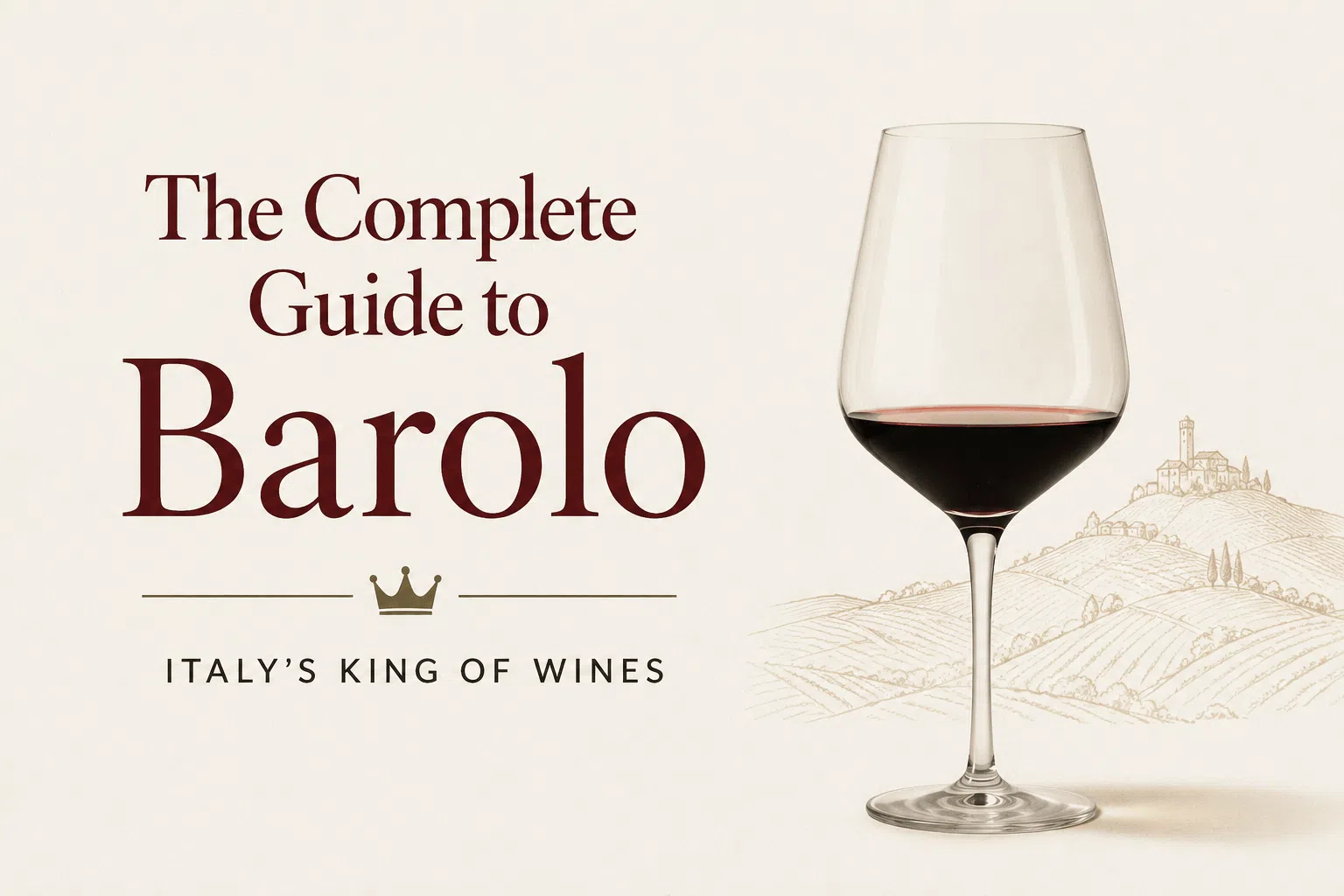
The Complete Guide to Barolo — Italy’s Wine That Doesn’t Do Casual
There are wines you drink.
And then there is Barolo — the kind of wine that doesn’t accept being ignored.
You don’t open it on a random Tuesday. You don’t multitask with it. If you treat it like background wine, it responds accordingly: it shuts down and makes you work for it.
Barolo is not loud. It’s deliberate.
People call it the king of wines, the wine of kings, and unusually for wine marketing, this one is actually backed by history, not imagination.
Some wines want attention.
Barolo expects respect.
Where Barolo actually comes from
Barolo is made in Piedmont, in northwest Italy — a landscape of rolling hills, fog, and vineyards that look like they’ve been carefully placed for maximum drama.
The official zone includes 11 communes, but five do most of the heavy lifting:
Barolo, La Morra, Castiglione Falletto, Serralunga d’Alba, Monforte d’Alba.
Same grape. Same region. Completely different personalities.
This is where Barolo stops being “a wine” and starts becoming a geography lesson with attitude.
Nebbiolo: the grape that ignores deadlines
Barolo is made from 100% Nebbiolo.
Nebbiolo behaves like it has its own calendar.
It buds early, ripens late, and spends the entire season refusing to rush anything. By the time harvest arrives, Piedmont is covered in fog — nebbia — which is where the grape gets its name.
At first taste, Nebbiolo gives you:
- roses
- cherries
- tar
Yes, tar. It’s not a metaphor. It’s just Nebbiolo being Nebbiolo.
Young Barolo is structured, tense, and slightly uncompromising. It doesn’t open quickly. It doesn’t pretend to.
It just needs time.
The history: when Barolo stopped being sweet
Barolo wasn’t always serious.
In the 1800s it was sweet, unstable, and mostly local.
Then Camillo Benso, Count of Cavour, decided Piedmont deserved better. He brought in French winemaker Louis Oudart, who did something radical for the time:
He finished fermentation properly. No leftover sugar. No shortcuts.
The result was dry, structured Barolo — the version that changed everything.
The House of Savoy approved it. Royal tables adopted it. And Barolo quietly became something bigger than wine.
It became status.
Why Barolo tastes so different from village to village
This is where most guides oversimplify it.
Barolo is not one style.
It splits into two personalities based on soil and geography.
The structured side (east)
Serralunga d’Alba, Monforte d’Alba, Castiglione Falletto
- deeper structure
- more tannin
- built for long aging
- not in a hurry to impress you
These are the “wait 10–15 years minimum” wines.
The elegant side (west)
La Morra, Barolo
- more perfume
- softer edges
- earlier approachability
- still serious, just less intimidating
Same grape. Different emotional response.
The rules Barolo refuses to break
Barolo DOCG is tightly regulated:
- Minimum 38 months aging
- At least 18 months in oak
- Riserva: minimum 5 years
This is not a wine that shortcuts its way into the bottle.
Also worth knowing: young Barolo often looks deceptively light in colour. Then it hits the palate and reminds you it’s not here to be gentle.
The Barolo identity crisis (and why it actually helped)
In the 1980s, producers split into two camps.
Traditionalists wanted long aging, big oak, patience.
The “Barolo Boys” wanted smoother, earlier-drinking wine.
It turned into a full regional argument.
But over time, both sides influenced each other. The result is modern Barolo:
structured, but not punishing
serious, but not unreachable
classic, but not frozen in time
The wine became more honest because of the disagreement.
Barolo Chinato: the thing nobody expects
After all that seriousness, Piedmont does something slightly rebellious.
Barolo Chinato is Barolo infused with herbs, spices, and cinchona bark (yes, the bitter tonic ingredient).
The result:
slightly sweet, slightly bitter, completely unforgettable.
It’s a digestif that feels like it belongs at the end of a long meal where nobody wants the evening to end.
How to actually drink Barolo
If you skip this part, you’ll misunderstand the wine.
Decant it. Especially young bottles. It needs oxygen to stop arguing with itself.
Serve it right. Around 16–18°C. Not cold. Not warm. Just controlled.
Give it food that matches it.
- braised beef
- lamb
- aged Parmigiano
- truffle if life is going well
Barolo alone is intellectual.
Barolo with food is emotional.
The honest truth about Barolo
Not every bottle is meant to be opened quickly.
Some wines are built around timing, not impulse.
Barolo rewards patience in a way most modern things don’t anymore.
You buy it. You wait. You forget about it.
Then one day you open it and realize it didn’t change.
You did.
If you want to go deeper
- The Complete Guide to Prosecco — Italy’s Most Joyful Wine
- 3 Italian Wine Facts That Change How You Order Wine
- Top 5 Most Expensive Wines in the World
Enjoy wine without the snobbery?
Make The Finest Italian Wine one of your Preferred Sources on Google.
Add The Finest Italian Wine to Preferred SourcesDiscover more from The Finest Italian Wine
Subscribe to get the latest posts sent to your email.