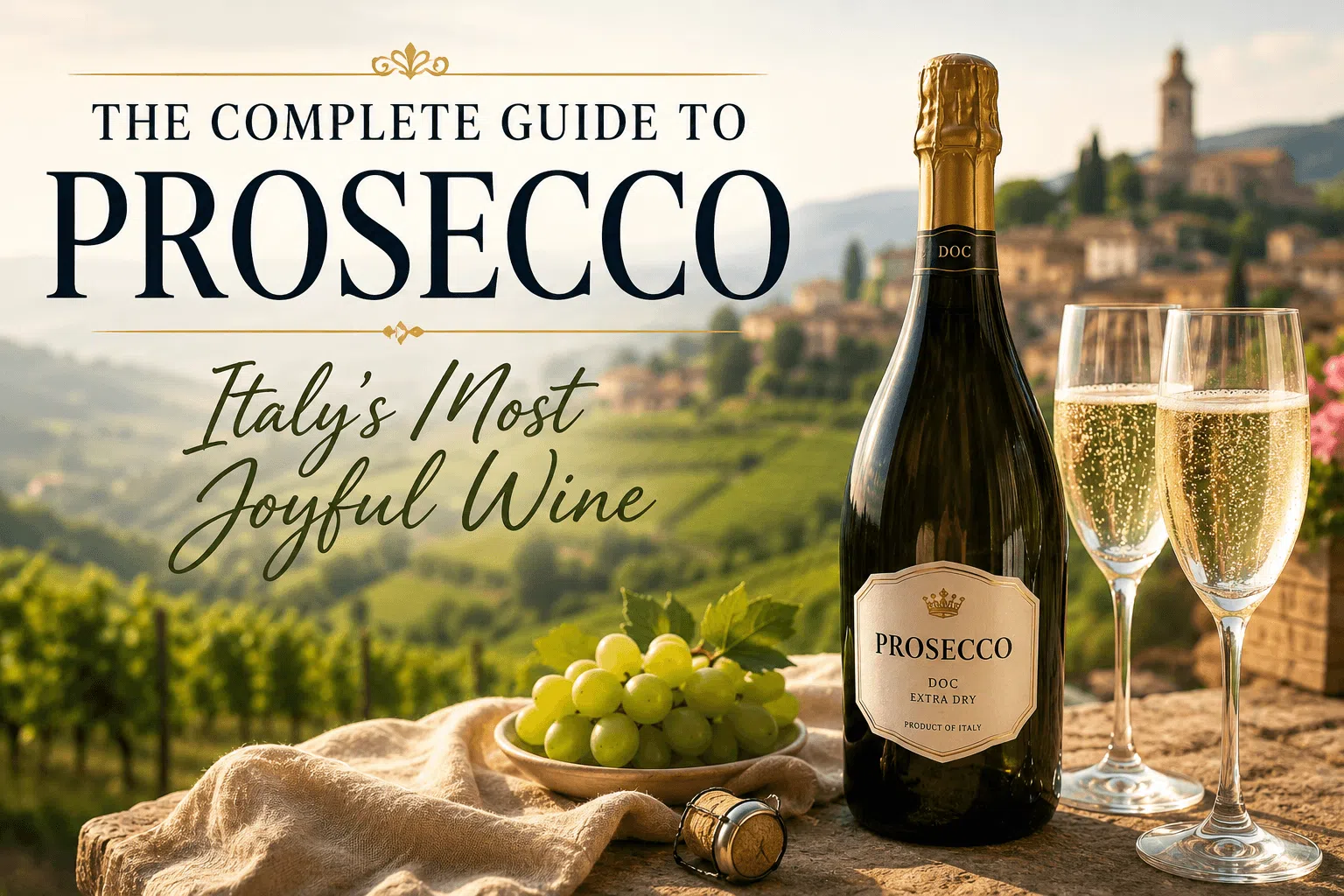
The Complete Guide to Prosecco — Italy’s Most Joyful Wine
Let me tell you something about Prosecco that nobody in a fancy wine shop will ever admit.
It doesn’t need a special occasion. It doesn’t need a reason. It doesn’t need a speech, a milestone, or a carefully chosen glass.
Prosecco is the wine that shows up when you need it, asks nothing complicated of you, and somehow makes whatever you’re doing feel slightly more like living.
I live in Veneto — the region where Prosecco is born — and I can tell you with complete confidence that locals here don’t save it for New Year’s Eve. They open it on a Tuesday. They drink it before dinner with a small plate of something salty. They treat it exactly the way it was meant to be treated: casually, happily, without overthinking it.
This guide is going to tell you everything worth knowing about Prosecco — where it comes from, what makes the good ones good, what the label is actually trying to tell you, and why one tiny hill in Veneto is considered the most prestigious 107 hectares in the entire sparkling wine world.
Glass in hand? Let’s go.
Where Does Prosecco Actually Come From?
Prosecco comes from northeastern Italy — specifically from Veneto and Friuli-Venezia Giulia — and its roots go back further than you might expect.
Wine production in the Prosecco region traces back to Roman times, when the Glera grape was already being cultivated near the village of Prosecco itself.
The Romans called it Pucino, considered it medicinal, and apparently credited it with keeping the Empress Livia alive and healthy into her eighties. Whether that’s the wine or just good Roman genetics is unclear. Either way, it’s a decent endorsement.
The village of Prosecco itself sits near Trieste, close to the Slovenian border — which is geographically interesting because the actual wine region, where almost all Prosecco is produced today, is the rolling hills around Conegliano and Valdobbiadene in Veneto, about 150 kilometres away. The name stuck to the wine even as production moved. These things happen.
Carpenè Malvolti, founded in Conegliano in 1868 by Antonio Carpenè, is credited as the first winery in Italy to produce Prosecco as a sparkling wine — and it was Etile Carpenè of that house who first printed the Prosecco name on a commercial label, doing so in 1924.
So the wine has been bubbling away in these hills, quietly, for centuries. Then the world discovered aperitivo culture and suddenly nobody could make it fast enough.
The Grape Behind the Bubbles
The grape that makes Prosecco is called Glera — and yes, it used to be called Prosecco too, which was a situation that got confusing very quickly.
In 2009, when Conegliano-Valdobbiadene Prosecco was promoted to full DOCG status, it was decided that the name Prosecco should be reserved exclusively for wines covered by Italy’s official Prosecco appellation titles — making it illegal for wine producers anywhere outside northeastern Italy to label their wines as Prosecco.
Smart move. The same way France protects Champagne, Italy now protects Prosecco. If the Glera grape is grown outside the protected zone, the wine has to be labelled as IGT Glera — good luck selling that at a Saturday brunch.
Glera itself is a fascinating grape precisely because it’s not that distinctive on its own. Glera’s high acidity, light body, and lower alcohol levels make it ideal for sparkling wine. It doesn’t fight the bubbles. It lets the freshness do the talking — green apple, pear, white peach, a hint of wisteria — clean and bright and easy. The kind of flavour profile that works at eleven in the morning and also at midnight, which is a genuinely useful quality in a wine.
Understanding the Label (Without a Degree)
Here’s the part that makes most people’s eyes glaze over, so I’m going to make it as painless as possible.
Prosecco comes in three quality tiers and you can tell which one you’re holding by what it says on the label.
Prosecco DOC is the broadest category, covering nine provinces across Veneto and Friuli-Venezia Giulia. Most Prosecco sold internationally is DOC. Production is largely on flatter land with mechanical harvest and significant volume. It’s the everyday Prosecco. The Tuesday Prosecco. Reliable, affordable, does exactly what you need it to do.
Prosecco DOCG Conegliano Valdobbiadene is the step up. The vineyards are on steep hillsides between the towns of Conegliano in the east and Valdobbiadene in the west. Grapes are largely hand-picked because of the slope. This is the UNESCO-protected zone, and the wine has tighter rules on yield, alcohol level and aging. More work, more character, more of everything. You’ll pay a bit more. Worth it for a special bottle.
Superiore di Cartizze is the crown jewel. A 107-hectare hill within Valdobbiadene that produces Prosecco’s most prestigious wines. Cartizze sits at the highest elevations of the DOCG zone, with steep south-facing terraces that ripen Glera more fully than anywhere else in the region. Only around 1.2 million bottles come from Cartizze each year. What makes it worth the premium? It tastes rounder, richer, more textured than a standard Prosecco — still fresh, still unmistakably itself, but with a depth that makes you slow down and actually pay attention. Less Tuesday aperitivo, more Sunday afternoon with nowhere to be. When you see it, buy it. Don’t think about it.
Simple version: DOC for everyday drinking. DOCG for when you want something special. Cartizze for when you really want to impress someone or just treat yourself on a Thursday because why not.
How Prosecco Gets Its Bubbles
This is the bit that explains everything — including why Prosecco tastes the way it does and why it’s priced the way it is.
Prosecco uses what’s called the Charmat method (sometimes called the tank method or Martinotti method). The second fermentation — the one that creates the bubbles — happens in large sealed steel tanks, not in individual bottles. The wine ferments under pressure for a minimum of 30 days, the bubbles are captured, and then it’s bottled.
Whereas the traditional, bottle-fermented production method for sparkling wines produces a brioche-yeasty character, the Martinotti method captures Glera’s fresh, fruit-forward nuances.
In other words, it’s not a shortcut. It’s the right method for this particular grape and this particular goal. Prosecco isn’t trying to taste like Champagne. It’s trying to taste like Prosecco — fresh, fruity, immediate — and the tank method is how it gets there.
This also means Prosecco is made to be drunk young. Don’t cellar it for ten years waiting for it to develop. Open it. Drink it. That’s the whole point.
This is also one of the reasons Prosecco and Champagne can taste so different despite both being sparkling wines. Champagne uses a different production method entirely — and the difference between sparkling wine and Champagne goes much further than where the bottle comes from.
Brut, Extra Dry, Dry — What Does It All Mean?
Another label moment that trips people up — and it’s especially confusing because the names seem to work backwards.
Brut — dry. Less sugar, crisper, more savoury. Extra Dry — slightly sweeter than Brut. Despite the name. Dry — sweeter still. Again, despite the name.
Yes, Extra Dry is sweeter than Brut. Yes, this is confusing. In fact, Extra Dry being sweeter than Brut is one of the most misleading things on a Prosecco label. The wine industry has been aware of this for decades and has chosen to do nothing about it. Welcome to Italian wine labelling.
Most people who say they want a “dry Prosecco” actually want Extra Dry — it has just enough sweetness to balance the acidity without tipping into dessert territory. Try both and see which one your glass prefers. That’s the most reliable method anyway.
The UNESCO Hills — Why Veneto Is Special
In 2019, the hills of Conegliano and Valdobbiadene were inscribed as a UNESCO World Heritage Site — and if you’ve ever driven through them, you understand immediately why.
The landscape is extraordinary. Steep terraced vineyards, tiny villages, views that go on forever in every direction. The combination of altitude, soil composition, and the microclimate created by warm air rising from the valley floor and cool air descending from the Alps produces a grape that simply doesn’t taste the same when grown anywhere else.
The average vineyard altitude is 250-300 metres above sea level, with hills rolling into one another and most slopes oriented to receive maximum sun exposure. Many of these vineyards have been tended by the same families for generations, on slopes so steep that machinery can’t reach them and every harvest is done by hand.
If Prosecco is on your wine travel list — and it absolutely should be — this is where you come. Drive the Strada del Prosecco, stop at a small family producer, sit outside with a glass of something cold and watch the hills. Italy has many beautiful corners. This one is particularly hard to leave.
How to Drink It
Properly cold. Around six to eight degrees. In a white wine glass or a flute — both work, though a wider glass lets you smell it better, which is half the experience.
At aperitivo hour, which in Veneto means sometime between five and seven in the evening, with olives, a handful of crisps, or a small plate of whatever the kitchen has going. This is Prosecco’s most natural habitat and the moment it was essentially designed for. Nobody planned a meeting for six o’clock in Veneto. Something cold was opened. That’s just how it goes here.
With seafood it’s almost criminally good. Prawns, oysters, grilled branzino, a plate of sarde in saor — the acidity cuts through, the bubbles reset your palate, and suddenly you’re eating more than you planned, which is honestly the sign of a wine doing its job properly.
But my honest favourite? A cold glass of Prosecco with a bowl of pasta on a weeknight when nobody’s watching and nothing special is happening. Not everything needs a reason. Sometimes the glass IS the reason.
Prosecco Rosé — The Newer Kid on the Block
In 2020, Prosecco Rosé was officially approved as a DOC category — and it has been making up for lost time ever since.
Made from a minimum of 85% Glera and 10-15% Pinot Nero vinified as red, it’s pale pink, delicate, and very pretty in a glass. Think all the freshness of classic Prosecco but with a faint berry note underneath — strawberry, raspberry, a hint of rose petal — that gives it just enough personality to feel different without trying too hard.
It requires a minimum of 60 days of tank fermentation rather than the standard 30, which gives the rosé a slightly more structured character than the white versions. Not dramatically different. Just a little more interesting to look at and a little more versatile at the table.
If you’ve never tried Prosecco Rosé, it’s worth picking up a bottle simply to understand what the fuss is about. It tends to win over people who claim they don’t really like Prosecco, which says everything you need to know about it.
One Last Thing
Prosecco is one of those wines that somehow managed to become hugely popular worldwide while still being completely underestimated by the people who consider themselves serious about wine. It gets dismissed as a party wine, a Champagne substitute, a cheaper option.
It’s none of those things.
It’s a wine with ancient roots, a UNESCO-protected landscape, eight generations of family producers who have dedicated their lives to getting it right, and a flavour profile that manages to be both completely unpretentious and genuinely delicious at the same time.
That’s not easy to achieve. Most things that try to be approachable end up being boring. Prosecco somehow avoided that entirely.
So next time someone hands you a glass and apologises for it not being Champagne, you can confidently tell them there’s nothing to apologise for.
And then you can drink it. Happily. Preferably on a hillside in Veneto. But anywhere will do.
Now that you know your Prosecco, go deeper: Prosecco vs Champagne vs Spumante — The Real Difference and 3 Italian Wine Facts That Will Change How You Order in a Restaurant.
#Prosecco #VenetoWine #ItalianWine #WineGuide #ProseccoDocg #ItalianWineTravel
Enjoy wine without the snobbery?
Make The Finest Italian Wine one of your Preferred Sources on Google.
Add The Finest Italian Wine to Preferred SourcesDiscover more from The Finest Italian Wine
Subscribe to get the latest posts sent to your email.