Ex-Employee Drains €2.5 Million Worth of Wine in Revenge
Quick Guide — The Cepa 21 Sabotage
- What happened: In February 2024, an intruder broke into Cepa 21 winery in Ribera del Duero, Spain, and opened the taps on five wine tanks
- The damage: Roughly 60,000 litres of premium wine lost, valued at over €2.5 million
- The motive: A former employee, reportedly let go after a temporary contract wasn’t renewed, was arrested months later in connection with the case
- The detail nobody can quite get over: Whoever did it clearly knew the winery’s equipment — the tanks were opened in under a minute
Some people update their LinkedIn headline to “open to work.” Somebody at Cepa 21 apparently had a different exit strategy in mind.
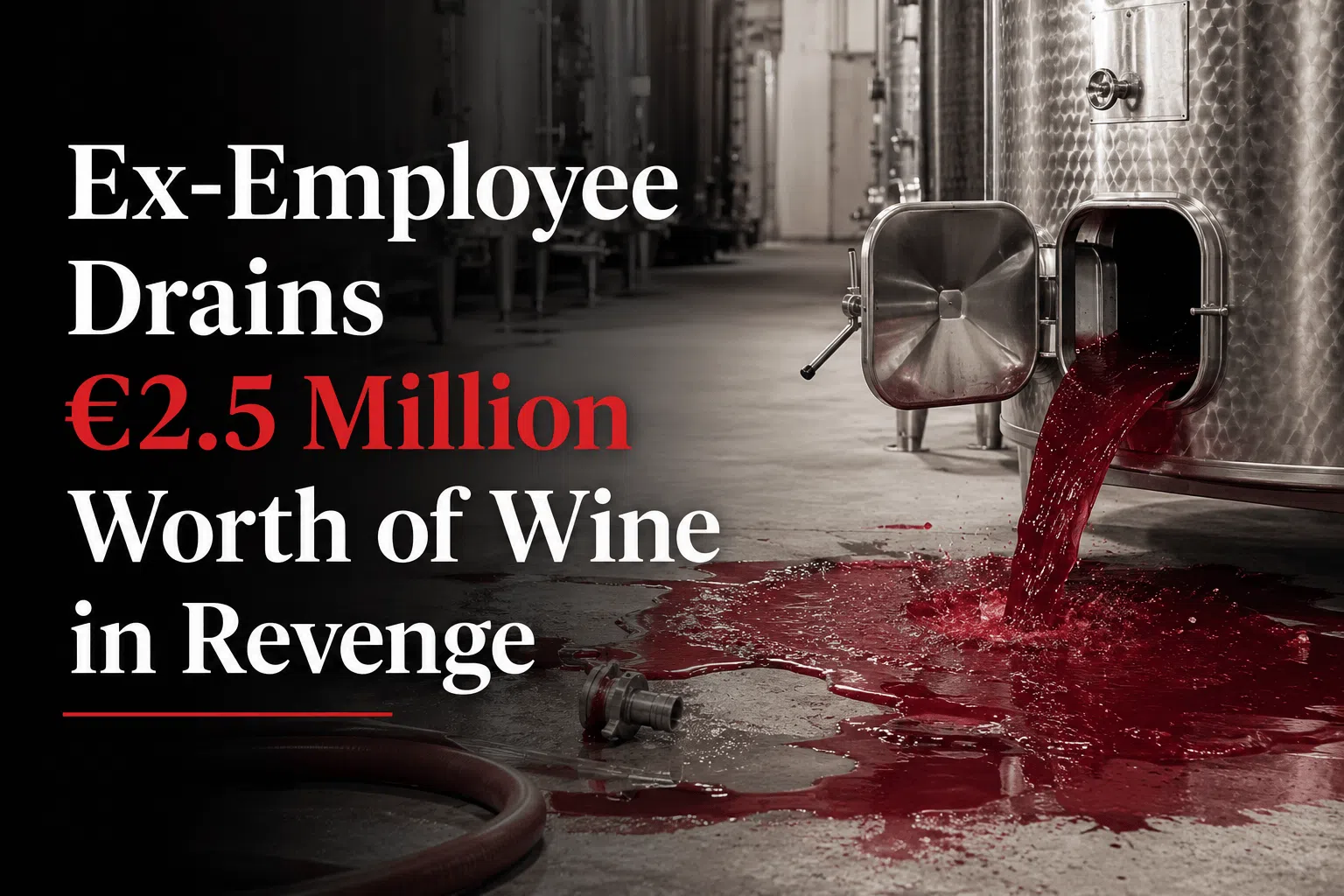
In the early hours of February 18, 2024, someone walked into this respected Ribera del Duero winery in Castrillo de Duero, Spain, wearing a hooded sweatshirt, and in under sixty seconds opened the valves on five stainless steel tanks. Two happened to be empty. Three were not.
By the time anyone found out, roughly 60,000 litres of wine — somewhere around 80,000 bottles’ worth — had already emptied itself onto the cellar floor, taking a full year of someone’s work down the drain along with it. Literally.
I’m not going to sit here and tell you what she should or shouldn’t have done. I wasn’t there, I don’t know what that job meant to her, and losing work you were counting on is genuinely awful no matter how it happens. But I am allowed to feel enormously sorry for the people who now have a wine-shaped hole where their year’s income used to be. Both things can be true at once. That’s basically what this whole story is.
What Actually Happened at Cepa 21?
Cepa 21 isn’t some anonymous bulk producer nobody’s heard of. This is a genuinely well-regarded name in Ribera del Duero, a region known for producing some of Spain’s finest Tempranillo, and the winery had recently been a sponsor at Spain’s Goya Awards. In wine terms, this is the equivalent of someone breaking into a respected local restaurant and quietly turning off every fridge in the building overnight.
Security cameras caught a hooded figure moving through the cellar with what investigators later described as clear familiarity with the equipment — not fumbling around looking for the right valve, just going straight to it. In under a minute, five tanks were opened. The whole thing was over before most people’s coffee would have finished brewing.
José Moro, the president of Cepa 21, put it plainly afterwards: this wasn’t a robbery. Nobody took anything home. Somebody simply let it all drain away and walked out into the dark.
Why Would Someone Do This?
Because, according to investigators, this wasn’t a random act by a stranger with a grudge against Tempranillo in general. This was someone who knew exactly where to go and exactly what to open.
Months later, in June 2024, Spain’s Guardia Civil arrested a woman reportedly connected to the winery as a former employee — one whose temporary contract had ended just weeks before the tanks were opened. Investigators haven’t laid out every detail publicly, and this is very much a case where “reportedly” and “allegedly” are doing real work in every sentence. But the timeline alone is the kind of thing that makes a room go quiet when you say it out loud.
Moro’s reaction, when the arrest came through, wasn’t triumphant. He described it as “bittersweet” — relief that the case was finally moving, tangled up with disbelief that someone who had actually worked inside those walls could do something he called an outright “sacrilege.”
That’s not a word people reach for lightly. Most business owners, describing a financial loss, talk about numbers. Moro reached for a word usually saved for something holy being violated. Which tells you exactly how personal this felt to the people it happened to.
Could Anyone Have Stopped This?
Almost certainly not, and that’s the genuinely unsettling part of the whole story.
Wineries run on a level of internal trust that most businesses simply don’t need. You can’t do cellar work from behind a locked partition — someone has to actually be able to walk up to a tank, open it, taste from it, adjust it. The exact skill that makes someone good at the job is the same skill that, in the worst-case scenario, makes them capable of doing precisely this kind of damage.
Cepa 21’s own team said as much — the intruder clearly knew the equipment. That’s not really a security failure you can fix with a better lock. It’s just the quiet risk that comes bundled with giving people real access to do real work, and it’s a sentence that’s probably kept more than one winery owner awake since this story broke.
What Happened to the Wine — and to Cepa 21?
The 60,000 litres were gone the second they hit the floor. There’s no salvaging wine once it’s mixed with a cellar floor — Moro was blunt about that part too, saying it could never be properly enjoyed again, which is one of the more heartbreaking sentences I’ve read from a winemaker in a long time.
Financially, the total losses ran past €2.5 million once you factor in the wine itself and the year of production tied up in it — including the entire year’s output of one label and a significant chunk of another. Cepa 21 kept operating. The wider Ribera del Duero region absorbed the story as a genuine shock, because wineries making international headlines is rare, and wineries making headlines for this particular reason is rarer still.
Frequently Asked Questions — The Cepa 21 Sabotage
How much wine was lost in the Cepa 21 sabotage? Roughly 60,000 litres, the equivalent of around 80,000 bottles, with total losses estimated at over €2.5 million.
Was anyone arrested for the Cepa 21 wine sabotage? Yes. In June 2024, Spain’s Guardia Civil arrested a woman reportedly connected to the winery as a former employee, months after the incident occurred.
Where is Cepa 21 winery located? In Castrillo de Duero, in the Valladolid province of Ribera del Duero, one of Spain’s most respected wine regions, known primarily for Tempranillo.
Was anything stolen from Cepa 21? No. The winery’s own leadership confirmed nothing was taken. The tanks were simply opened and left to empty.
One Last Thing
What gets me most about this story isn’t the euro figure, dramatic as it is. It’s the timeline. Wine takes a season to grow, weeks to ferment, sometimes years to be ready for anyone to actually drink it. It took less than a minute to lose.
I don’t know what was going through anyone’s head that night, and it’s honestly not my place to guess. But I do know what it’s like to pour real time into something and watch it vanish through no fault of your own, and there’s a particular kind of ache reserved for the people standing in that cellar the next morning, looking at a floor that used to be a year of their life.
Pour something nice tonight. Preferably from a tank that’s still got all its wine in it.
— Kelly 🍷
#WineNews #WineAndPeople #RiberaDelDuero #SpanishWine #WineIndustry
Enjoy wine without the snobbery?
Make The Finest Italian Wine one of your Preferred Sources on Google.
Add The Finest Italian Wine to Preferred SourcesDiscover more from The Finest Italian Wine
Subscribe to get the latest posts sent to your email.