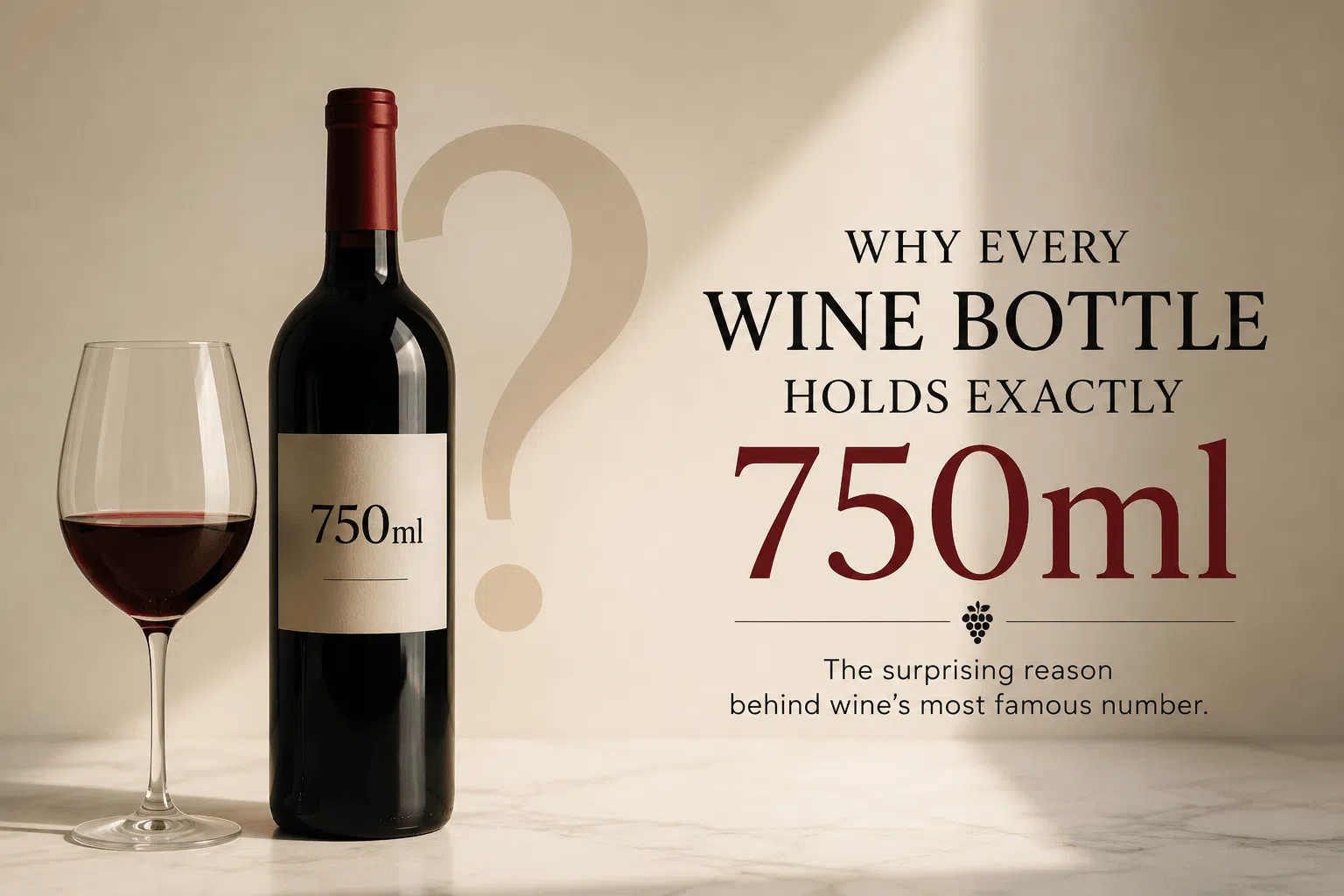
Why Every Wine Bottle Holds Exactly 750ml (And It Has Nothing to Do With Wine)
Pick up a bottle of wine from Italy, then one from Argentina, then one from South Africa. Different grapes, different climates, different languages on the label. And yet every single one holds exactly 750ml.
Not 700. Not a clean, sensible litre. Just 750, over and over, no matter which side of the planet the wine came from.
Nobody questions this. We’ll argue for an hour about whether red wine should ever touch an ice cube, but the actual container the wine lives in? Total silence. So let’s break that silence, because the real story here has almost nothing to do with wine itself, and almost everything to do with barrels, British trade math, and one very persistent myth that refuses to die.
So why is 750ml the standard, really?
Blame the British, and blame a barrel.
For centuries, England was one of the biggest buyers of French wine, and Bordeaux was shipping it over by the barrel-load. A standard Bordeaux barrique held around 225 litres. Meanwhile, the British weren’t measuring anything in litres at all — they were working in imperial gallons, at roughly 4.5 litres each. Do that math and a 225-litre barrel comes out to almost exactly 50 imperial gallons.
Once merchants started dividing that barrel into individual bottles, something convenient happened: 225 litres split cleanly into 300 bottles of 750ml apiece. No fiddly remainders, no awkward fractions. Just a tidy number that made the accounting easier for everyone involved.
That’s genuinely it. Not romance, not ritual. Spreadsheet math from three centuries ago, and we’re all still living inside the result of it.
Wait, didn’t glassblowers decide the size based on their lungs?
You’ll see this one everywhere, and it’s one of my favourite kinds of wine myth: charming, widely repeated, and almost certainly not true.
The story goes that early glassblowers could only exhale enough air in one breath to inflate a bottle to about 750ml, and that’s supposedly where the size came from. It’s a lovely image. It also doesn’t hold up against the actual documented history, which points squarely at barrel math and British trade accounting instead.
Here’s the thing about a myth like this: it survives because it’s a better story than the truth. A human lung deciding the shape of the wine industry is far more romantic than a 19th-century merchant doing division to simplify his ledger. But better story doesn’t mean true story, and I’d rather hand you the boring, accurate version than the charming one.
Did anyone officially decide on 750ml, or did it just happen?
Nobody sat in a room and voted on it, if that’s what you’re picturing.
It spread the way most standards do: gradually, and mostly because switching to something else would have been more trouble than it was worth. Producers noticed the size worked well for shipping, for pricing, for stacking in cases, and one by one they fell in line without any grand announcement.
The legal paperwork came much later, and it happened in stages. Wine-trading nations broadly agreed on 0.75 litres as the international standard sometime around 1970, well before any single country made it official law. The United States followed with its own formal regulation in 1979, phasing out the old “fifth” measurement in favour of the metric standard. Even Germany’s traditional tall, slender Rhine bottles — long associated with Riesling — were commonly filled to 700ml right up until 1977, before falling in line with everyone else. By the time any government had actually written the number into law, the wine world had already been doing it out of habit for the better part of a century.
Is 750ml actually a good amount, or did we just get used to it?
Honestly, both.
A standard bottle works out to roughly five generous glasses at dinner, or six smaller tasting pours if you’re sampling rather than settling in. That’s enough to share comfortably across a meal without either running dry too soon or leaving you with a half-full bottle staring at you from the counter the next morning, silently judging your restraint.
But let’s be fair about this: 750ml isn’t some scientifically optimised serving size for the human body. It’s a shipping unit that happened to also work reasonably well at the dinner table. We didn’t design the size around drinking. We just got lucky that the math for barrels and the math for a nice dinner landed in roughly the same place.
Split between two people, though, the math gets a little less flattering. Two glasses each barely touches the bottle, but three glasses each starts nudging you both toward a genuinely tipsy evening. There’s no elegant, moderate way to split 750ml exactly in half between two people on a Tuesday night. Someone’s always either short-changed or slightly overserved, and there’s no version of a barrel calculation from 1800s Bordeaux that was ever going to solve that particular problem for us.
What about magnums and those enormous bottles?
Once 750ml became the baseline, everything else in the wine world simply scaled up or down from it.
A magnum holds 1.5 litres, exactly double a standard bottle, and it’s not purely for showing off at a party (though it does that job beautifully too). Wine in a magnum tends to age more gracefully over time, because there’s proportionally less oxygen sitting inside the bottle relative to the volume of wine. Less oxygen exposure per litre means a slower, more graceful evolution in the bottle.
Go further and you’ll run into bottles named after biblical kings — Jeroboam, Methuselah, Nebuchadnezzar — each one a multiple of that same original 750ml. It’s a strange little corner of the wine world where ancient history and party-sized bottles somehow collided, and nobody’s ever fully explained why kings got the naming rights instead of, say, popes or footballers.
The same barrel math even explains why wine is so often sold in boxes of six or twelve rather than, say, ten. If you’ve ever wondered whether there’s a smarter way to buy in bulk than just grabbing whatever’s stacked at the front of the shop, here’s my full guide to buying a case of wine, we also have a post on a guide to wine bottles, this will help you understand the math better.
So will the 750ml bottle ever change?
Almost certainly not, and here’s why that’s actually the more interesting answer.
Wine racks are built around it. Shipping cases are built around it. Restaurant pour sizes, pricing models, even the language we use to describe “a bottle” of wine, all of it assumes 750ml as the baseline. Changing it now wouldn’t just mean redesigning a label. It would mean unpicking a system that’s been quietly running the entire global wine trade for well over a hundred years.
Sometimes a standard sticks around not because it’s perfect, but because everyone downstream has already built their entire business on top of it.
So next time you’re holding a bottle from three different countries with three different labels and three completely different stories to tell, remember they’re all quietly agreeing on one thing before you’ve even opened them. Not because anyone designed it that way. Because three centuries ago, a barrel full of French wine and a British merchant’s tidy arithmetic accidentally decided it for all of us, and nobody’s ever found a good enough reason to argue with the math since.
FAQ
Why are wine bottles 750ml instead of a full litre? The size traces back to Bordeaux barrels, which held around 225 litres and divided cleanly into 300 bottles of 750ml when British merchants started trading wine by that measurement in the 19th century. A litre bottle would have left an awkward, uneven remainder from the same barrel.
Is it true that glassblowers’ lung capacity determined the 750ml size? No. It’s a widely repeated story, but it isn’t supported by the documented history, which points to barrel and trade math instead. Treat it as wine folklore, not fact.
When did 750ml become the official legal standard? Wine-trading nations broadly settled on 0.75 litres as the international standard around 1970. The United States made it formal law in 1979, replacing the older “fifth” measurement. Even traditional German Rhine bottles, historically filled to 700ml, fell in line with the 750ml standard around 1977. The size itself, though, had already been in common use for roughly a century before any of that paperwork existed.
How many glasses of wine are in a standard 750ml bottle? Roughly five generous glasses, or about six smaller tasting pours, depending on how generously you’re pouring.
Enjoy wine without the snobbery?
Make The Finest Italian Wine one of your Preferred Sources on Google.
Add The Finest Italian Wine to Preferred SourcesDiscover more from The Finest Italian Wine
Subscribe to get the latest posts sent to your email.