
Why Screw Caps Are Better Than Corks (And Why We Still Feel Weird About It)
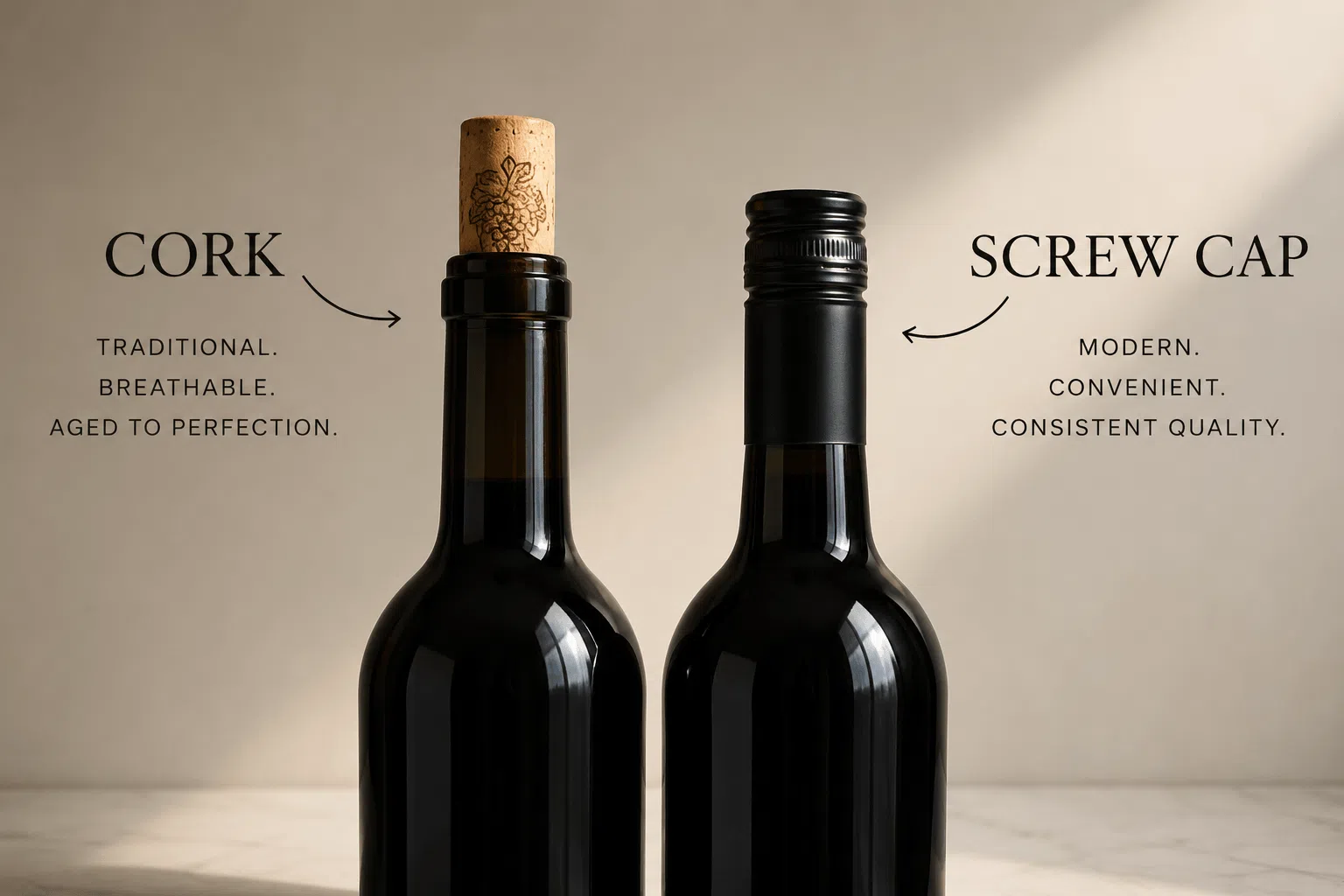
You know the moment. You’re two turns into the corkscrew, everyone’s watching, and the cork snaps in half.
Now you’re not opening a bottle of wine. You’re performing minor surgery on a bottle of wine, fishing bits of cork out with the end of the screw while trying to look calm about it, and there’s a decent chance you’re about to serve your guests a glass with cork floating in it like some kind of rustic garnish nobody asked for.
I’ve done this more times than I want to admit. And every single time, standing there gouging bark out of a bottleneck with a broken corkscrew, I’ve thought the same thing: why are we still doing this?
Then I actually looked into what cork does to wine beyond the occasional snapped stopper, and it turns out the broken-cork moment isn’t even cork’s worst offense. It’s just the most visible one.
Are screw caps actually better than corks?
For most wines, yes. Not “fine, I suppose.” Better.
Here’s the thing nobody tells you at the dinner table: cork is a natural product harvested from tree bark, and natural products come with natural problems. One of those problems is a compound called TCA, which forms when fungi living in the cork’s pores react with certain chemicals. When TCA gets into your wine, it doesn’t always announce itself with a dramatic stench. Sometimes it just quietly mutes the wine — flattens the fruit, dulls the aromatics — and you walk away thinking the wine simply wasn’t very good, when actually the cork sabotaged it before you ever poured a glass.
How often does this happen? Depends who you ask, which is itself a little suspicious. The cork industry’s own studies land under 1%. Independent tasting panels testing thousands of bottles a year have repeatedly found rates closer to 3-7%. Split the difference and you’re still looking at something like one bottle in every case or two, quietly underperforming, and nobody in the room knowing why.
Screw caps don’t have this problem. There’s no bark, no fungus, no TCA pathway. The wine tastes like the winemaker intended it to taste, bottle after bottle, with almost boring consistency.
Boring is underrated. Boring means you’re not gambling.
Does screw cap wine age as well as cork?
They can — but not in the way people assume.
Screw caps seal more tightly than cork, which means less oxygen sneaks in over time. For wines built to be drunk young and fresh — most whites, rosés, and a huge share of everyday reds — that’s exactly what you want. The wine tastes the way it did the day it was bottled, rather than slowly, unpredictably drifting.
The argument against screw caps has always been about aging: that wine needs a small, steady trickle of oxygen through cork to develop properly over years in the cellar, and a screw cap starves it of that.
This is where I’ll actually give cork some credit, because the science here is genuinely more complicated than either side likes to admit. Some age-worthy reds probably do benefit from a bit of oxygen ingress over a decade or more. But “some benefit from a little oxygen eventually” is a completely different claim from “screw caps ruin wine,” and the second one gets repeated a lot more often than the first one gets tested.
And here’s the point most screw cap cheerleaders conveniently skip: that same near-total lack of oxygen can occasionally work against the wine. Without any air getting in at all, some wines develop a reductive streak — a whiff of rubber or struck match, sometimes worse, that a small trickle of oxygen would normally air out. It’s fixable (a good decant sorts most of it, and winemakers now design caps with tiny calibrated amounts of oxygen transfer to avoid it), but it’s real, and pretending screw caps are flawless would be exactly the kind of one-sided argument I’m accusing cork lovers of making.
And one region actually ran the experiment properly, in public, on purpose.
Why did wineries start using screw caps?
Because a group of winemakers in Clare Valley, Australia, got tired of losing their best wine to a random manufacturing defect.
In 2000, fourteen Clare Valley Riesling producers — led by Jeffrey Grosset, a name worth remembering if you ever see it on a label — collectively agreed to bottle their entire vintage under screw cap instead of cork. At the time, this was treated less like a business decision and more like an act of vandalism. Cork meant quality. Screw cap meant supermarket plonk you drink alone on a Tuesday. Everyone knew this. It was gospel.
The Clare Valley producers didn’t care. They’d watched vintage after vintage of serious, ageable Riesling get randomly wrecked by cork taint, and they decided consistency mattered more than tradition. A group of New Zealand wineries followed their lead the year after.
Then came the part that actually matters: the wines aged beautifully. Decades later, some of those original bottles are still showing gorgeously — fresh, precise, alive — while plenty of cork-sealed wines from the same era went to random early graves. Australia and New Zealand now close the overwhelming majority of their white wines under screw cap, including bottles that cost more than your weekly grocery shop.
The people who actually make wine for a living stopped arguing about this two decades ago. The rest of us are still catching up.
So why does cork still feel more “premium”?
Because the pop is theatre, and theatre works.
There’s a specific ritual to cork — the foil, the twist, the resistance, the little exhale of the bottle opening. It feels like an event. A screw cap gives you the sound of opening a bottle of aspirin. No drama, no crescendo, nothing to perform for the table.
I understand the appeal. I like ceremony as much as anyone; I live in a country that turns lunch into a three-hour occasion. But there’s a difference between loving a ritual and mistaking that ritual for a quality signal. The cork isn’t protecting your wine better. It’s just giving you a better show while doing a worse job.
It’s the same instinct, honestly, as assuming “Extra Dry” must be the driest Prosecco on the shelf just because of the name — it isn’t, and it’s confidently wrong for the exact same reason: we trust the label over the evidence.
Winemakers in places like New Zealand, Austria, and increasingly here in Italy have started using screw caps on wines that cost real money, precisely because they’ve stopped needing the theatre to sell the bottle. When a producer is confident enough in their wine, they don’t need the pop to convince you it’s serious.
I’ll give cork one honest point back, though, because pretending it has nothing going for it would be its own kind of dishonesty. Cork is a renewable material — the tree isn’t cut down, just stripped of its bark every nine years or so, and it keeps living for decades. Aluminum screw caps are recyclable, but making them in the first place isn’t free of environmental cost either. If sustainability is genuinely the deciding factor for you, it’s not the slam-dunk in screw cap’s favour that the taste and consistency argument is.
Should you avoid wines with screw caps?
No. If anything, treat it as a small, quiet signal that the winemaker cared more about what’s in the bottle than what happens when you open it.
Next time you’re standing in a wine shop and you see a screw cap on something that looks genuinely good, don’t put it back on the shelf out of habit. Pick it up. You’re not settling. You might actually be getting the better bet.
And the next time a cork snaps in your hand halfway through a dinner party, do me a favour. Don’t blame yourself. Blame the cork. Read our post on The Ten Best Wine Openers to help guide you.
(And if you want to stop second-guessing yourself at the wine list next time you’re out, here’s how to order like a local instead of a tourist.)
FAQ
Are screw cap wines cheaper or lower quality than corked wines? No. Screw caps are used across every price point, including premium age-worthy wines, especially from Australia and New Zealand. Price and closure type aren’t linked — the cork industry just had a decades-long head start on convincing people otherwise.
Can wine still age well under a screw cap? Yes. Producers who made the switch over twenty years ago have opened decades-old bottles that show excellent development. Whether extreme long-term aging needs a touch of oxygen ingress is still debated among winemakers, but the idea that screw caps prevent aging altogether hasn’t held up.
What is cork taint and how do I know if my wine has it? Cork taint comes from a compound called TCA that can develop in natural cork. At high levels it smells like wet cardboard or a damp basement. At lower levels, it doesn’t smell “off” so much as it just makes the wine taste flat and less expressive than it should.
Why do some expensive wines still use cork? Tradition, market expectation, and in some cases, genuine belief in cork’s role in slow aging. It’s also worth saying plainly: a lot of it is marketing. Cork still reads as “serious wine” to a lot of buyers, and producers know it.
Do screw caps trap bad smells in wine? Occasionally, yes. Because screw caps let in almost no oxygen, some wines can develop a reductive note — a whiff of rubber or struck match — that a little air exposure would normally clear. A decant usually solves it, and many producers now use cap liners engineered to allow a tiny, controlled amount of oxygen in specifically to avoid this.
Enjoy wine without the snobbery?
Make The Finest Italian Wine one of your Preferred Sources on Google.
Add The Finest Italian Wine to Preferred SourcesDiscover more from The Finest Italian Wine
Subscribe to get the latest posts sent to your email.