Soave’s Reputation Was Written Into Law
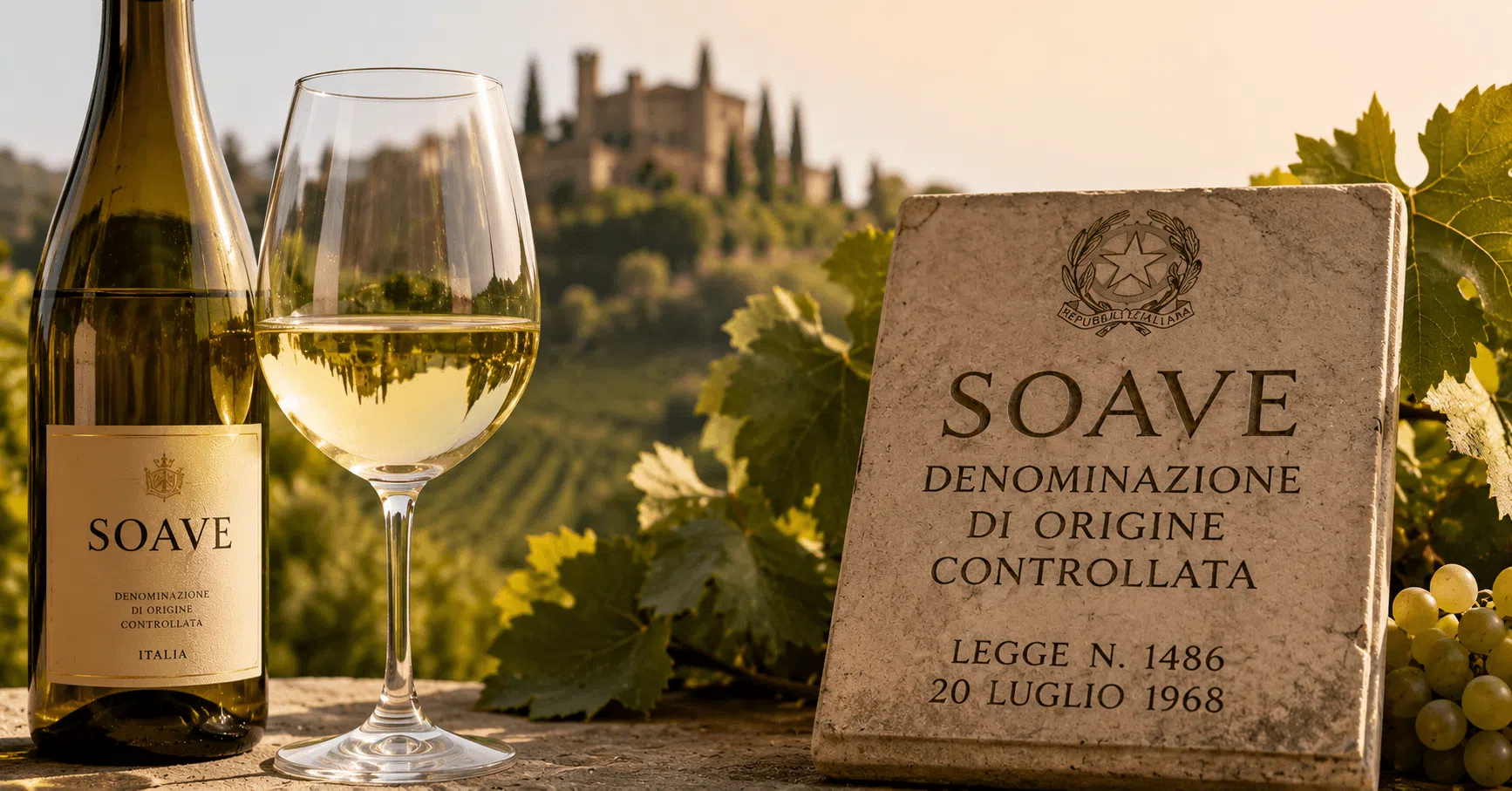
At one point in the 1970s, Soave outsold Chianti in the United States. Not a niche category win. The actual best-selling Italian wine in the country, red or white, full stop.
Ask most people about Soave today and you’ll get a shrug. Or a memory of a thin, forgettable white from a red-and-white-tablecloth restaurant sometime in the 1980s. Somewhere between those two facts, an entire wine region got flattened into a punchline. I think that’s a genuine shame, and I think it’s also completely explainable once you see what actually happened. It’s not really a story about the wine. It’s a story about a law.
The Zone That Started at 1,700 Hectares
In 1931, Italy named Soave and Chianti among the very first wine zones officially recognized by royal decree. That’s decades before the modern DOC system even existed. The boundary covered roughly 1,700 hectares of hillside vineyards. That’s above two villages, Soave and Monteforte d’Alpone, just east of Verona. Those hills sit on the remains of an extinct volcano. The soil there is volcanic and mineral-rich, nothing like the valley floor below.
That original hillside zone is what we now call Soave Classico. It’s small, it’s steep, and it’s where the best wine has always come from. It was also, at one point, apparently good enough to borrow someone else’s name entirely. Dario Pieropan, of the family winery that’s farmed here for generations, has told the story of old bottles labeled simply “Chablis.” Before the DOC formalized anything, that’s the company Soave was trying to keep.
Then Demand Showed Up, and the Law Followed It
After the war, American and British buyers fell hard for Soave. The dominant exporter at the time, Bolla, pushed sales through big, affordable bottles. Demand climbed fast enough that 1,700 hillside hectares couldn’t keep up. When Soave earned full DOC status in 1968, the solution was simple. The official production zone jumped to roughly 7,000 hectares. Most of it was flat, fertile land, nothing like the original volcanic soil.
Cooperatives moved in to handle the new volume. Some blended in up to 30% neutral Trebbiano Toscano just to meet orders. By the 1980s and 90s, yields in parts of the expanded zone reportedly ran past 100 hectoliters per hectare. That’s the kind of number that dilutes flavor fast, in any country, in any grape. Heavy TV advertising did the rest, and “Soave” quietly became shorthand for thin, inoffensive, and cheap.
None of that is a rumor. A production zone four times the original size exists to do one thing: make a lot of wine, fast. That’s what happens when demand outgrows a hillside that was never built for volume.
The Reputation Never Really Left
“Soave is still suffering a little bit from its past,” the producer Alessandra Tessari of Suavia told Wine Enthusiast. “But Soave is not the thing that people used to know. All of us are working to give a new image.”
A small group of estates never left the original hillsides, and their wines tell a completely different story. Pieropan’s Calvarino, one of Italy’s first single-vineyard cru wines, debuted over 50 years ago. It’s still grown organically, still ferments in concrete instead of oak, and still ages gracefully. Producers like Inama, Suavia, Prà, and Gini followed a similar path. Low yields, hillside fruit, real character, usually for $20 to $40 a bottle. Wine critics now regularly call Soave one of Italy’s most underrated whites. The wine never actually changed. The industry around it did, twice.
The Surprising First
Here’s a fact that stops most people cold. Recioto di Soave, a sweet, golden wine made from partially dried Garganega grapes, became a DOCG in 1998. That makes it the first wine in the entire Veneto region to earn Italy’s top classification. It beat Soave Superiore itself (2001) and Amarone (2009) by over a decade.
The technique is properly ancient. Written references to a similar sweet wine from this same area go back roughly 1,500 years. Grapes get hand-selected, then dried for five to six months before pressing, concentrating both sugar and flavor. Today Recioto di Soave makes up roughly a third of one percent of total Soave production. That makes it one of the rarest things you’ll actually find on an Italian wine list.
What’s Actually Changing Right Now
This next part almost never makes it into Soave writing, probably because it’s still happening. Under new leadership since 2022, the Consorzio has started actively reversing the damage the 1968 expansion caused. It banned Trebbiano Toscano outright. It banned new vineyard plantings in the flatland zone. It reduced the total area declared under the Soave DOC. It also increased checks to make sure producers actually follow the rules.
Producers have also mapped the Classico zone into 33 official sub-zones, called UGAs. It’s the same basic idea as Burgundy’s climats or Barolo’s MGAs. Take Foscarino and Carbonare, two adjoining hillsides that share the same volcanic bedrock. Foscarino faces one way, Carbonare faces another, and that single difference in wind exposure produces noticeably different wines. Now that difference has an official name on the label, instead of getting lumped into one generic “Soave.”
I think this is the most interesting Soave story going right now, and almost nobody outside the trade talks about it. A region is actively legislating its way back out of a mess a different law created fifty years earlier.
How to Actually Buy It
Skip anything labeled just “Soave DOC” with no other qualifier. It’s almost certainly flatland fruit made to move volume, not to impress you.
Look instead for one of these on the label:
- Soave Classico, from the original hillside zone
- Soave Superiore, a DOCG tier with lower yields and stricter standards
- Recioto di Soave, if you want the rare, ancient, sweet version
Producer names to trust: Pieropan, Inama, Suavia, Prà, and Gini. Expect to pay $15 to $40 depending on the bottle and vintage. It pairs beautifully with seafood, which happens to be one of the best uses for Italian whites in general. The acidity and minerality do exactly what a good white should do next to something out of the water.
Quick Answers
Why does Soave have a cheap reputation? A 1968 law expanded its official growing zone from about 1,700 hillside hectares to roughly 7,000, mostly flat farmland. Cooperatives used that extra land to meet booming export demand through the 1970s and 80s. Quality dropped sharply as volume rose.
What’s the difference between Soave and Soave Classico? Classico comes only from the original hillside zone on volcanic soil, the historic heartland of the wine. Regular Soave DOC can come from the much larger flatland zone added in 1968, on different, less distinctive soil.
Is Soave a good wine? The best Soave Classico from producers like Pieropan, Inama, or Suavia is legitimately excellent: mineral, textured, and capable of aging well. The reputation problem comes almost entirely from decades of cheap flatland bottlings, not from what the wine is capable of.
What is Recioto di Soave? A sweet, golden wine made from partially dried Garganega grapes. It became the first DOCG wine in the entire Veneto region in 1998, over a decade ahead of Amarone. It’s made in tiny quantities today, well under 1% of total production.
Enjoy wine without the snobbery?
Make The Finest Italian Wine one of your Preferred Sources on Google.
Add The Finest Italian Wine to Preferred SourcesDiscover more from The Finest Italian Wine
Subscribe to get the latest posts sent to your email.