Can You Really Make Money Collecting Italian Wine?
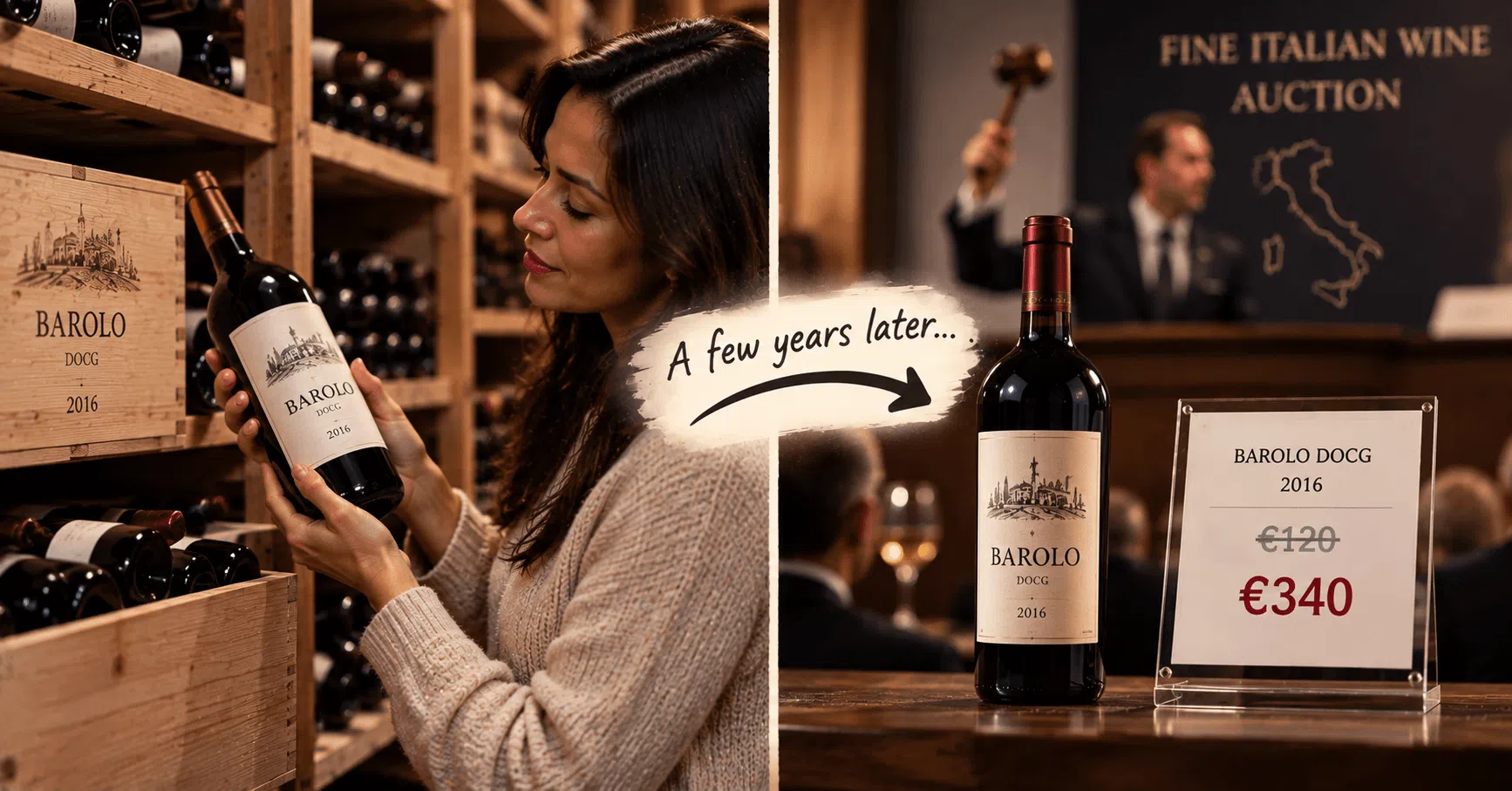
There is a wine auction happening in Milan, and some of the bottles on the list look less like something you open with dinner and more like something you discuss with your accountant. Nothing here touches the truly absurd numbers on my list of the world’s most expensive wines, but it’s still serious money.
Sassicaia. Masseto. Ornellaia. Tignanello. Soldera. Biondi-Santi. Old Barolo. Monfortino.
There are even original wooden cases containing 12 bottles of Sassicaia, because apparently buying Sassicaia one bottle at a time is for people who lack commitment.
You don’t need a Milan saleroom to feel this, either. I’ve stood in an ordinary cantina here and seen a red wine with a €100 price tag on the shelf, sitting there as calmly as the €12 bottle right next to it. That kind of price tag does something to your brain before you’re anywhere near an auction house.
And looking at all this, I had a dangerous thought.
Can you really make money collecting Italian wine?
Because if the answer is yes, some of us may have been drinking our investments.
Before you inspect the wine rack in your kitchen and start calculating your retirement, we need to clear something up. A good wine is not automatically a collectible wine, and an expensive wine isn’t automatically an investment. And that old bottle you’ve forgotten at the back of a cupboard? Don’t resign from your job yet.
Yes, People Really Do Make Money From Italian Wine
There is a genuine secondary market for fine wine. Collectors buy bottles and cases, store them properly, and sometimes sell them years later through specialist merchants, trading platforms and auction houses. Italian wine is very much part of that market.
The Liv-ex Italy 100, which tracks some of the most actively traded Italian fine wines on the secondary market, rose 1.9% in the first half of 2026. That sounds fairly modest until you look at individual bottles.
Giacomo Conterno’s Barolo Monfortino Riserva 2005, for example, rose about 26% in six months. Bruno Giacosa’s Barolo Falletto Vigna Le Rocche Riserva 2016 gained 19.2%, while wines from Soldera, Masseto and Bartolo Mascarello were also among the stronger performers.
So yes, Italian wine can increase substantially in value. But there is one detail that tends to disappear when people start talking about wine as an investment.
Most wine won’t.
Your €18 Barolo Probably Isn’t Funding Your Retirement
Italy produces an enormous amount of excellent wine, and collectors are not fighting over all of it. The bottles that repeatedly appear at serious auctions tend to come from a relatively small group of producers. In Tuscany, names such as Sassicaia, Masseto, Ornellaia, Solaia, Tignanello, Soldera and Biondi-Santi are familiar territory for collectors. Piedmont has its own heavyweights, including Giacomo Conterno, Bartolo Mascarello, Bruno Giacosa and Gaja.
Look through a major Italian wine auction and these names keep coming back. Not because the wines are delicious, though they are. There are thousands of delicious Italian wines. What these bottles have is demand long after they’ve disappeared from normal shop shelves.
That’s the part I find fascinating. You can make an extraordinary wine, receive wonderful reviews, and still never become particularly collectible. For prices to climb years later, somebody has to want your bottle badly enough to pay more for it than the first buyer did.
Without that second buyer, you don’t have an investment. You have dinner.
Which, to be fair, isn’t a terrible outcome.
So What Makes an Italian Wine Collectible?
There isn’t a secret grape that turns into money after 15 years. Usually, several things come together.
Reputation matters enormously. Collectors are more comfortable spending serious money on producers with decades of history, critical recognition and international demand. A brilliant small winery nobody outside its village has heard of may make spectacular wine, but spectacular doesn’t automatically mean easy to resell.
Then there’s scarcity. Once a sought-after vintage is released, that’s it. Nobody can decide in 2035 that Sassicaia 2021 has become popular and make another batch. Meanwhile, people keep opening the existing bottles, so the number left in the world gradually shrinks.
The wine also needs to be capable of ageing well. If you’re buying something to hold for ten or twenty years, it helps if the wine isn’t exhausted before your investment strategy is.
And then there’s the vintage. This is where simply buying a famous name can get you into trouble. Different vintages have different reputations, drinking windows, critic scores, production levels and demand. Buying Sassicaia doesn’t mean you’ve discovered a machine that turns euros into more euros.
The Price You Pay Matters Too
Suppose you buy a bottle for €500 and eventually sell it for €550. The price went up, so technically you made money. Now add proper storage, insurance, and auction or merchant fees. Remember inflation. Our retirement in Tuscany is already looking slightly less glamorous.
This is why a headline saying a particular wine gained 20% should never be read as “Italian wine goes up 20%.” Individual bottles can perform brilliantly while others fall, and even the wider fine-wine market goes through difficult periods.
Wine may improve with age. Its price has signed no such agreement.
The Bottle’s Past Matters Almost as Much as What’s Inside It
Let’s say you manage to choose the right producer, the right wine and the right vintage. You can still get this wrong.
Collectors care enormously about provenance, which is basically the bottle’s biography. Where has it been stored? Who owned it? Was the temperature controlled, and has the bottle been exposed to heat or light? Does the label show any damage, and is the fill level still good? Is the original wooden case even available?
In other words, has your Barolo spent 15 years peacefully resting in a proper cellar, or has it lived above somebody’s fridge in Naples? These are not equivalent childhoods.
Poor storage can damage wine, and once buyers are spending hundreds or thousands of euros on a bottle, uncertainty becomes expensive. A buyer isn’t only purchasing the wine. They’re purchasing confidence that the wine inside is still what it’s supposed to be. That’s why complete cases, original packaging and documented professional storage can matter, and it’s worth knowing the basics of proper wine storage even if you never plan to sell a single bottle.
And it’s also why discovering an ancient bottle in your grandmother’s cupboard doesn’t automatically mean you’ve found treasure. Some genuinely ancient bottles have sold for extraordinary sums precisely because of where they’d been and who owned them, as I found out researching the oldest wines in the world. But most of the time, Grandma was just storing vinegar for you.
Could an Ordinary Wine Lover Do This?
Yes, but this is where I’d separate collecting wine from investing in wine.
Remember that €100 bottle from the cantina? That’s exactly the kind of decision this all comes down to. Are you buying it because you genuinely want to drink it, or because you’ve quietly convinced yourself it might be worth something someday?
If I were starting as an ordinary wine lover, I’d rather buy bottles I genuinely wanted to own. Imagine buying six bottles of a wine you love. Ten years later, the price has doubled. Lovely. You can sell a few, keep a few, or invite people you particularly like and drink your profits. If the price doesn’t rise, you still own wine you wanted.
That’s a very different situation from buying an expensive bottle you don’t even enjoy because someone online promised it was going “to the moon.”
When It Stops Being a Hobby
Once you’re buying primarily for financial return, this stops being simply a wine hobby. You need to understand market prices, storage, provenance, insurance, authenticity, selling costs and liquidity. You may also have money tied up for years with no guarantee the bottle will be worth more when you finally want to sell it.
And this is the part I think gets lost when wine investment is made to sound glamorous.
Fine wine is not a savings account with a cork.
There’s money in the market, certainly. But there’s risk too. I’d also be cautious about articles telling you exactly which Italian wines to “buy now.” Established names such as Monfortino, Sassicaia, Masseto, Soldera and Biondi-Santi are useful for understanding what collectors already value. That doesn’t mean every vintage from those producers is a good investment at every price.
Sometimes the smartest bottle to buy is simply the one you’d be perfectly happy to drink if your grand investment plan goes nowhere. At least then disappointment comes with dinner.
So, Can You Really Make Money Collecting Italian Wine?
Yes. People already do. Certain Italian wines have developed serious international secondary markets, and some individual bottles have produced impressive returns. Italy is no longer standing quietly behind Bordeaux and Burgundy while collectors discuss investment-grade wine.
But there’s a huge difference between can make money and will make money.
You need a wine people will still want years from now, the right vintage and a sensible purchase price. Then you need to store it properly and be patient, accounting for the costs of eventually selling it too.
And after doing all of that, you have one final problem. You must resist drinking it.
Personally, this is where my investment strategy would probably collapse. Imagine carefully storing a beautiful Barolo for twenty years, watching its value climb, waiting patiently for exactly the right moment to sell.
Then you make osso buco.
Investment over.
Salute.
Kelly’s Note
Fine wine is a collectible alternative asset, not a guaranteed investment. Prices can rise or fall, and storage, insurance and selling costs can reduce returns considerably.
The Liv-ex Italy 100 rose 1.9% in the first half of 2026. Giacomo Conterno’s Barolo Monfortino Riserva 2005 gained about 26% over six months, and Bruno Giacosa’s Barolo Falletto Vigna Le Rocche Riserva 2016 gained 19.2%. These figures describe past secondary-market performance, not future returns.
Finarte’s “Collectible Wines” auction ran on 16 September 2026 in Milan, with 245 of the 400 lots Italian, including a 12-bottle original wooden case of Sassicaia 2006. It’s a useful current snapshot of which Italian producers are actively traded in the specialist collectible-wine market right now.
Quick Questions
Does Italian wine increase in value?
Some does. Established collectible wines from producers with strong reputations, limited supply and international demand can appreciate significantly. Most Italian wine, however, is made and bought to be enjoyed rather than resold.
What makes an Italian wine collectible?
Producer reputation, scarcity, vintage quality, ageing potential, provenance, bottle condition and sustained demand on the secondary market all matter.
Is old wine automatically valuable?
No. Age alone doesn’t create value. An old bottle with little collector demand or a poor storage history may be worth very little.
Is collecting wine a safe investment?
No investment is guaranteed. Fine wine also carries specific risks, including storage, authenticity, condition, liquidity and changing collector demand.
Continue Exploring
Enjoy wine without the snobbery?
Make The Finest Italian Wine one of your Preferred Sources on Google.
Add The Finest Italian Wine to Preferred SourcesDiscover more from The Finest Italian Wine
Subscribe to get the latest posts sent to your email.