Brunellopoli: When Italy’s Most Trusted Wine Got Caught Cheating
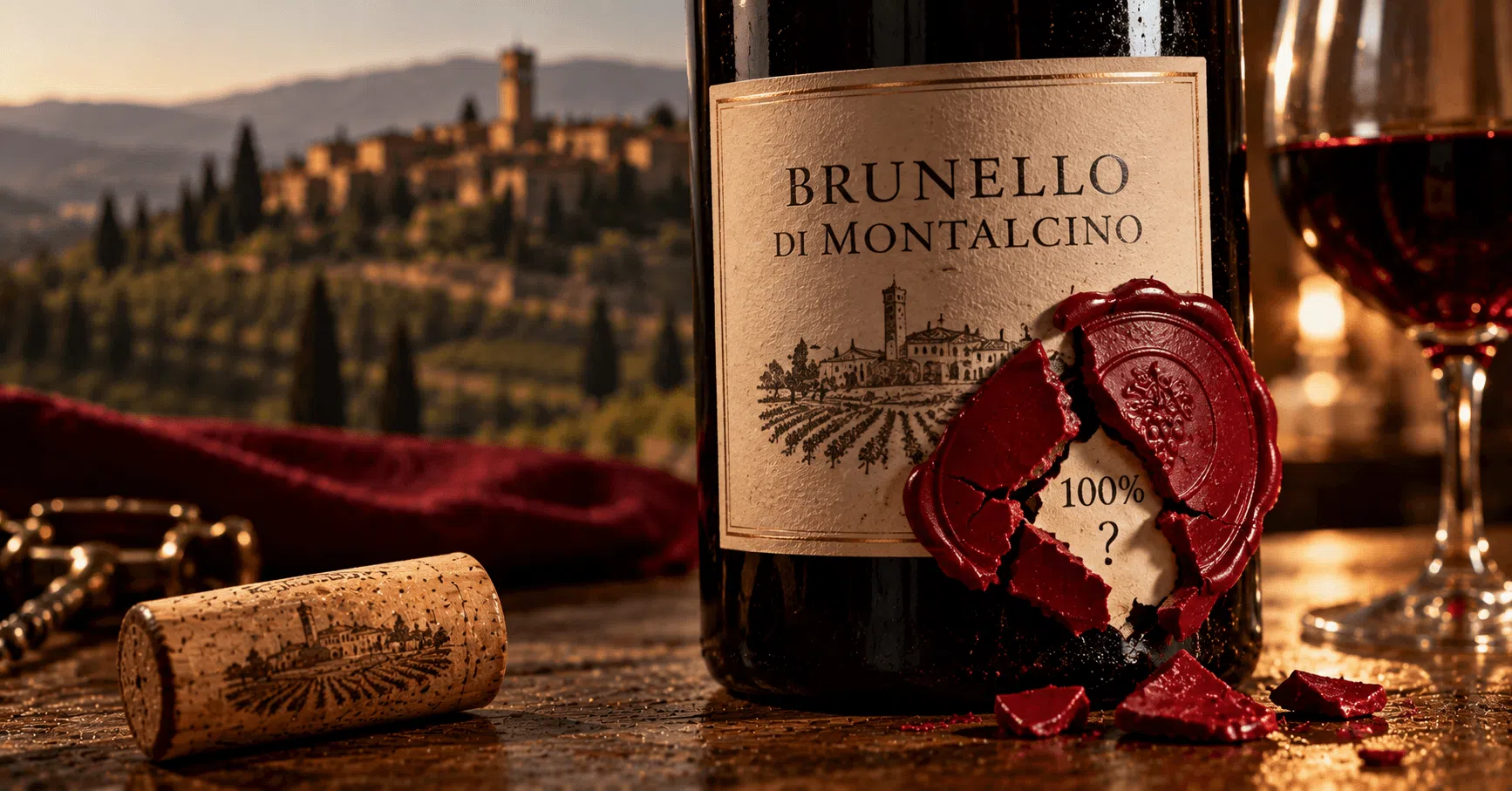
Brunello di Montalcino has exactly one rule that actually matters. The bottle has to be 100% Sangiovese. No blending, no shortcuts, no quiet exceptions for a rough vintage. It’s arguably the simplest, strictest law in Italian wine, and for decades it’s been the whole reason people trusted the name.
In 2008, an Italian wine journalist discovered that a chunk of the region had been ignoring it. Not accidentally. Not for one bad year. For years.
The story that followed involves a whistleblower, twenty suspected wineries, and millions of liters of impounded wine. There’s an American import ban threat in there too, and a nickname straight out of an Italian tabloid. It’s the messiest thing to happen to one of Italy’s proudest wines. Most people who love Brunello have never heard the full story.
Quick Facts
- In 2008, journalist Franco Ziliani exposed allegations that some Brunello di Montalcino producers were secretly blending in grapes other than Sangiovese, violating the region’s strict 100% rule
- Roughly 20 wineries came under investigation, and authorities seized or quarantined hundreds of thousands of bottles
- The US government briefly threatened to block Brunello imports that lacked lab proof of 100% Sangiovese content
- Officials permanently declassified about 20% of the 6.7 million liters of impounded wine down to basic Toscana Rosso IGT
- The Italian press nicknamed the scandal “Brunellopoli,” borrowing the “-poli” suffix Italy uses for its biggest scandals
What Actually Makes Brunello Different From Every Other Italian Red
Most Italian DOCG wines allow some flexibility. A splash of another grape here, a regional variation there. Brunello di Montalcino doesn’t. Brunello earned DOCG status in 1980, one of the very first four regions to get it. The law has required 100% Sangiovese ever since. Full stop. No “mostly.” No “basically.”
That single-grape purity is a huge part of why Brunello commands the prices it does. Collectors and critics treat it as one of Italy’s most honest expressions of Sangiovese, growing on one hillside in Tuscany with nothing hiding behind a blend. You’re paying for Sangiovese and Sangiovese alone. The bottle spelled that out as a legal promise. Which makes the next part so satisfying.
How a Journalist Blew the Whistle on an Entire Wine Region
In March 2008, wine journalist Franco Ziliani did the one thing Montalcino’s producers were apparently hoping nobody would ever bother to check. He asked what was actually in the bottle. His answer: allegedly, not just Sangiovese. Wine Spectator critic James Suckling picked up the story soon after, and that’s the exact moment a quiet regional rumor turned into an international headache.
By April, the Italian magazine L’Espresso had a number attached to the rumor. Around 20 firms under suspicion. Possibly millions of liters of wine that wasn’t what its label promised. Not a rounding error. Not one bad barrel from one confused winemaker. Millions of liters. Italian authorities quarantined vineyards. Hundreds of thousands of bottles got seized so investigators could figure out exactly what was hiding inside them.
Then, because scandals apparently love an encore, the story went international. In May 2008, the US government, Brunello’s single biggest export market, threatened to block imports that couldn’t prove 100% Sangiovese content through lab analysis. This wine had spent decades selling itself on that one number. Having an entire country’s customs office question it is about as bad as press gets.
Why Producers Were Allegedly Cutting Corners
Here’s the part that makes this more interesting than a plain fraud story: the alleged motive wasn’t pure greed dressed up as winemaking.
Pure Sangiovese, especially from Montalcino’s warm, dry hillsides, can be a tough, tannic wine in its youth. It needs years to soften. Some producers are believed to have quietly blended in small amounts of cheaper, darker grapes from southern Italy. Partly to boost yields. Partly to make young Brunello taste rounder and drink better sooner, exactly what international buyers wanted.
That’s almost the same problem Sassicaia solved a generation earlier by breaking Bolgheri’s rules in plain sight, and eventually getting its own appellation for the trouble. The difference is everything, though. Sassicaia’s producers used grapes nobody sanctioned, said so on the label, and let the market catch up to what they’d built. The Brunellopoli producers, if the allegations were true, used grapes nobody sanctioned and hid it. They kept selling the wine under a protected name that promised something else entirely.
One is innovation. The other is just lying to your customer.
What Actually Happened to the Wine, and the Winemakers
Nobody enjoys watching lawyers argue about grapes for half a decade, but that’s essentially what happened next. Of an original 17 people investigated, 11 took plea bargains rather than find out how a Siena courtroom feels about oenology. Six held their ground and went to trial, including figures tied to major names like Castelgiocondo and Argiano.
The one number that actually matters here: about 20% of 6.7 million liters of impounded Brunello got permanently declassified. Stripped of DOCG status. Sold off instead as basic Toscana Rosso IGT, the exact same lowly category Sassicaia spent decades in, for the exact opposite reason. One wine got demoted for being too honest about its ambition. This wine got demoted for lying about its ingredients. Same shelf, wildly different crimes.
Argiano’s case is the one with a fully documented ending, and it’s a clean one. Roughly 80,000 of its bottles sat impounded while the case crawled forward for five years. In 2013, a Siena court dropped every charge against the winery’s former owner, ex-CEO, and winemaker, finding no evidence to support the fraud allegations at all. Argiano didn’t quietly move on. It released its declassified wine under a new name, Il Duemilatre di Argiano, essentially turning a five-year legal nightmare into a single line on a label. If you’re going to get dragged through an investigation for nothing, you might as well bottle the receipts.
Frequently Asked Questions
Where does the name “Brunellopoli” come from? Italian journalists have a habit of tacking “-poli” onto the country’s biggest scandals, a nod back to Tangentopoli, the sprawling political bribery scandal of the early 1990s. Brunellopoli follows the same pattern. English-language wine media picked up a different nickname for the same story: Brunellogate. Same scandal, two names, depending on which side of the Atlantic you read about it first.
Is Brunello di Montalcino still trustworthy today? Yes, and there’s a specific reason why. The Consorzio responded by creating a “Board of Guarantee” that uses gas chromatography, actual lab science, to verify Sangiovese content in the wine. It was the first time an Italian wine region had leaned on scientific analysis to enforce its own rules. The producers who went through that overhaul are, if anything, more scrutinized today, not less.
Did anyone actually go to prison over this? No convictions have been made public. Eleven people accepted plea bargains rather than go to trial. Of the cases that played out fully in court, Argiano’s ended in a complete acquittal in 2013.
Why did the US get so involved in an Italian legal matter? Because the US was, and still is, Brunello’s single biggest export market. American importers had no independent way to verify Sangiovese content themselves. They relied entirely on Italy’s own certification system. The moment that system looked compromised, the US Treasury Department’s alcohol regulators threatened action of their own.
Sassicaia proved that breaking Italy’s wine rules can occasionally make you a legend. Brunellopoli proved what happens when you break them quietly instead. Same country, same rulebook, two completely different endings.
Continue Reading
- Exploring the World of Red Wine: A Journey Through Popular Varieties
- What Goes With Chianti? The Best Food and Pasta Pairings
- Fun Facts About Italian Wines
— Kelly 🍷
#ItalianWine #WineFacts #Brunello #BrunelloDiMontalcino #WineHistory
Enjoy wine without the snobbery?
Make The Finest Italian Wine one of your Preferred Sources on Google.
Add The Finest Italian Wine to Preferred SourcesDiscover more from The Finest Italian Wine
Subscribe to get the latest posts sent to your email.