Italian Wine Exports Are Falling. Asti Just Grew 35% Anyway.
If Italian sparkling wine is having a decent year while everything else struggles, there’s an obvious explanation. Prosecco. It’s always Prosecco, the bottle that conquered brunch, colonized the aperitivo hour. The one that convinced half the world that adding orange liquid to bubbles counts as a personality.
Except Prosecco is down.
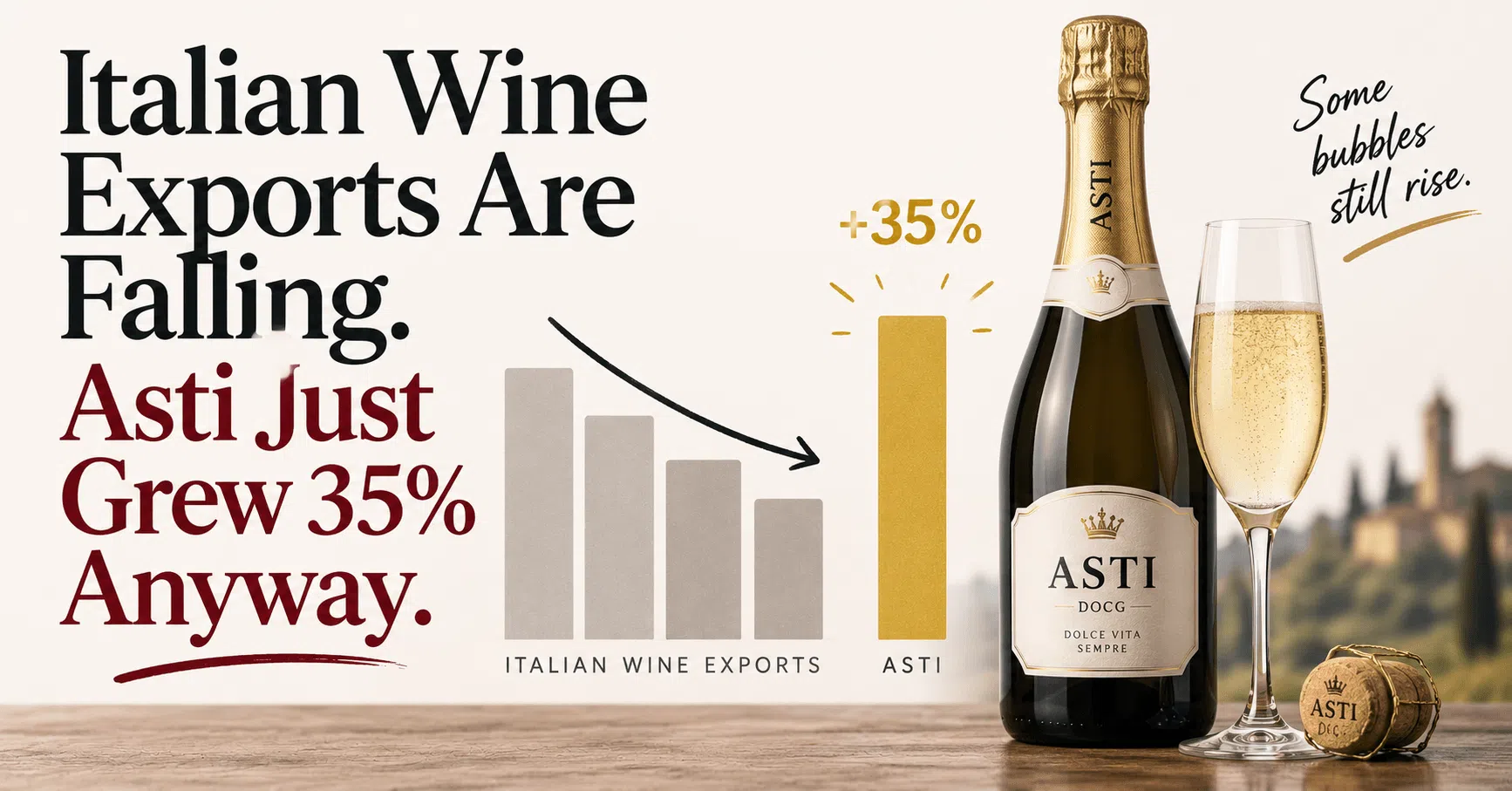
Between January and May 2026, Italy exported roughly €876 million worth of sparkling wine, essentially flat against last year. Total Italian wine exports, meanwhile, fell almost 7%. Prosecco DOP, which still makes up about three-quarters of that sparkling total, dropped 2.2%.
Sitting quietly on the other side of the ledger is Asti. Up 35%.
Asti. The sweet, low-key Italian sparkler that spent the last two decades watching Prosecco become everyone’s favorite child. Apparently it would like some attention back.
Italian Wine Is Not Having a Good Year
Between January and May, total Italian wine exports came in around €2.98 billion. That’s down 6.9% against the same period in 2025. Volumes fell too, roughly 5%, to 809 million liters. The United States, Italy’s largest export market, dropped more than 15% in value, largely tariff-driven. Germany and the UK were both down. Bottled still wine specifically fell 9.6%.
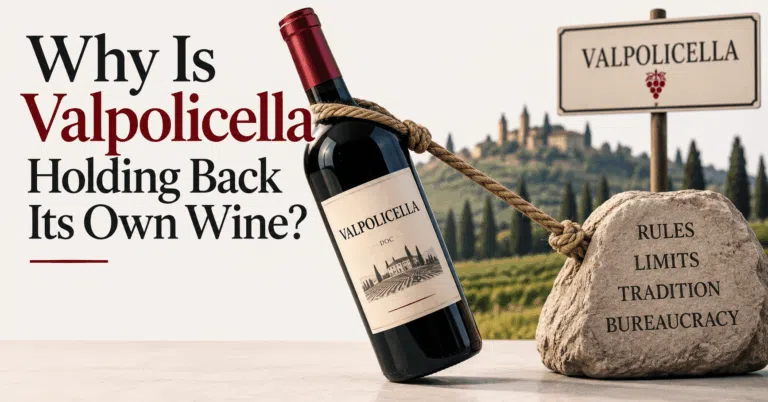
It’s not the spreadsheet you open before lunch. I’ve been here before this month: I just wrote about how Valpolicella is deliberately holding back 20% of its own 2026 harvest rather than sell into a market that can’t absorb it. Read that piece next to this one and a bigger picture starts forming. Sparkling wine, unlike red, mostly held its ground this year. That alone is worth a second look. That Prosecco wasn’t the reason it held is worth a third.
Prosecco Is Still Enormous. It’s Just Not Growing.
Let’s be clear before anyone from Veneto comes looking for me. Prosecco isn’t collapsing. At roughly €669 million in exports over five months, it’s still around 76% of Italy’s entire sparkling wine export value. If Italian sparkling were a family business, Prosecco would still own the building outright.
But its exports slipped 2.2%. Asti climbed 35%, other DOP sparkling wines edged up 0.9%, varietal sparkling gained 2.6%, and even generic sparkling rose 1.5%. The giant took a small step back. Several of the smaller siblings stepped forward. One of them considerably faster than the rest.
Wait, Asti?
There’s something genuinely funny about Asti being the interesting sparkling wine story of 2026. Asti was famous long before Prosecco was anything at all.
For decades, Asti Spumante was one of Italy’s best-known sparkling exports: fruity, aromatic, sweet, and unapologetically celebratory. Then wine fashion changed direction. Dry got sophisticated. Brut became a word everyone suddenly understood how to pronounce with confidence. Prosecco slid neatly into that new drinking culture because it asked nothing of you. No birthday required. No dessert required. No wine knowledge required. You said “Prosecco?” and somebody said yes, and that was the entire transaction.
Asti had a harder problem. It was sweet. Wine spent a solid twenty years teaching people that admitting you liked sweetness was faintly embarrassing, even from people who put three spoons of sugar in their coffee without a flicker of self-consciousness. So Asti quietly became the wine people assumed their grandparents drank.
Which makes this year’s number worth sitting with. Asti’s export value rose 35% in five months. There’s a detail underneath that makes it more interesting still. Earlier Nomisma data covering January through April showed Asti’s export volume growing only about 1%, while its value jumped nearly 20% and its average price rose 18.5%. Translation: Asti isn’t flooding the market with more bottles. It’s selling the bottles it already makes for meaningfully more money.
What If Asti Got Modern by Accident
Here’s the part I find genuinely fascinating.
For years, Asti’s defining traits read like a list of liabilities. Sweet. Intensely fruity. Unashamedly aromatic. Notably lower in alcohol than most table wine. Then the entire conversation around drinking shifted underneath it. Moderation stopped being a January resolution and became a year-round habit. Lower alcohol went from apology to selling point. “Drinking less but better” turned into an industry mantra repeated at every trade conference.
And there was Asti, sitting at a gentler alcohol level than almost anything else in the wine aisle. It looked like it had been patiently waiting for the rest of the industry to catch up.
That doesn’t prove low alcohol is driving Asti’s growth. The export numbers can’t establish causation on their own. But it raises a genuinely better question than “why is Asti suddenly popular.” Maybe Asti didn’t become fashionable. Maybe fashion just drifted back toward where Asti already was standing.
China is part of this story too. Italian wine exports to China rose about 18% in value over the same five months. That’s still a small market next to the US or Germany, but Nomisma has specifically pointed to China as a contributor to Asti’s improved numbers. That matters more than one grape’s fortunes. It suggests Italy’s next wave of export growth might not come from selling more of the same wine to the same people. It might come from different wines finding entirely different audiences.
Prosecco Hasn’t Lost. It’s Grown Up.
There’s a more generous way to read Prosecco’s 2.2% dip. Maybe expecting relentless double-digit growth forever was always going to hit a ceiling.
Look at what Prosecco already conquered. Aperitivo. Brunch. Weddings. Airport lounges. Tuesday. There are only so many occasions left to colonize. A smaller category can post 35% growth far more easily than a category already worth hundreds of millions can casually add another third on top. At some point the real question stops being how much more Prosecco Italy can sell. It becomes how much of what Prosecco already built is worth protecting. Having Asti and the smaller DOP sparklers grow alongside it isn’t necessarily bad news for Prosecco. It might be exactly what a mature category needs standing next to it.
The Bigger Pattern
Put this next to Valpolicella and the picture gets sharper. Red wine categories are broadly struggling, hence the storage measures and the yield cuts. The same conversation is happening right now in Chianti and Piedmont. Meanwhile a low-alcohol, sweet, historically unfashionable sparkling wine is growing by more than a third. Same shifting consumer. Nearly opposite outcome, depending entirely on what was already sitting in the glass.
That doesn’t mean red wine is finished, and nobody needs to start writing Barolo’s obituary. But price matters more now, alcohol content matters more, and occasion matters more. Lighter, easier styles currently have real room to move while heavier ones fight for the same shrinking attention.
Is Asti Really Making a Comeback
Maybe. I wouldn’t uncork a celebration bottle yet. Asti is growing from a far smaller base than Prosecco. One strong five-month stretch doesn’t establish a decade-long trend on its own.
What makes it worth watching is the combination. Growing while the overall category shrinks, growing in value faster than in volume, and doing it with exactly the traits, lower alcohol, approachable sweetness, easy drinking, that the rest of the industry keeps insisting today’s drinker wants. Wine has an odd relationship with fashion. Something gets declared old-fashioned for twenty years. Then the world quietly changes what it wants and discovers the thing it now wants was sitting on the shelf the entire time, mildly confused about why nobody was talking to it.
Quick Answers
Is Prosecco declining in 2026? Its export value fell 2.2% over the first five months of 2026. That’s a real dip, but Prosecco still represents roughly three-quarters of Italy’s sparkling wine export value, nowhere close to collapse.
Why is Asti growing so fast? Its export value rose 35% in the same period, driven more by higher prices than higher volume. Growing demand in markets like China and a broader shift toward lower-alcohol, approachable wine styles both appear to be contributing factors.
Is Asti sweeter than Prosecco? Generally yes. Asti is made from Moscato Bianco and known for its aromatic, distinctly sweet character. Prosecco spans several sweetness levels but is typically made and marketed as a drier wine.
Does this mean red wine is struggling more than sparkling? Broadly, yes, in export terms. Several major Italian red categories introduced supply-management measures in 2026 to match softening demand, while multiple sparkling categories, Asti most dramatically, posted real growth over the same period.
Salute.
Continue Exploring
- Why Is Valpolicella Holding Back Its Own Wine?
- Italy Has Fewer Wine Drinkers. They Got More Interesting.
- Stop Calling Prosecco “Italian Champagne” — Here’s What It Actually Is
Sources
Export figures for January–May 2026 are drawn directly from Gambero Rosso’s analysis of Istat trade data, published September 1, 2026. Overall Italian wine export totals are corroborated by WineNews’ independent analysis of the same Istat release. Earlier January–April Asti volume and pricing detail comes from Nomisma Wine Monitor reporting.
Enjoy wine without the snobbery?
Make The Finest Italian Wine one of your Preferred Sources on Google.
Add The Finest Italian Wine to Preferred SourcesDiscover more from The Finest Italian Wine
Subscribe to get the latest posts sent to your email.