Wine Jokes #10: What If Wine Labels Actually Told the Truth?
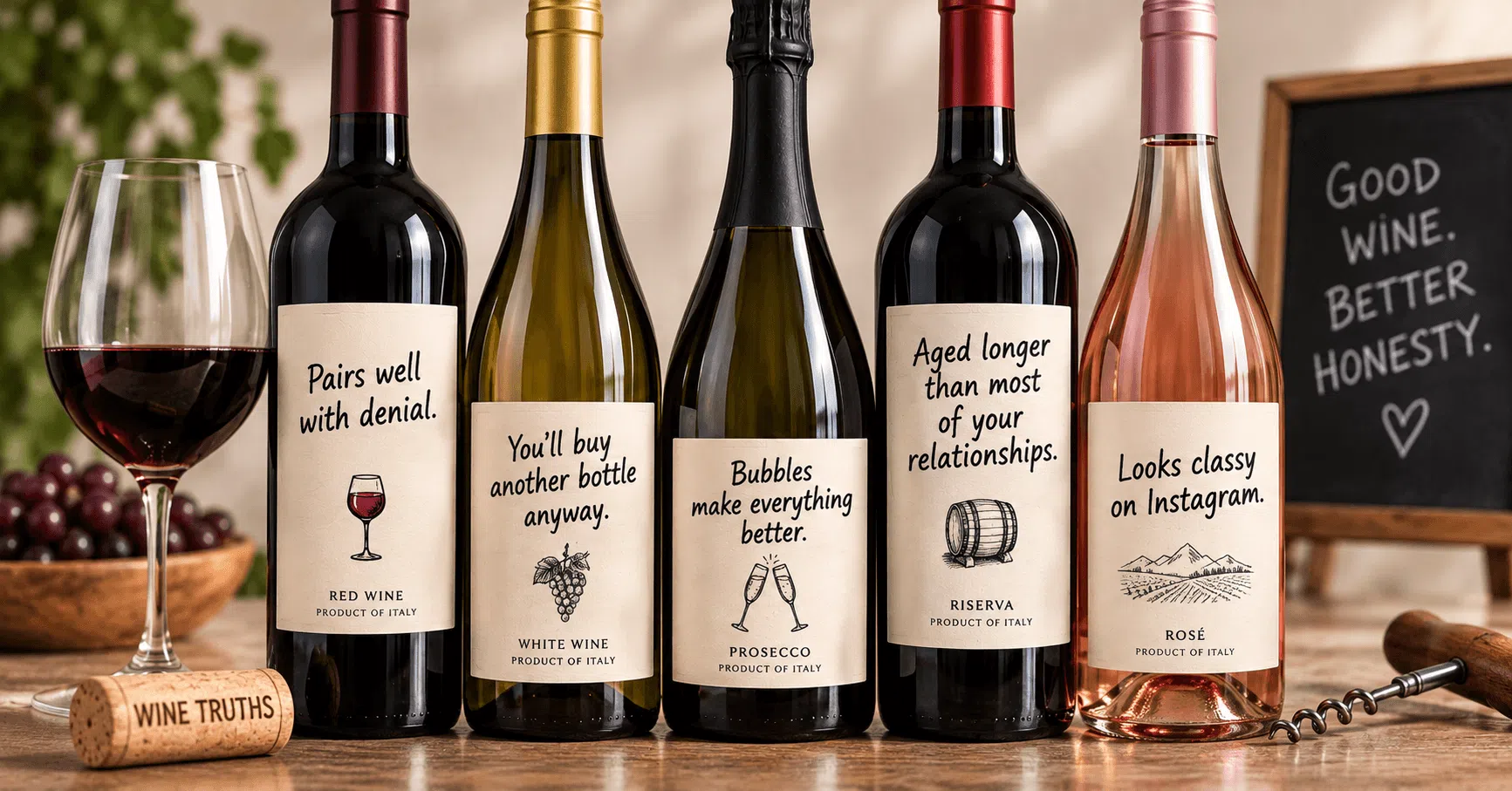
Have you ever read the back of a wine bottle and thought, did a poet write this or did someone just really need a job?
“Velvety tannins with a lingering finish of dark plum and forest floor.”
Forest floor. Someone held a glass of wine, took a sip, and thought, yes, this tastes like the ground outside. And then they got paid for it.
I’ve been drinking Italian wine long enough to know that what the label says and what the wine actually does are two very different things. So I decided to fix that. I wrote the labels that should have existed all along.
Honestly, I think I’ve found my calling.
So here they are: six funny wine labels for Italian wines that finally say what we’re all thinking.
The Wine Labels That Finally Got It Right
🍷 Casa Verità “Sopravvissuto al Lunedì” — Rosso
Veneto, Italy · 13.5% · 750ml
This wine was made for people who have already given up on the week and would now simply like everyone to stop asking them questions.
It pairs well with dinner you didn’t feel like cooking, news you didn’t want to hear, and the specific kind of evening where opening a bottle somehow feels more achievable than deciding what to watch on Netflix.
On the nose, resignation, with hints of “this was supposed to be a dry January.” On the palate, full-bodied, like a decision you made at 11pm that seemed perfectly reasonable at the time.
The finish is long. Much like the week ahead.
Contains sulphites and good intentions. Best consumed before you check your emails.
🍾 Prosecco della Scusa — Prosecco DOC Frizzante
Veneto & Friuli-Venezia Giulia, Italy · 11% · 750ml
Congratulations. You’ve opened a Prosecco. This means one of the following things has happened: someone got promoted, someone got dumped, it’s Friday, it’s not Friday but you’ve decided it is, or a friend texted “come over” and you grabbed the nearest bottle on your way out.
In any case, you made the right call.
This Prosecco is light, bright and completely committed to making the next two hours better than the last two. It does not ask questions. It does not judge. It has, in fact, never judged anyone. Not even that time you finished the whole bottle during a Tuesday night reality show and told no one.
On the nose, celebration, whether or not there is anything to celebrate. On the palate, enthusiasm. Pure, uncomplicated, infectious enthusiasm.
Contains sulphites. Does not contain regrets. Pairs with everything. Has always paired with everything. Will continue to pair with everything.
🍷 Barolo Riserva “Il Silenzio” — DOCG
Piedmont, Italy · 14.5% · 750ml · Minimum 62 months ageing
This wine does not need your approval.
It has been ageing since before you made most of your major life decisions and has somehow turned out significantly better than several of them.
Do not open this bottle unless you are ready. Ready meaning you have a decent glass, you have time, and you have at least pretended to clear your schedule. If you are planning to drink this while scrolling your phone, the wine would prefer you didn’t.
But if you do? Fine.
Barolo has survived decades of people arguing about the correct glass, decanting time and serving temperature. It can probably survive your WhatsApp notifications.
On the nose, authority, dark fruit and the quiet confidence of something that has absolutely nothing to prove. On the palate, complexity that arrives in waves, like a conversation with someone far more interesting than anyone else in the room.
The finish lasts approximately as long as it takes you to wonder whether you should have bought another bottle.
Decant if you have the patience. Don’t if you don’t. Barolo will still be Barolo tomorrow morning. You, however, may have questions.
🌿 Pinot Grigio “Non Complichiamo” — delle Venezie DOC
North-Eastern Italy · 12% · 750ml
This is not a complicated wine. That is the whole point.
You’ve had a day. You don’t need oak ageing and phenolic structure and a guided meditation through the vineyards of northern Italy. You need something cold, something easy and something that will be ready in the fridge before you’ve even finished taking your shoes off.
That is what this is. That is what this has always been.
On the nose, a crisp breeze and the complete absence of anything that requires effort. On the palate, clean, light and deeply committed to not making your evening any more complicated than it already is.
Serve cold. Very cold. Fancy glass optional. We don’t judge here. We’ve seen what you drink from at picnics.
🍷 Amarone della Valpolicella “L’Ultimo” — DOCG
Veneto, Italy · 15.5% · 750ml · Limited Production
You are not ready for this wine.
Actually, forget that. You’ve already opened it. Here we are.
This Amarone was produced from grapes that were dried for months before fermentation, a process called appassimento which, loosely translated in my head, means “we made this wine more complicated on purpose and we’re extremely pleased with ourselves.”
It is rich, powerful and demanding in ways that may make you rethink your previous understanding of what wine is supposed to feel like. It may also make you rethink whether you really needed that second glass.
On the nose, dark cherry, chocolate, spice and the specific feeling of realising you’ve been doing something wrong for years but only now understanding exactly how wrong. On the palate, everything. At once.
And that 15.5% written on the label? That’s not decoration.
Best enjoyed when you have nowhere urgent to be. If you do have somewhere urgent to be, this was a very interesting choice.
🍷 Lambrusco “Il Malinteso” — Sparkling Red
Emilia-Romagna, Italy · 11% · 750ml
Yes, this is a sparkling red wine. No, that is not a mistake.
This bottle has spent years being picked up, examined with suspicion and then put back down in favour of something safer. At this point, Lambrusco would like a word.
Lambrusco has been made in Emilia-Romagna for centuries, and generations of Italians somehow managed to enjoy fizzy red wine without holding an emergency meeting about whether fizzy red wine should exist. Maybe they were onto something.
It pairs beautifully with the sort of food Emilia-Romagna produces as if calories are somebody else’s administrative problem. Pizza, prosciutto, salumi, Parmigiano. Bring everybody.
On the nose, ripe berries, freshness and the quiet dignity of something that has been underestimated for far too long. On the palate, lively, slightly tart and just smug enough to know you’re about to admit you judged it too quickly.
Best served slightly chilled. Best served to someone who just announced, “I don’t like Lambrusco.” Pour theirs first.
Honestly Though
The funny thing is, some of these ridiculous labels might actually tell me more about what I’m about to drink than “forest floor,” “graphite” or “a whisper of dried violet.” Take Prosecco. This wine has carried weddings, birthdays, promotions, breakups, Friday nights and random Tuesdays on its back, and all we gave it was “fresh and lively with fine persistent bubbles.” After everything Prosecco has done for us?
I still want the proper information. Tell me the grape, the region and how the wine was made. Just tell me like we’re having a glass together, not sitting an exam. Give me “dark fruit, firm tannins and a persistent finish,” but maybe add: “This is 15.5%. If you have somewhere to be after dinner, behave yourself.” Now that’s useful information.
And perhaps the most honest wine label of all would simply say: “You bought me because the label was pretty. It’s okay. I won’t tell anyone.”
We’ve all done it.
A Quick Note From Me
I’m a wine enthusiast living in Italy, not a sommelier, and this article is satire. The wines, regions and winemaking references behind the jokes are real, but Casa Verità, Prosecco della Scusa, Barolo “Il Silenzio” and the other labels came entirely from my imagination.
Unfortunately.
If any Italian winery would like to make Prosecco della Scusa, however, we should probably talk.
Quick Questions
Are these real Italian wine labels?
No. I made them up, although I’m now slightly annoyed that Prosecco della Scusa doesn’t actually exist. The Italian wines behind the jokes, including Prosecco, Barolo, Amarone, Pinot Grigio and Lambrusco, are very real.
Why do wine descriptions use words like “forest floor” and “graphite”?
They’re sensory descriptions used to communicate aromas and flavours people associate with a wine. Nobody is suggesting the winemaker actually threw a handful of forest floor into the barrel. At least, I hope not.
Do Italian wine labels actually tell you useful information?
Absolutely. The producer, denomination, origin, alcohol level and other details can tell you quite a lot about what’s inside the bottle. The problem isn’t that wine labels tell us too much. Sometimes they just need translating from Wine Person into Normal Human.
Continue Exploring
- How to read wine labels: Part one – common features on wine labels
- How to read wine labels: Part two – piecing the clues together
- Decoding the Italian Wine Label: What DOCG, DOC, and IGT Actually Mean
- Classico, Riserva, Superiore: What They Really Mean on a Wine Label
Enjoy wine without the snobbery?
Make The Finest Italian Wine one of your Preferred Sources on Google.
Add The Finest Italian Wine to Preferred SourcesDiscover more from The Finest Italian Wine
Subscribe to get the latest posts sent to your email.