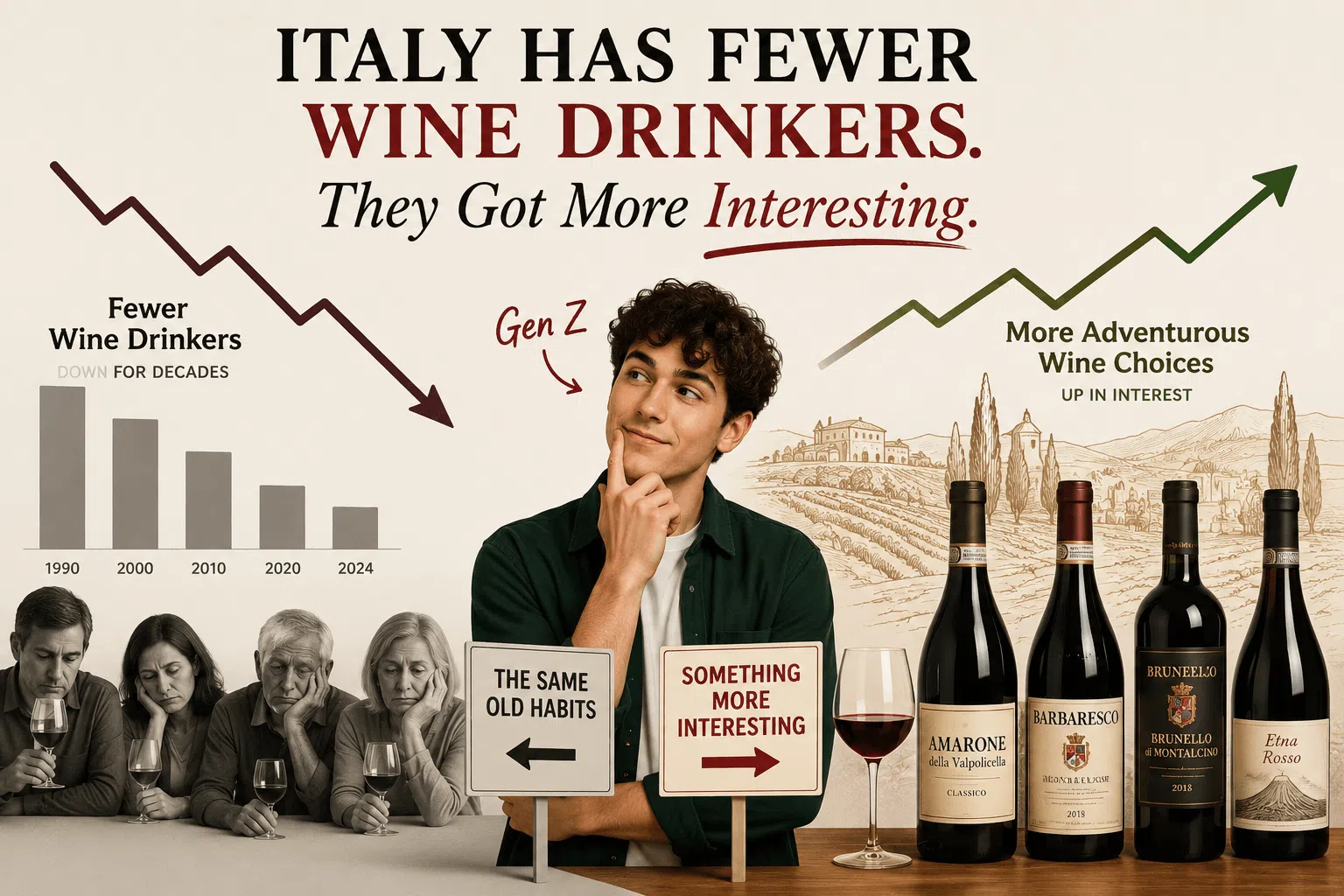
Italy Has Fewer Wine Drinkers. They Got More Interesting.
In the early 1900s, the average Italian drank about 128 liters of wine a year. Today, that number sits around 26.
Read that as a decline, and you’d be right. Read it as the whole story, and you’d be missing the genuinely interesting part.
The Decline Is Real. It’s Also a Century Old.
This isn’t a sudden 2026 crisis. Italian per-capita wine consumption has been sliding since the 1970s. That’s long before anyone was talking about mindful drinking or Dry January. The most recent ISTAT data puts the share of Italians who drink wine at all at 54.1% in 2025, down slightly from 54.7% the year before.
Wine simply stopped being what it used to be. It was once a daily staple poured at every meal, treated more like a food group than a beverage. That role is mostly gone, and it isn’t coming back.
Here’s the Part Almost Nobody Reports
The Unione Italiana Vini’s Vinitaly Observatory found something that flips the usual “young people don’t drink anymore” narrative on its head.
Twenty years ago, Italian wine drinkers split roughly the opposite way they do now. Most drank daily; a minority drank only occasionally. Today that’s reversed: 61% occasional, 39% daily. Fewer Italians drink wine regularly. But the ones who remain in the category are, on average, more deliberate about it.
And the generational story is the real surprise. Gen Z isn’t abandoning wine. They’re the one age group genuinely growing as a share of Italy’s wine-drinking population, even though they’re a smaller generation overall. What they’re drinking is where it gets unexpected. Prosecco remains the favorite of Boomers, Gen X, and Millennials. The youngest drinkers are gravitating toward serious, structured reds instead: Amarone della Valpolicella, Barbaresco, Taurasi, Bolgheri, and Chianti among them.
I’ve started noticing it myself around Padova. Order Amarone at a bar these days and increasingly the person doing the ordering next to you is twenty-three, not fifty-five. Their nonno would be delighted. Their Prosecco-loving parents are mildly baffled.
Fewer Bottles, More Meaning
Every recent industry report converges on the same phrase, worded slightly differently each time: drinking less, choosing better.
NielsenIQ’s most recent WiNeIQ analysis found that nine out of ten Italians visited a bar, restaurant, or wine bar in the past three months. That’s a genuinely high number, higher than most other major European countries. It’s not a population that’s disengaged from wine culture. It’s a population going out less often for casual, everyday drinking, and choosing more deliberate moments to actually pay attention when they do.
It’s worth being honest about the flip side of that shift, too. Recent industry data shows Italy’s wine shops and wine bars saw sales value drop in 2025, alongside softer restaurant and bar spending overall. That’s a sign “choosing better” is happening against a backdrop of real economic caution, not simply evolving taste. Italians aren’t necessarily spending more on wine overall. They’re being pickier about where the spending goes.
Why This Matters More Than a Single Bad Year
A country’s relationship with wine can look completely different depending on which number you’re staring at. Total consumption: down, and has been for decades. Number of people who drink wine at all: essentially stable over the last five years, and up slightly since 2011. Who’s driving new interest: not the generation everyone assumed.
None of this is Italy losing interest in wine. It’s Italy’s relationship with wine finishing a transition that’s been underway since before most Gen Z drinkers were born. Wine went from a daily habit to a deliberate choice.
That shift shows up everywhere once you know to look for it. It’s the same instinct behind Bolgheri producers building a wine nobody in Chianti’s rulebook accounted for. It’s the same instinct behind Piedmont quietly perfecting a sparkling wine most people have never heard of instead of chasing Prosecco’s volume. Italian wine has a long, consistent habit of getting more interesting exactly when it stops trying to please everyone at once.
Somewhere in this data, a bottle of Prosecco is quietly having an identity crisis.
The Reveal That Gets Stranger the More You Zoom Out
Here’s what makes this genuinely odd, not just contrarian. Most current Gen Z wine research out of the US and UK points in the opposite direction entirely: lighter styles, lower alcohol, natural wines, reds served slightly chilled. That’s the dominant global story right now, backed by IWSR and NielsenIQ data alike.
Italy’s youngest drinkers are apparently doing the opposite of their global peers, not just the opposite of what everyone assumed about their own generation.
I have a theory, and I want to be honest that it’s a theory, not a fact the data proves outright. In Bordeaux or Napa, reaching for a serious, structured red often reads as reaching upward, toward status, toward something aspirational. In Italy, Chianti and Amarone aren’t imported prestige. They’re the wine from two towns over. The bottle an uncle argued about at Sunday lunch. For a young Italian drinker, picking it up isn’t reaching upward. It’s reaching sideways, toward something that was already theirs.
If that’s right, the generation everyone assumes is running from tradition everywhere else might be running straight into it here. Not because of a wine trend. Because of what it means to be Italian.
Quick Answers
Are Italians really drinking less wine? Yes. Per-capita consumption has fallen from roughly 128 liters a year in the early 1900s to about 26 today, and the decline has been steady since the 1970s. It isn’t a recent trend.
Do young Italians not drink wine anymore? That’s a myth the data doesn’t support. Gen Z is the only age group growing as a share of Italy’s wine-drinking population, even though they’re a smaller generation numerically. They favor serious reds like Amarone, Barbaresco, and Chianti over lighter, more casual styles.
Are Italian wine bars actually growing? Not straightforwardly. Visitation stays very high, with nine in ten Italians visiting a bar, restaurant, or wine bar in the past three months. But recent sales data shows the wine bar and wine shop channel’s value declined in 2025, reflecting tighter household spending alongside the cultural shift toward quality over quantity.
What does this mean for Italian wine going forward? Less volume, more intention. Producers making distinctive, well-made wine in smaller quantities are better positioned than those competing purely on price or familiarity.
Continue Exploring
- How a “Table Wine” Became One of Italy’s Most Expensive Bottles
- The Italian Sparkling Wine That Isn’t Trying to Be Prosecco
- The Complete Guide to Chianti, Tuscany’s Most Misunderstood Wine
- More Wine History
Enjoy wine without the snobbery?
Make The Finest Italian Wine one of your Preferred Sources on Google.
Add The Finest Italian Wine to Preferred SourcesDiscover more from The Finest Italian Wine
Subscribe to get the latest posts sent to your email.