These Wine Laws Actually Exist. We’re Serious.
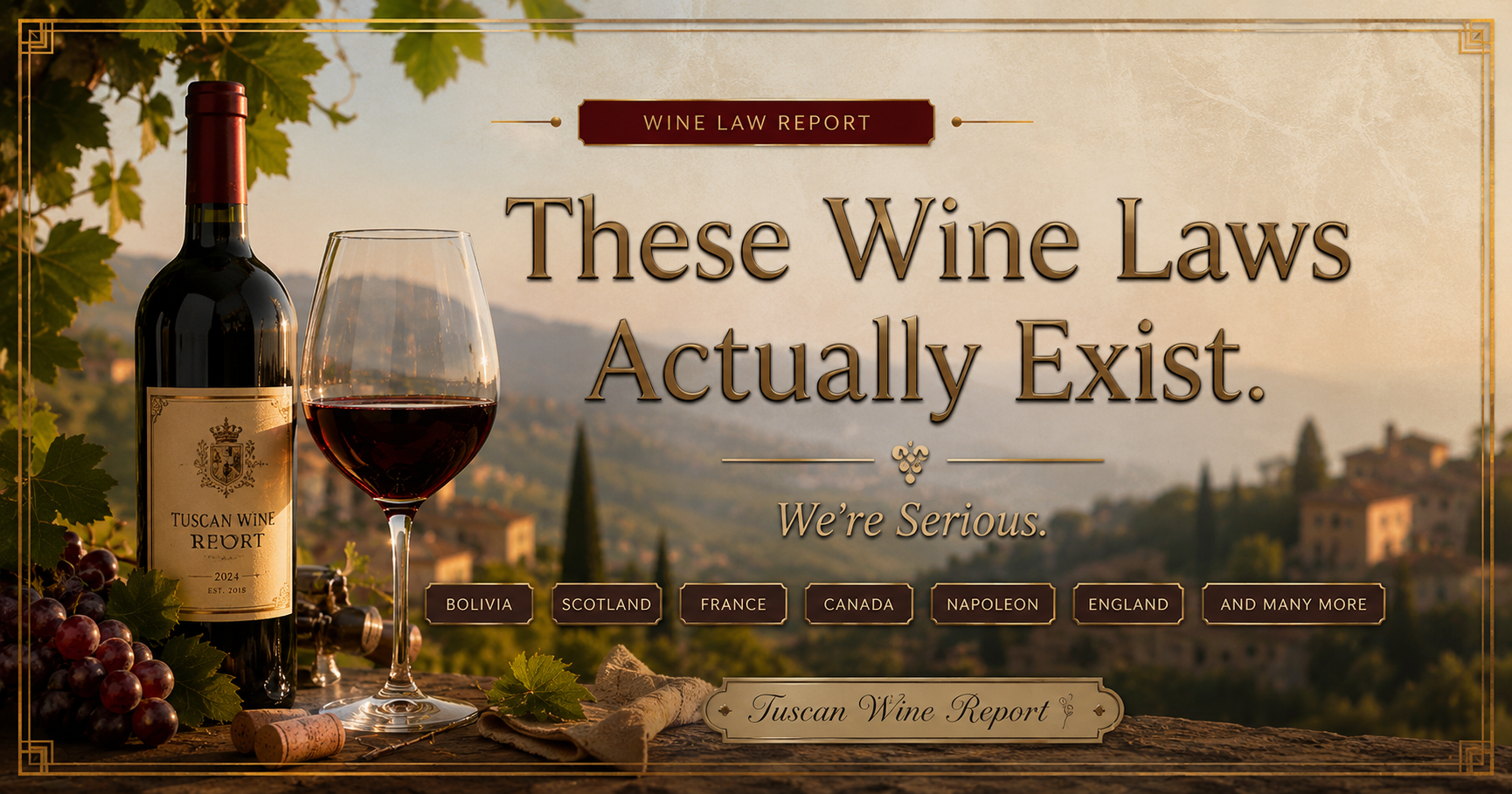
Think drinking wine is simple? Think again. From Napoleon’s grave to a Scottish cow field, these are the world’s strangest wine and alcohol laws — and some of them are still very much in effect.
Here’s something nobody tells you when you uncork a bottle of wine.
Somewhere in the world, at this very moment, someone is technically breaking the law by doing exactly what you’re doing. Not because they’re drunk. Not because they’re driving. But because of a law so absurd, so spectacularly unnecessary, that you’ll question everything you thought you knew about civilization.
Wine has been around for over 8,000 years. And for almost as long, governments have been trying — with wildly mixed results — to regulate, restrict, and occasionally ruin it.
This is their story. Pour yourself a glass. You’ve earned it.
1. Bolivia: One Glass, Ladies. The Government Is Watching.
We start in South America, where someone in La Paz, Bolivia once looked at a glass of wine and thought: “You know what? Two glasses is a moral crisis waiting to happen.”
Under a law still technically on the books today, married women in La Paz are legally permitted to drink just one glass of wine in a public bar or restaurant.
The statute — written with the kind of breathtaking confidence only history’s worst ideas possess — declares that drinking more makes a woman “morally and sexually lax.”
And the punishment? Her husband can legally divorce her for over-indulging.
Let that sink in. A second glass of Malbec. Grounds for divorce.
Now, in practice, this law is rarely enforced. But rarely is doing a lot of heavy lifting in that sentence.
The fact that it exists at all is a testament to the spectacular audacity of lawmakers throughout history — and a very good reason why Bolivian women deserve not just a second glass, but the whole bottle and a formal apology.
2. Scotland: Step Away From the Cow, Sir.
Scotland in 1872 was, by all accounts, a place where things got out of hand.
How do we know? Because that year, the Scottish government passed the Licensing Act of 1872, which among its many provisions, made it explicitly illegal to ride a cow, horse, or steam engine while drunk.
A cow. They specified a cow.
We can forgive the horse — drunk horseback riding is genuinely dangerous. But the fact that someone in Victorian Scotland had to sit down, dip their quill in ink, and write the words “also, the cow” tells you everything you need to know about what was happening in the pubs of Edinburgh on a Saturday night.
And the steam engine clause? That one haunts us. What happened? Who was involved? How many times did it happen before a law became necessary?
We may never know. But this law is still technically in force today.
So the next time you’re in Scotland enjoying a gorgeous glass of Barolo — and we strongly recommend you do — resist the urge to mount any livestock on the way home. The law is watching.
3. France: Wine at Work? The Government Says Go Ahead.
Now, a palate cleanser. A law so glorious it almost makes up for all the others.
For most of modern French history, employees were legally permitted to drink beer, wine, and cider in the workplace — provided they weren’t drunk and could still do their jobs. It was only in 2014 that French employers were finally granted the right to officially ban alcohol at work. But here’s the magnificent catch:
Unless a boss specifically prohibits it, the old law still applies.
Right now. Today. In 2026. Somewhere in France, a perfectly respectable office worker is pouring a glass of Sancerre at their desk, and it is entirely, beautifully, 100% legal.
The French gave us champagne, coq au vin, and the concept of the lunch break lasting three hours. Of course they also gave us the legal right to drink wine while answering emails. This is not a surprise. This is destiny.
Meanwhile, the rest of us are stress-eating biscuits over our keyboards and calling it self-care.
4. Napoleon’s Wine Tax: He Lost the War. The Tax Won.
Here is a story about a man who conquered most of Europe, redrew the map of the Western world, and eventually died in exile on a remote island in the South Atlantic.
His wine tax outlived him.
Napoleon Bonaparte, in his infinite ambition, created a law requiring French winemakers to give 1% of their wine to the state each year to supply his armies. The Napoleonic Wars ended. The empire fell. Napoleon was defeated at Waterloo, exiled to Saint Helena, and died in 1821.
The wine tax did not care.
Today, French winemakers are still legally required to hand over the equivalent in grape skins, pips, and pulp left after pressing — a direct descendant of Napoleon’s original decree. It has survived two centuries, multiple republics, two world wars, and the invention of the internet.
You can stop Napoleon. Apparently, you cannot stop his paperwork.
5. Canada: Your Wine Has a Passport. Use It Correctly.
Canada is widely known for being polite, reasonable, and exceptionally fair-minded. And then you look at the interprovincial wine laws and everything falls apart.
In Newfoundland, you can only bring back 1.14 liters of wine from another province for personal use. Wine ordered online from other provinces can be confiscated.
In Quebec, wine cannot be shipped to you at all — though you can personally carry up to nine liters back from a trip if you physically transport it yourself. And in Alberta, you can bring back as much wine as you want — but it must remain with you personally at all times. No gifting. No shipping. No mailing a Merlot to your mother.
Your wine, in Canada, essentially needs its own travel itinerary.
The good news is that Canadian wine is actually excellent and getting better every year — so you may not need to import anything at all. The bad news is that if you do, the regulations read like a tax form written by someone who really, really doesn’t trust you.
6. England: Being Drunk in a Pub Is Technically Illegal
And we save the finest contradiction in all of human lawmaking for last.
Under the Licensing Act of 1872 — yes, the same year Scotland was worrying about cows — it is technically illegal to be drunk on licensed premises in England. Licensed premises meaning, specifically, a pub.
The pub. The place built for drinking. The cornerstone of British culture. The institution that has shaped English social life for over 400 years. The place where people go, deliberately and enthusiastically, to drink alcohol.
Being drunk there is against the law.
If this law were ever seriously enforced, the entire country would collapse within 48 hours. The economy would freeze. Parliament would empty. The Premier League would grind to a halt. So it isn’t enforced. But it sits there, on the books, magnificent in its absurdity, a monument to the great British tradition of passing laws and then collectively agreeing never to think about them again.
God save the King. And God save the pint.
The Takeaway? Wine Has Always Been Complicated.
Eight thousand years of winemaking. Countless civilizations built on vineyards. And still — still — we can’t agree on how many glasses a married woman in La Paz is allowed to have, whether the Edinburg office cow is safe on a Friday night, or exactly how many litres of Pinot Noir a Canadian is allowed to carry across a provincial border.
Wine isn’t just a drink. It’s a mirror of humanity — beautiful, complex, and occasionally baffling beyond all reasonable explanation.
Next time you open a bottle of your favourite Italian wine, pour with confidence. Because compared to the legal landscape we’ve just walked you through?
You’re living your best, most law-abiding life.
Cheers. 🍷
👉 This Is Only Part One.
We’re heading to the United States for Part 2 — and America, bless its heart, has taken wine legislation to a whole new level. Teacups. Sexy labels. Permission slips from your wife. It only gets better from here.
[Read Part 2: America’s Craziest Wine Laws →]
And coming very soon — our Celebrity Wineries series returns. A rock legend. A 900-acre Tuscan estate. Wines named after his biggest hits. Stay close.
Enjoy wine without the snobbery?
Make The Finest Italian Wine one of your Preferred Sources on Google.
Add The Finest Italian Wine to Preferred SourcesDiscover more from The Finest Italian Wine
Subscribe to get the latest posts sent to your email.