How a “Table Wine” Became One of Italy’s Most Expensive Bottles
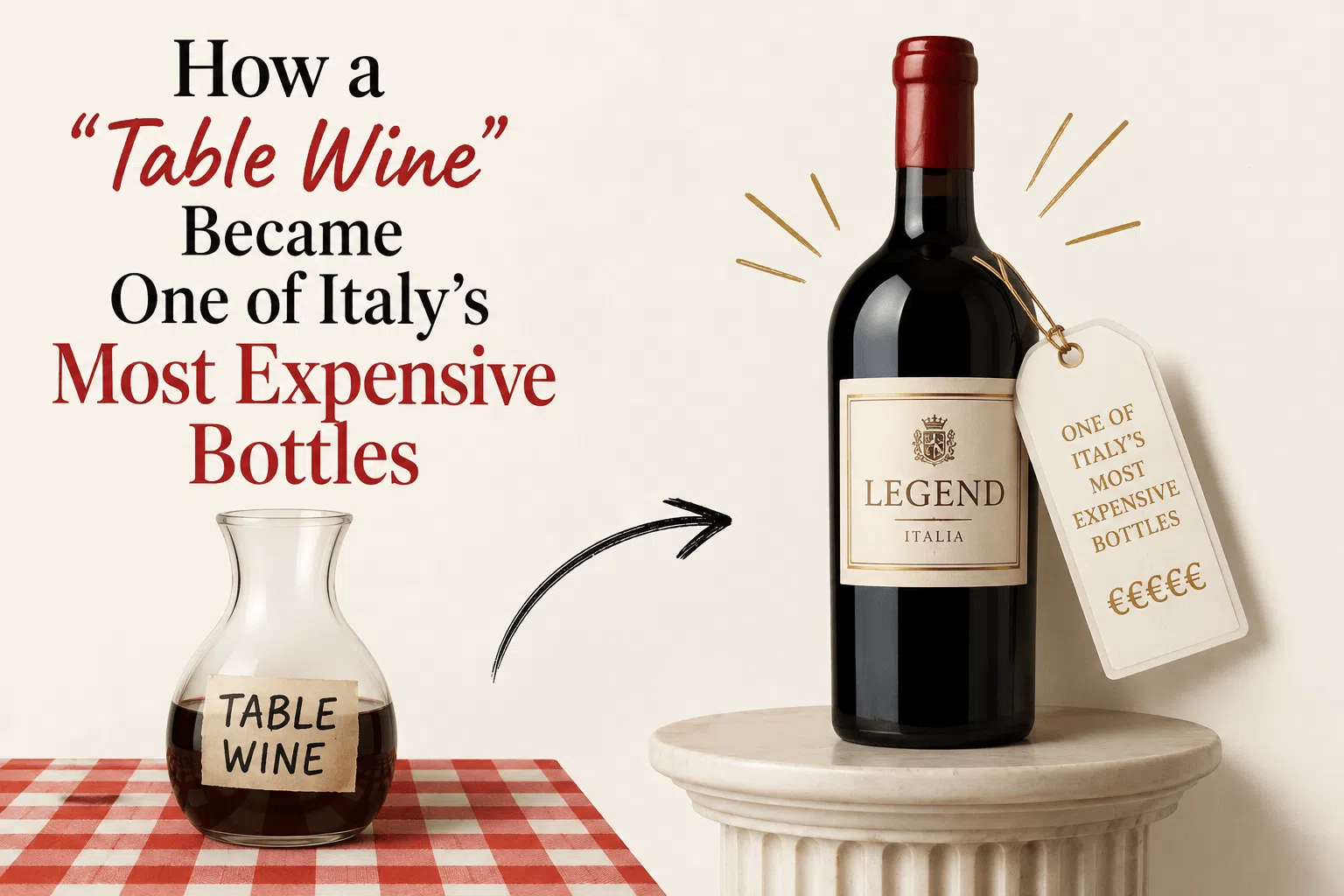
A bottle of Sassicaia will run you several hundred euros today. Sometimes considerably more.
In 1971, Italian law considered it exactly the same grade as jug wine on a Tuscan kitchen table.
Not because it tasted bad.
Because of paperwork.
The wine simply didn’t follow enough rules to earn anything better than Vino da Tavola — table wine, Italy’s lowest classification, the box reserved for whatever didn’t qualify for a real name.
Then it walked into a blind tasting in London.
And beat some of Bordeaux’s most famous names.
The label didn’t change overnight. But nobody serious about wine looked at Italy quite the same way again.
Tuscany Had a Rulebook, and Everyone Followed It
Chianti meant Sangiovese, grown a certain way, in a certain place, under a formula written into law. That’s what DOC and DOCG classifications exist for. I’ve gone into the full system of DOCG, DOC, and IGT before, but the short version holds up here: the tighter the rules, the more official the wine.
For most of the 20th century, that formula wasn’t optional. Producers who wanted the region’s name on their label followed the region’s rules, full stop.
Then One Marchese Planted the Wrong Grape
Marchese Mario Incisa della Rocchetta wasn’t trying to start a rebellion. He just liked Bordeaux.
In the 1940s, he planted Cabernet Sauvignon on his estate at Bolgheri, on Tuscany’s coast. The gravelly, sun-baked land reminded him of France’s Graves region. He wasn’t chasing fame. For over twenty years, the wine stayed private, poured only for family and friends, never sold to anyone.
That wine was Sassicaia. It had a problem baked in from the start: Cabernet Sauvignon wasn’t a grape Tuscan classification law had any category for. When the family finally released it commercially in 1971, there was no DOC it could legally claim. It went to market as Vino da Tavola, the same designation as everyday jug wine. Italian wine law simply had no better box to put it in.
Tignanello Joined the Rebellion a Few Years Later
Sassicaia wasn’t alone for long. In 1971, the Antinori family released the first vintage of Tignanello, grown inside the official Chianti Classico zone but breaking its rules anyway. It dropped the white grapes Chianti’s formula required. It aged Sangiovese alongside Cabernet in French oak barriques, a technique nobody in the zone was using at the time.
Same result: technically inside Chianti Classico’s borders, legally forbidden from calling itself Chianti Classico. Another serious, deliberate wine shoved into the same bargain-bin label as Sassicaia.
“Table Wine” Was Never a Verdict on Quality
Here’s the part that trips people up.
Vino da Tavola never meant the wine tasted cheap. It meant the wine didn’t fit the paperwork.
Italy has a real gift for wrapping brilliant things in extremely serious paperwork — ask anyone who’s ever tried to register a car here.
Wine classification runs on the same instinct. It measures how closely a wine follows its region’s rules. Not how good it tastes.
A wine can break every rule in the book and still be extraordinary. It just doesn’t get to wear the fancy label while doing it.
Sassicaia and Tignanello were extraordinary wines wearing the same classification as bulk plonk. Italian law simply hadn’t built a category yet for “brilliant, but not what we expected.”
The Tasting That Made the Absurdity Impossible to Ignore
In 1978, Decanter magazine organized a blind tasting in London, judged by heavyweight critics including Hugh Johnson. Thirty-three Cabernet-based wines went into the lineup, most of them from Bordeaux.
The 1972 Sassicaia came out on top. Still, on paper, labeled as Italy’s cheapest, most generic wine category, while every serious palate in the room ranked it above the competition.
That’s the moment the wine world had to sit with an uncomfortable fact. Its own classification system had just been publicly outsmarted by a bottle it had refused to take seriously.
Italy Eventually Admitted the System Had a Gap
The change didn’t happen in one dramatic legal reversal. It built slowly. More producers followed Sassicaia and Tignanello’s lead, and more critics started asking why Italy’s most talked-about new wines were stuck in its lowest tier.
In 1992, Italy created Toscana IGT, a new middle category built specifically for ambitious, boundary-breaking wines. It gave them somewhere respectable to live without forcing them into a formula they’d never follow. Two years later, in 1994, Sassicaia went further still and earned Bolgheri Sassicaia DOC. It’s an appellation built around a single producer, which remains a genuine rarity in Italian wine law to this day.
Are the Rebels Still Rebels?
Sassicaia broke the rules so thoroughly that it eventually got handed a rulebook of its own.
A one-producer DOC is about as establishment as Italian wine law gets. Strange fate for a wine that started out too disobedient to earn a real name at all.
Today, a bottle of Sassicaia routinely costs more than plenty of DOCG wines that followed every rule Chianti ever wrote. The rebellion won so completely it quietly became the establishment.
Once a system builds an entire category around accommodating you, are you still breaking the rules? Or did you just get promoted to writing the next ones?
Quick Answers
What is a Super Tuscan? A Tuscan wine made outside traditional DOC/DOCG rules, typically using non-native grapes like Cabernet Sauvignon or Merlot, often blended with or instead of Sangiovese. The term describes a style, not an official classification.
Why was Sassicaia originally labeled Vino da Tavola? Because Italian wine law at the time had no classification for a Bolgheri wine made from Cabernet Sauvignon. It defaulted to the lowest tier by process of elimination, not by any judgment on quality.
What’s the difference between Sassicaia and Tignanello? Sassicaia is made almost entirely from Cabernet Sauvignon and Cabernet Franc, from Bolgheri on the Tuscan coast. Tignanello blends Sangiovese with Cabernet, from within the Chianti Classico zone itself.
Are Super Tuscans always expensive? Not all of them, but the pioneers command serious prices today, driven by decades of critical acclaim and Bolgheri Sassicaia’s DOC status specifically. Plenty of newer, less famous Super Tuscan-style wines stay considerably more affordable.
Continue Exploring
- Decoding the Italian Wine Label: What DOCG, DOC, and IGT Actually Mean
- More Wine History
- More From the Blog
Enjoy wine without the snobbery?
Make The Finest Italian Wine one of your Preferred Sources on Google.
Add The Finest Italian Wine to Preferred SourcesDiscover more from The Finest Italian Wine
Subscribe to get the latest posts sent to your email.