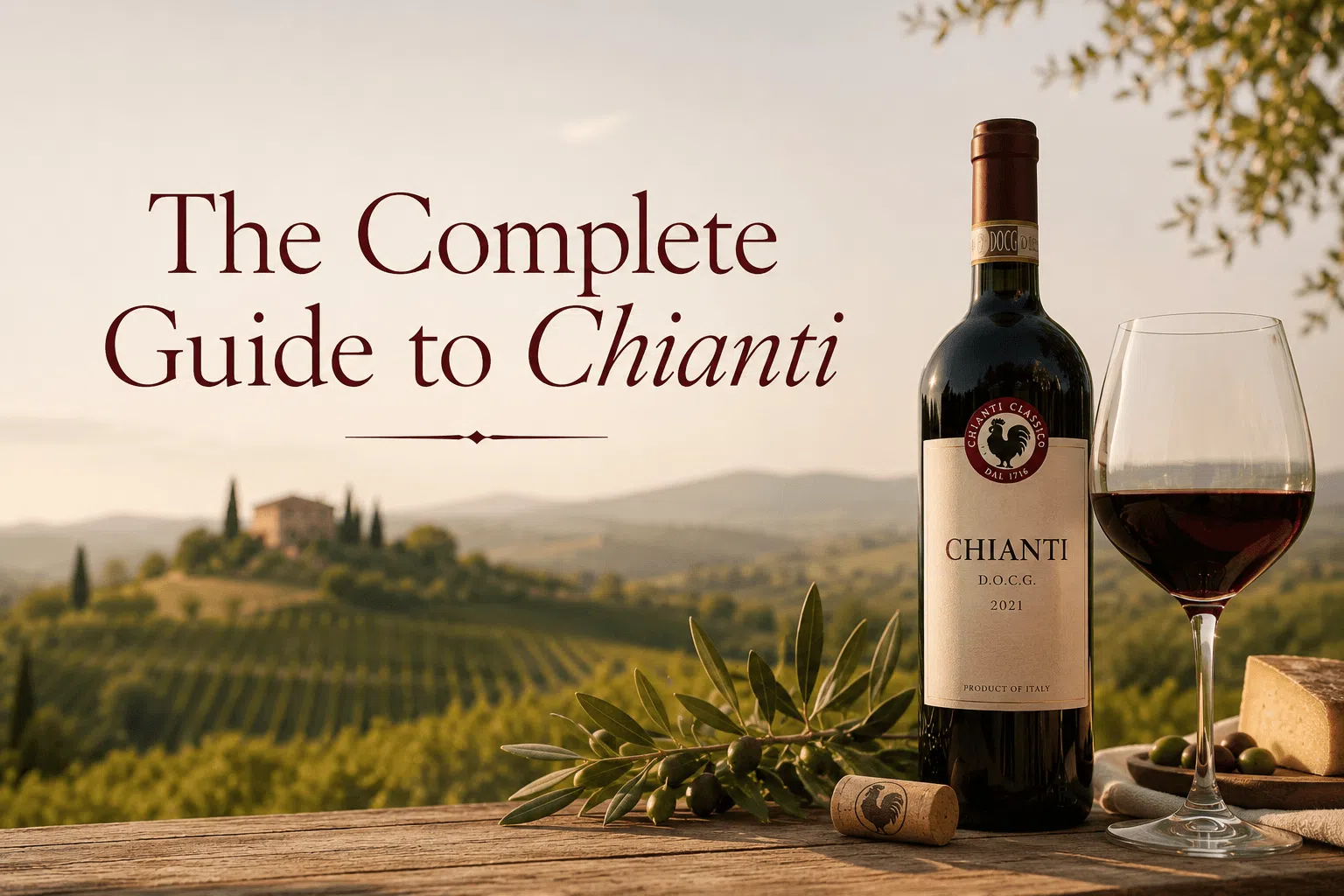
The Complete Guide to Chianti — Tuscany’s Most Misunderstood Wine
Quick Guide — Chianti Wine
- Where: Tuscany, between Florence and Siena — Chianti Classico is the original, smaller, stricter zone at the historic heart of it
- The grape: Sangiovese, minimum 70-80% depending on classification
- Key symbol: The Gallo Nero (black rooster), exclusive to Chianti Classico DOCG
- Classification tiers: Chianti DOCG (broad, everyday), Chianti Classico DOCG (the real deal), Riserva, and Gran Selezione (the top tier)
- Best for: Tomato-based pasta, roasted meats, and anyone who thinks they already know Chianti from a straw-covered bottle in a 1980s restaurant
Here’s a story that sounds made up but genuinely isn’t.
Sometime in the 13th century, Florence and Siena were locked in one of their endless territorial disputes, this time over the Chianti hills sitting between them. Rather than fight it out indefinitely, the two cities agreed to settle it with a horse race. At the sound of a rooster crowing at dawn, one rider from each city would set off toward the other, and wherever the two riders met would become the new border.
Siena, apparently keen to get a head start, picked a white rooster and fed it well the night before, hoping a well-rested bird would crow right on schedule at sunrise.
Florence had a different idea. They chose a black rooster and starved it half to death.
A hungry rooster, it turns out, crows in the dark, long before dawn, the moment it senses the faintest hint of light. Florence’s rider set off hours before Siena’s competitor had even woken up, and by the time the Sienese horseman finally got moving, the two riders met just a few kilometres outside Siena’s own city walls. Florence won almost the entire Chianti territory on the back of one very hungry bird.
That black rooster — the Gallo Nero — has been the symbol of Chianti Classico ever since. Whether the story is entirely true or has picked up a bit of decoration over seven centuries of retelling, it’s the story every Chianti producer will tell you with a completely straight face, and it’s a far better introduction to this region than anything you’ll find printed on a bottle.
Now let’s actually talk about the wine, because there’s a genuinely good chance you don’t know it as well as you think you do.
What Is the Difference Between Chianti and Chianti Classico?
This is the single most important thing to understand about this wine, and it trips up more people than almost anything else in Italian wine labelling.
Chianti DOCG is the broad, larger zone — covering a wide stretch of central Tuscany, producing an enormous volume of wine every year, much of it simple, affordable, and entirely pleasant without being particularly memorable. This is very likely the Chianti most people have actually had. Easy-drinking, reliable, the sort of bottle you grab without thinking too hard about it.
Chianti Classico DOCG is something else entirely. This is the original, historic heart of the region — the actual hills between Florence and Siena that were fought over in that rooster story — legally defined all the way back in 1716 by Cosimo III de’ Medici, Grand Duke of Tuscany. That date matters more than it might sound like it should. Cosimo’s decree predates France’s entire Appellation d’Origine Contrôlée system by roughly two centuries. Long before the French formalised the idea of protecting a wine region by law, the Medici had already done it.
Chianti Classico carries the Gallo Nero seal, follows stricter rules, requires a higher minimum percentage of Sangiovese, and comes from a smaller, more clearly defined zone with genuinely superior terroir — higher altitude, dramatic day-to-night temperature swings, and soil that Sangiovese seems to have been specifically designed for. It’s not a fancier version of the same wine. It’s a different, more serious wine that happens to share a name with something far more casual.
If a bottle just says “Chianti,” you’re most likely getting the everyday version. If it says “Chianti Classico” and carries that black rooster on the neck of the bottle, you’re getting the real thing.
What Grape Is Chianti Made From?
Sangiovese, almost entirely, and the story of how that became the rule is worth knowing.
For most of the 1700s, Chianti was made purely from Sangiovese alone — a grape sensitive enough to its surroundings that it changes character noticeably depending on exactly where it’s grown, which is part of why the region eventually became so obsessed with defining precise boundaries. Then in the 19th century, a Tuscan nobleman named Baron Bettino Ricasoli decided the wine needed a formula, and came up with a blend that would define Chianti for the next century and a half: roughly 70% Sangiovese, 15% Canaiolo Nero, 10% Malvasia Bianca Lunga, and a small remainder of other grapes.
That formula — white grapes and all — became the standard recipe for Chianti for generations, which explains a detail that surprises almost everyone the first time they hear it: for a long stretch of its history, Chianti actually included white wine grapes blended directly into a red wine. It sounds almost heretical by modern standards, and eventually the rules changed to phase white grapes out of Chianti Classico specifically, leaving Sangiovese to properly lead the wine on its own.
Today, Chianti DOCG requires a minimum of 70% Sangiovese. Chianti Classico DOCG requires a minimum of 80%, with the remainder typically made up of Canaiolo, Colorino, or in some more modern interpretations, international grapes like Cabernet Sauvignon or Merlot added for extra fruit and structure.
Sangiovese itself is worth understanding a little, because it’s genuinely one of Italy’s great grapes and gets less international credit than it deserves. Its calling card is bright, mouth-watering acidity, a translucent ruby colour that never quite goes fully opaque no matter how ripe the fruit, and flavours built around red and black cherry, sometimes dried herbs, sometimes a faint earthiness that Tuscans will tell you tastes like the actual soil it grew in. Whether or not you believe wine can taste like dirt in a good way, there’s something to that description once you’ve had enough of it.
What Do Annata, Riserva, and Gran Selezione Actually Mean?
Once you’re in Chianti Classico territory specifically, there are three tiers worth knowing, and I promise this is less complicated than it sounds once someone actually walks you through it over a glass rather than a spreadsheet.
Annata (meaning simply “vintage”) is the entry point — minimum 80% Sangiovese, medium-bodied, aged around a year, built for bright fruit and immediate drinkability rather than long cellaring. This is Chianti Classico saying “just enjoy me, I’m not trying to be complicated.” I have a lot of time for a wine that’s honest about what it is.
Riserva steps things up — a minimum of 24 months aging, including time in bottle, resulting in more structure, more oak influence, and a wine built to reward a bit of patience rather than being opened the same week you bought it. This is the one to bring to dinner when you actually want people to stop talking for a second and pay attention to what’s in the glass.
Gran Selezione sits at the top of the pyramid, introduced relatively recently as Chianti Classico’s answer to the question “what’s your absolute best.” Minimum 30 months aging, stricter sourcing requirements, and from 2027 onward, an even higher minimum Sangiovese requirement of 90%. These wines are meant to represent a producer’s single finest expression of the region, often sourced from one specific named vineyard rather than blended across the wider estate. It’s essentially a winemaker standing up and saying “no, seriously, this is the good stuff,” and given the rules attached to earning that label, I tend to believe them.
If you see all three tiers from the same producer sitting on a shelf together, don’t think of it as good-better-best. Think casual-serious-occasion. All three can be genuinely excellent. They’re just built for completely different Tuesdays.
Does It Matter Which Village in Chianti Classico a Wine Comes From?
Genuinely, yes, and this is the part most casual Chianti drinkers never get told, which is a shame because it’s the most interesting thing about the wine once you know it.
Chianti Classico isn’t one uniform hillside making one uniform style of Sangiovese. It’s nine separate communes spread between Florence and Siena, and the differences between them are real enough that producers have spent years lobbying for the right to actually put the village name on the label. As of the Gran Selezione tier, they finally can.
Radda sits high on a ridge and is, by reputation, the coolest and most austere corner of the whole zone. Wines from here tend to be linear, taut, almost rocky in youth — the kind of Sangiovese that smells faintly of violets and wet stone rather than ripe fruit. Not the easiest introduction to Chianti Classico. Possibly the most rewarding one, if you give it time.
Gaiole, just next door, is the largest of the UGAs and mostly forested — around seventy percent woodland, which changes everything about how the vineyards that remain actually perform. Limestone-rich soil, a wilder, less manicured landscape, and wines with real vertical energy, floral and peppery rather than dense and jammy. Some of Chianti’s genuinely historic estates, Castello di Brolio among them, call this commune home.
Panzano, technically part of the larger Greve municipality, is the showstopper. Its Conca d’Oro — literally the “golden basin” — is a south-facing amphitheater of vines that catches sun the way a satellite dish catches signal. Wines from here run deep, dark, and full-bodied, the fullest expression of Sangiovese’s power rather than its restraint. If Radda is a wine that asks you to sit still and pay attention, Panzano is one that walks into the room first.
Castellina runs warmer and windier than its northern neighbours, producing something in between — not as austere as Radda, not as powerful as Panzano, generally an excellent, reliable middle ground.
Lamole, tucked into the hills above Greve at genuinely high elevation, makes some of the most delicate, almost translucent Chianti Classico in the entire zone — pale in the glass, intensely perfumed, more mountain flower than dark fruit. It’s becoming its own official UGA in 2027, which tells you the people who study this seriously already consider it one of a kind.
None of this is snobbery for its own sake. It’s the same reason nobody would describe all of Burgundy as tasting identical just because it’s all Pinot Noir. Sangiovese is a genuinely honest grape — it tells you almost exactly where it grew, if you’re paying attention. Chianti Classico spent decades being sold as one single idea. It was always nine.
Why Does Chianti Have a Reputation Problem?
Because for a long time, it deserved one, and the region has spent decades quietly working to fix it.
If you’re picturing a straw-wrapped bottle sitting in the middle of a checkered tablecloth at a mediocre Italian-American restaurant sometime in the 1970s or 80s, you’re not imagining something that doesn’t exist. That image is real, and for a stretch of the 20th century it was genuinely representative of a lot of what got exported and sold under the Chianti name — cheap, mass-produced, more about the novelty basket than what was actually in the bottle.
The producers who actually cared about quality spent the following decades doing exactly what Italy’s wine industry has done again and again when its reputation took a hit — tightening the rules, raising the standards, and letting the good wine slowly speak louder than the bad reputation. The introduction of Gran Selezione, the phasing out of white grapes from Chianti Classico, the increasingly strict DOCG requirements — all of it has been a long, deliberate climb back toward the seriousness this region actually deserves.
The straw bottle still exists, technically. But it’s no longer remotely representative of what serious Chianti producers are doing today, and treating modern Chianti Classico like that old stereotype is a bit like judging all of Italian cinema by whatever was playing at a roadside motel in 1978.
What Should You Eat With Chianti?
Honestly, this deserves its own full answer, and we’ve already given it one — read our complete guide to pairing Chianti with pasta for the detailed version.
The short version: Sangiovese’s bright acidity makes it one of the most naturally food-friendly red wines in the world, particularly with anything involving tomato. That’s not a coincidence — tomato-based Tuscan cooking and Sangiovese essentially grew up together in the same kitchens, which is why the pairing works as well as it does. Roasted meats, aged pecorino, grilled vegetables with good olive oil — Chianti Classico handles all of it without breaking a sweat.
Frequently Asked Questions — Chianti Wine
Is Chianti Classico better than regular Chianti? Not automatically “better” in every sense, but it comes from a smaller, stricter, historically superior zone with tighter production rules and a higher minimum Sangiovese content. For quality and complexity, Chianti Classico is generally the more serious wine.
What does the black rooster on a Chianti bottle mean? The Gallo Nero seal indicates the wine is Chianti Classico DOCG, produced within the original historic Chianti zone under the strictest rules. It cannot legally appear on bottles from the broader Chianti DOCG area.
What grape is used to make Chianti? Primarily Sangiovese — a minimum of 70% for Chianti DOCG and 80% for Chianti Classico DOCG, with the remainder typically made up of other native or international red grapes.
How long can Chianti be aged? Entry-level Chianti is generally made for drinking young, within a couple of years of release. Chianti Classico Riserva and especially Gran Selezione are built with proper aging in mind and can improve for a decade or more in good vintages.
Why did Chianti get a reputation for being low quality? Decades of mass-produced, low-quality Chianti exported globally — often in the recognisable straw-wrapped bottle — damaged the wine’s reputation throughout the mid-to-late 20th century, even as serious producers within Chianti Classico continued making genuinely excellent wine.
One Last Thing
I think about that rooster story more than is probably reasonable for a grown woman living in a completely different wine region.
There’s something wonderfully Tuscan about it — the idea that an entire territorial border, one that still roughly defines wine law seven hundred years later, came down to which city was willing to starve a bird strategically. It’s clever, it’s a little ruthless, and it’s exactly the kind of story that makes Italian wine so much more interesting than the tasting notes alone.
Chianti deserves better than its own worst reputation. The straw bottle had its moment and it’s largely gone now. What’s left, if you go looking properly, is a genuinely serious wine, built on a grape that tastes like the actual hills it grew on, wearing a black rooster that’s been quietly telling this same story for centuries.
Order the Classico next time. Skip the straw entirely.
Go deeper into Tuscany’s wines: Pairing Chianti with Pasta, and if you’re building out a full Italian wine education, our guides to Prosecco and Barolo round things out nicely.
— Kelly 🍷
#Chianti #ChiantiClassico #Tuscany #Sangiovese #ItalianWine #WineGuide #GalloNero
Enjoy wine without the snobbery?
Make The Finest Italian Wine one of your Preferred Sources on Google.
Add The Finest Italian Wine to Preferred SourcesDiscover more from The Finest Italian Wine
Subscribe to get the latest posts sent to your email.