Why Italian Winemakers Are Picking Grapes in the Dark
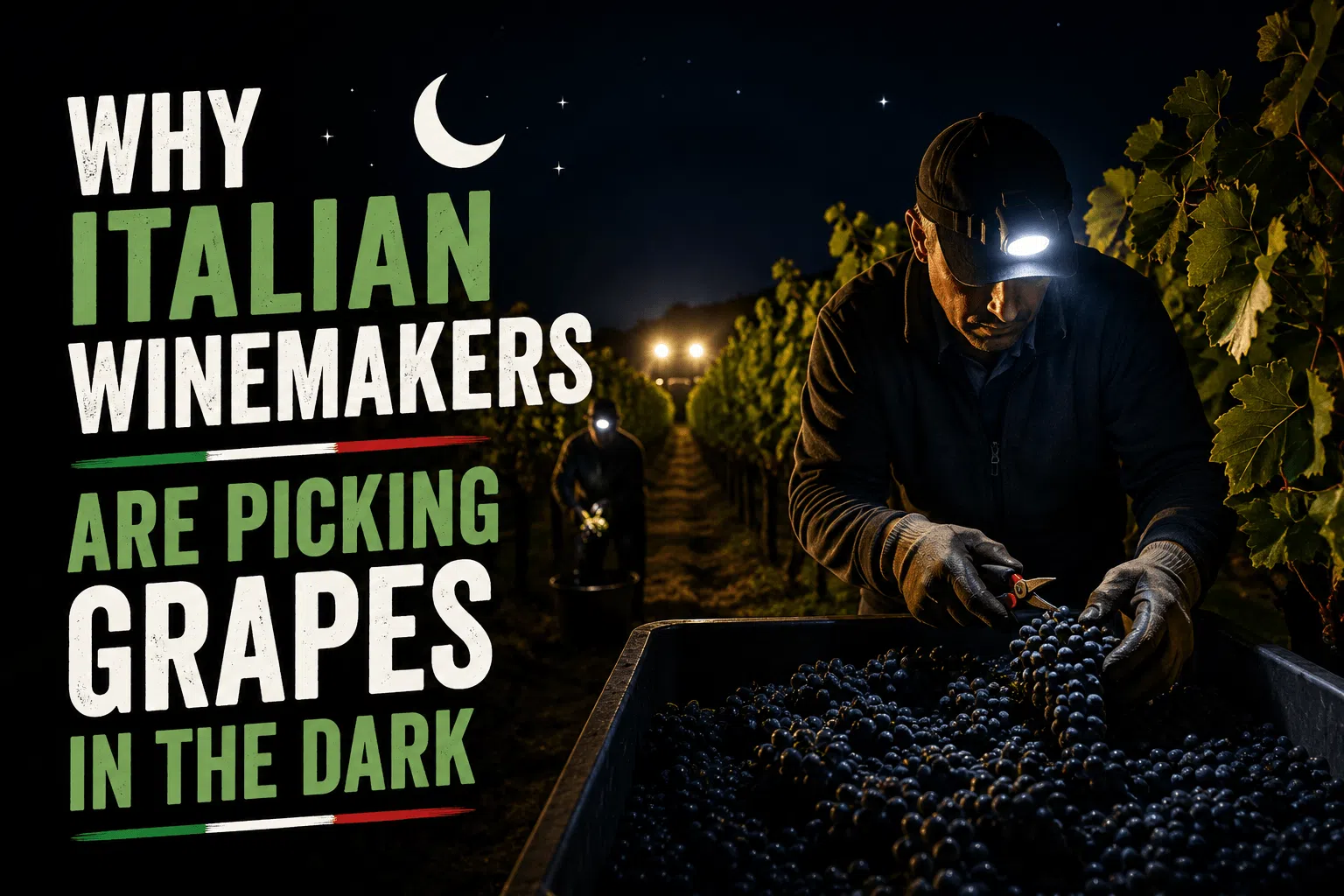
On July 30th, in the villages of Gussago and Montorfano, pickers walked into the vineyards of Franciacorta and started the earliest harvest this region has ever recorded. Not earliest in a decade. Earliest, full stop, since anyone started keeping track. Weeks of temperatures sitting around 37 to 38 degrees Celsius pushed the grapes there faster than the calendar was ready for. A few days later, Berlucchi, the region’s biggest producer, started picking its own vineyards in Corte Franca, some of it before sunrise, some of it after dark, by floodlight.
As Emanuele Rabotti, president of the Franciacorta Consortium, put it, “Nature sets the timing, and we adapt accordingly.” Franciacorta doesn’t ripen all at once, different parcels, different soil, different timing, so seeing one village start in July while another follows a few days later isn’t unusual on its own. What’s unusual is that it’s all happening this early, this fast, in a wine that’s supposed to have all the time in the world.
This isn’t a one-season story either. It’s becoming a pattern, and once you understand why heat forces growers into the dark, you understand something real about what actually happens between the vine and the glass.
Heat Doesn’t Just Ripen Grapes Faster, It Changes What “Ripe” Means
Grapes ripen through a simple trade. As they mature, sugar climbs and acidity falls. In a normal year, that trade happens slowly enough to watch and time it well. In a heatwave, it happens in days instead of weeks, which leaves almost no room for error. Miss the window and you end up with fruit too sweet and too flat on acid for the wine you were trying to make.
For sparkling wine, this window matters more than it does for most still wines. Acidity here isn’t decoration, it’s structure. It’s what gives a sparkling wine its lift, its sense of freshness rather than heaviness, and its ability to age gracefully through a long second fermentation. Lose it, and no amount of skill in the cellar fully brings it back.
Why the Grape’s Temperature at Picking Actually Matters
Here’s the part that surprises people who assume harvest timing is only about sugar levels. The physical temperature of the grape when it’s cut matters too, separate from how ripe it is.
A grape picked in the heat of the afternoon arrives at the winery warm, and warm fruit starts changing the moment it’s off the vine. Oxidation, the same process that dulls a glass of wine left open too long, starts working on the grape must earlier than winemakers want. Fermentation can begin unevenly, before anyone’s ready for it, which makes it harder to control the clean, precise flavor a sparkling wine depends on.
A grape picked at 4am in cool air arrives at the press closer to the temperature the winemaker actually wants to start from. Less stress on the fruit, more control over when fermentation kicks off, and better protection for the aromatics that make a wine like Franciacorta worth the wait in the first place.
Franciacorta Isn’t Prosecco, and This Is Exactly Why That Distinction Matters Here
Quick correction before this goes any further, because it comes up constantly and this is the perfect moment to settle it. Franciacorta and Prosecco are both Italian sparkling wines, and that’s roughly where the similarity ends.
Franciacorta uses the same traditional bottle fermentation method as Champagne, where the second fermentation happens inside the bottle you’ll eventually drink from, followed by months or years of aging on the lees. Prosecco is made using the Charmat method, where that second fermentation happens in large steel tanks, built for speed and freshness rather than patience.
That difference is exactly why the harvest timing story matters more for Franciacorta than it does for a lot of other sparkling wine. A tank-fermented wine built to be drunk within the year has some room to absorb a slightly less precise harvest. A wine that’s about to sit on its own yeast for years, developing that toasty, layered character everyone associates with serious sparkling wine, has almost none. The grapes have to arrive close to perfect, because there’s no fast turnaround to hide behind later.
Is This Just This Year, or the New Normal?
Franciacorta isn’t harvesting in the dark alone. Growers in Portugal’s Alentejo region have been picking through the night for years, and some Italian producers have quietly done the same for over a decade. This year, Burgundy broke a harvest record that had stood for nearly 500 years, since 1556, with growers cutting Grand Cru Montrachet fruit in mid-August. Closer to home, the Colli Euganei in Veneto started their own harvest about a week earlier than last year.
What used to be a technique a handful of producers used to chase an edge is turning into something closer to a necessity for entire regions in a single season. Whether it becomes fully standard practice depends on how consistently these heatwaves keep showing up, but harvest dates across Italy and beyond have been creeping earlier for years, and the trend line isn’t subtle.
The Part Nobody Warns You About When You Get Into Wine
I’ve had Franciacorta myself, more than once. It’s a common pour here in Veneto, bone dry, all citrus and green apple with a faint toasty note underneath from the time it spends resting on its lees, and once you’ve had a glass you understand exactly why people keep reaching for the Champagne comparison.
Here’s what I find genuinely funny about all this. A vineyard spends an entire year on a single harvest. Pruning through winter, praying through spring frost, watching the fruit all summer like it’s a houseguest who might leave early. And after eleven and a half months of patience, the actual moment of truth arrives at four in the morning, by headlamp, while most of the world is asleep and has no idea any of this is happening.
Somewhere, I promise you, a marketing team is already drafting the label copy. Hand-Picked Under a Full Moon. Add €15. It isn’t magic, though. A grape that wasn’t going to make good wine in daylight isn’t going to make good wine at midnight either. The real advantage of picking in the dark isn’t romance, it’s control over fermentation before it even starts, fewer chances for the fruit to go wrong before it reaches the press.
It’s not the postcard image people have of harvest season either, golden afternoon light, a relaxed lunch under a vine-covered pergola. It’s closer to a small, quiet operation with a ticking clock, and the fact that it produces something as elegant as Franciacorta at the end of it makes the whole process feel even stranger. Wine always looks calm by the time it reaches your glass. It rarely was.
Quick Answers
Why are Italian winemakers harvesting grapes at night? Extreme summer heat is ripening grapes faster than usual, causing sugar to rise and acidity to drop within days instead of weeks. Picking at night or before dawn, when temperatures are cooler, protects the grape’s acidity and prevents the fruit from arriving at the winery already warm and oxidizing.
When did the 2026 Franciacorta harvest start? The earliest parcels, in Gussago and Montorfano, began picking on July 30, the earliest recorded start in the region’s history. Other producers, including Berlucchi in Corte Franca, followed within days, since Franciacorta’s vineyards don’t all ripen at the same time.
Is Franciacorta the same as Prosecco? No. Franciacorta uses the traditional bottle-fermentation method, the same one used for Champagne, and ages for months or years. Prosecco is made using the faster tank-based Charmat method, built for freshness rather than long aging.
Does the temperature of the grape at harvest actually matter? Yes. Warm grapes begin oxidizing and can start fermenting unevenly before the winemaker intends. Cooler grapes give producers more control over when fermentation starts and better protect delicate aromatics.
Is night harvesting new, or unique to Italy? Not entirely. Producers in Portugal and parts of Italy have harvested at night for over a decade, and this year Burgundy broke a nearly 500-year-old harvest record of its own. What’s new is how widespread and urgent the practice has become across multiple regions in a single season.
Enjoy wine without the snobbery?
Make The Finest Italian Wine one of your Preferred Sources on Google.
Add The Finest Italian Wine to Preferred SourcesDiscover more from The Finest Italian Wine
Subscribe to get the latest posts sent to your email.