Is the Supermarket Light Ruining Your Wine Before You Even Buy It?
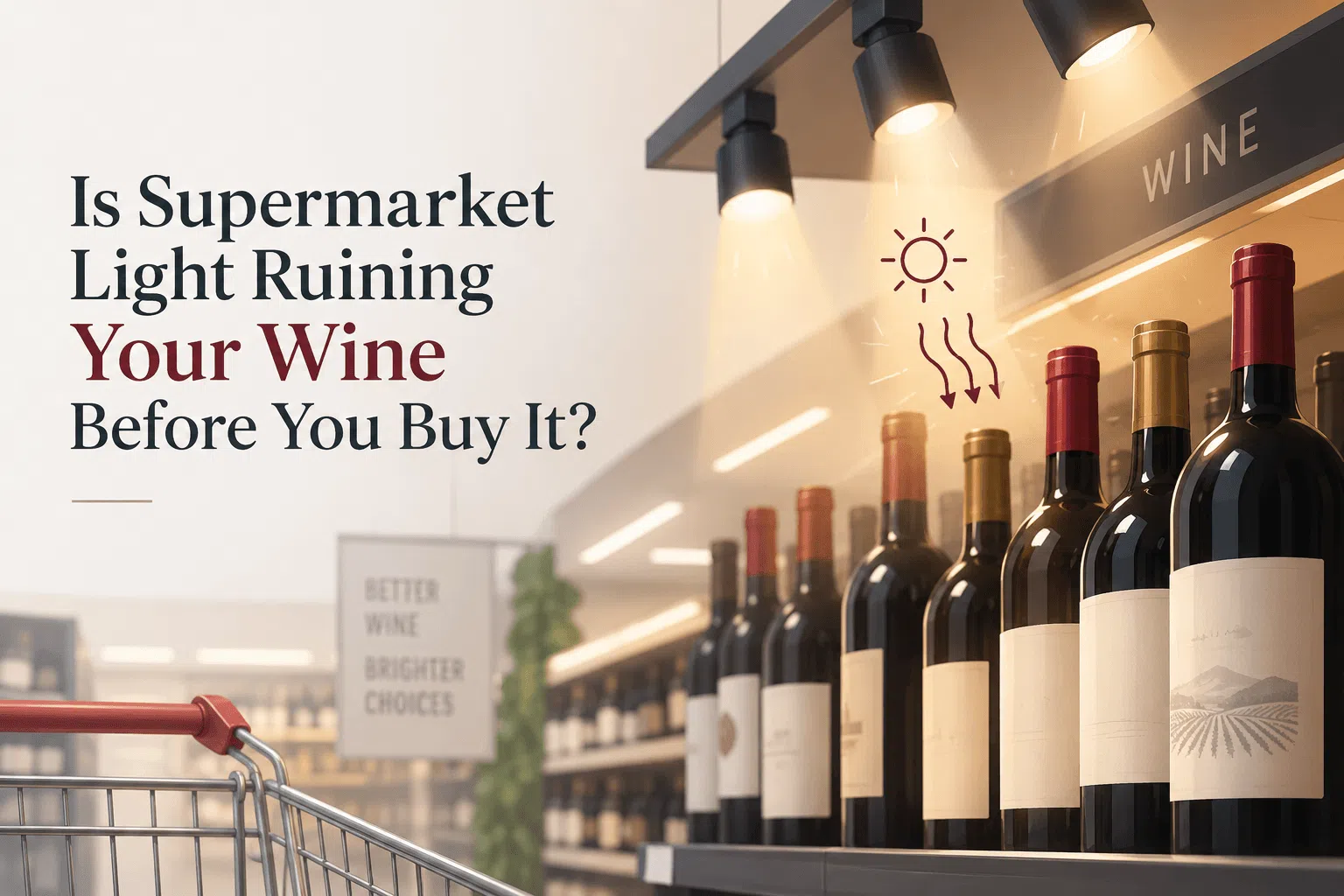
Okay, so I need to tell you something. It’s going to make you side-eye every wine shop you’ve ever walked into.
You know how you pick up a bottle, check the label, maybe Google it standing in the aisle like a completely normal person? Then you take it home. There’s a question none of us ever ask, and it turns out we probably should have been asking it the whole time.
How long has that bottle been sitting under the shop lights?
Because while you’ve been busy deciding whether €18.99 is really that different from €12.99, the light above the shelf may have been quietly doing something to your wine.
Not ruining it, necessarily. Not yet. But messing with it in a way that starts before you’d ever notice anything was wrong.
I have a new supermarket habit now. I’m taking the bottle from the back. Let me tell you why.
I’ve already given you a whole checklist for picking a decent bottle in that exact aisle, avoiding the suspiciously cheap famous names, the sticker explosions, the mystery bottles with no actual region on them. This is the one thing I never mentioned in that piece, and it turns out it might matter more than half of what I did mention.
Wait, Light Really Damages Wine?
Yes, genuinely, and this isn’t some wine-snob rule invented to justify owning a cellar. It’s called light strike, sometimes goût de lumière if you want to sound insufferable about it. White and sparkling wines get hit the hardest.
Here’s the part that surprised me: the culprit is riboflavin. Vitamin B2. The same stuff in your multivitamin is sitting in your wine. When it absorbs certain wavelengths of light, it kicks off reactions with sulfur compounds that eventually produce aromas people describe as onion, or cooked cabbage.
Not exactly what you want your Sauvignon Blanc doing.
Scientists have known about this for decades. What’s new is a study published in OENO One at the end of August 2026, from a research team including Zsófia Laposa, who runs a winery in Hungary and has been studying exactly this problem for years. They exposed sparkling wines, different production methods, different ages, different time on the lees, to controlled light. Then they tracked what happened before the wine hit the obvious cabbage stage.
And here’s the genuinely interesting bit: the wine starts changing before anyone would call it light-struck. Some samples even tasted fine at first, arguably different but not bad. Then it slid toward sulfurous, oxidized notes the longer the light kept hitting them.
So it’s not a switch that flips one afternoon. There’s a quiet middle stage most people never clock, sitting right between “fine” and “ruined.”
Suddenly That Pretty Clear Bottle Looks Nervous
Think about everything that goes into a bottle before it even reaches a shop. The harvest, the fermentation, the winemaker obsessing over oxygen and temperature, sometimes years of aging for a serious sparkling wine. Then it lands on a shelf, and somebody puts it directly under a light. None of that careful work gets a say in the matter anymore.
This doesn’t mean every lit-up wine aisle is a crime scene. It depends on the wine, the type and strength of the light, how long it’s been sitting there. And one very obvious thing we mostly ignore: the bottle itself.
Dark glass isn’t dark because it looks fancier. It’s doing an actual job. There’s an earlier study, this one from 2020, that tested white wines in clear versus green bottles. The conditions were built to copy a real supermarket shelf. Green glass held up fine for the entire test. Clear glass was a different story. Wine in it started developing the fault within days, and every clear-bottled wine in the experiment had it by somewhere between 20 and 40 days.
Dark glass is basically sunscreen for wine. Not the good stuff that blocks everything. More like the SPF 15 you forgot you were wearing, but still better than nothing.
So Why Do Producers Even Use Clear Bottles
Because wine sells partly through your eyes, not just your palate. A pale rosé looks genuinely beautiful through clear glass. So does a delicate white. Producers know we like seeing what we’re buying. Clear glass shows off color in a way dark glass just can’t.
Unfortunately, light also enjoys seeing what you’re buying, and unlike you, it never has to pay for the bottle.
There’s a real trade-off happening here between marketing the wine and protecting it. That’s not a knock on producers who choose clear glass. Packaging is genuinely complicated, brand identity, shelf presence, what customers expect to see. But once you know about light strike, that gorgeous transparent bottle sitting directly under a bright fixture starts looking a little different.
So Should You Grab the Bottle at the Back?
This was the first thing I wanted to know. Picture two identical bottles, one sitting right under the light, one tucked in behind it. Which one am I taking?
The one at the back. Not because the front bottle is definitely damaged, it probably isn’t. And there’s no guarantee the one behind it got meaningfully less light either. Stock rotates, lighting setups vary, you have no idea how long either bottle’s really been sitting there. But given the choice between the bottle posing under the spotlight and its shy cousin hiding behind it, I’m taking the shy one every time.
Will someone in the aisle wonder why I suddenly have strong feelings about shelf depth? Probably. I’ll survive it.
That same 2020 study looked at shelf position too. Bottles placed farther from the strongest light did get some extra protection, though it only delayed the problem rather than solving it. So reaching backward isn’t some secret sommelier move that guarantees a better bottle. It’s just cutting an unnecessary risk down a little. Sorry, front bottle. You really did photograph beautifully.
Here’s the Part That Genuinely Bugs Me
If a wine gets badly light-struck, you’ll probably know. Cooked cabbage doesn’t hide well. But what about the smaller changes?
You open a bottle and just think, huh, expected more from this. You blame the producer. Or the vintage. Or you quietly decide you don’t like that wine. Or worse, that your own palate somehow failed some invisible test everyone else apparently passed.
But you have no control bottle. You have no idea what that exact wine tasted like the day it left the winery. That’s what makes this new research more interesting to me than another study proving that enough light eventually ruins wine, obviously it does.
This one’s suggesting the aroma can shift before the classic fault ever announces itself. A fully ruined bottle at least tells you something’s wrong. A slightly altered one might just quietly disappoint you, and you’ll never know why.
Should Prosecco and Champagne Drinkers Panic
No. Pay attention, don’t panic.
The new study focused on sparkling wine specifically. It found different wines respond differently depending on production method, composition, and how long they sat on the lees. There’s no tidy rule here, no “twelve hours under a supermarket lamp and your Prosecco’s done.” Wine is annoyingly unwilling to make this simple. Bottle color still matters enormously too. A sparkling wine in dark glass is in a totally different situation than one sitting in clear.
So I’m not going to start interrogating every bottle in the sparkling aisle. But if I’m spending real money on Champagne, Franciacorta, Trentodoc, or anything serious, I already care how it’s been stored. Light’s officially joining that list now, especially if I can see straight through the glass.
Your Sunny Kitchen Isn’t Helping Either
Quick related confession: we do this at home too. Beautiful bottle, nice label, so it ends up sitting on the counter, or on top of the fridge, or right by a window because it looks good there. Wine does not care that it looks good there.
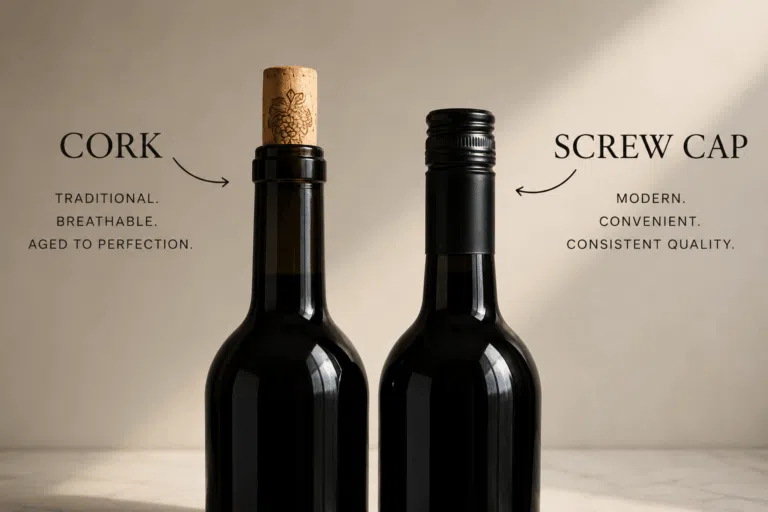
If you’re storing a bottle rather than drinking it tonight, cool and dark beats decorative every time. This is one of the five rules I lay out in my dos and don’ts of wine storage, though this new research gives the “keep it out of light” rule a lot more scientific backing than I originally had for it. I’ve also gone into the other big reasons wine goes bad once it’s open separately, and light exposure belongs right alongside oxygen and temperature on that list, just earlier in the wine’s life. You don’t need a Tuscan cellar with a guy named Giovanni checking humidity levels. A dark cupboard away from heat and sun is already a real improvement. The cork going in doesn’t mean the wine stops changing. Heat matters, oxygen matters, time matters. Apparently shop lighting would like a seat at that same table.
Are Supermarkets Secretly Ruining Our Wine
No, and I want to be careful here, because a genuinely interesting study can turn into a ridiculous headline embarrassingly fast.
This research doesn’t prove every bottle under supermarket lighting is damaged. It shows that light can start altering a sparkling wine’s aroma before the obvious fault shows up, and that some wines are more vulnerable than others. The earlier bottle-color study gives extra reason to care, especially about white wine in clear glass. That’s a very different statement from “never buy supermarket wine, the lights have ruined everything,” because they haven’t.
The actual question worth asking is simpler: if cumulative light exposure can genuinely affect quality, should producers, shops, and shoppers all be paying it a bit more attention? I think yes. We already obsess over temperature during transport and storage. Light probably deserves a seat at that table too.
Anyway, I’m Looking at Shelves Differently Now
That’s what I love about good wine science, it takes something completely ordinary and makes it impossible to look at the same way again.
Yesterday the bottle at the back was just inconvenient. Today I’m wondering if it’s been living a quieter life. I’m not panicking about supermarket lighting, I’m not boycotting clear bottles, and I’m definitely not sniffing every sparkling wine suspiciously for cabbage notes. But if two identical bottles are sitting there and one’s clearly spent less time directly under a bright light, I’m reaching for the one in back.
We already spend so much energy asking what happened to a wine before it went into the bottle: where the grapes grew, when they were picked, how long it aged. Maybe it’s worth occasionally asking what happened after, too. The story doesn’t end when the cork goes in, and apparently, neither do the opportunities to mess with it.
Quick Answers
Does light really damage wine? Yes. Light can trigger chemical reactions, involving riboflavin and sulfur compounds, that gradually change a wine’s aroma and can eventually produce the fault known as light strike. White and sparkling wines are the most vulnerable.
What does light-struck wine really smell like? At its worst, aromas commonly described as onion or cooked cabbage. Less obvious light exposure can shift the aroma more subtly before it reaches that stage.
Why are so many wine bottles green or brown? Colored glass blocks more of the light that triggers light strike. Clear (flint) glass offers far less protection, which is part of why white and rosé wines in clear bottles are considered more at risk.
Should I grab the bottle from the back of the shelf? For white, rosé, or sparkling wine in clear glass, it’s a reasonable, low-effort precaution. It’s not a guarantee the bottle is better, just a way to reduce an unnecessary risk when the choice is right there in front of you.
Salute.
Continue Exploring
- How to Choose Italian Wine in a Supermarket
- The 5 Dos & Don’ts of Wine Storage
- Why Wine Goes Bad
- How Long Does Wine Last After It’s Opened?
Sources
Laposa, Z., Balla, J., Héberger, K., & Keszei, E. (2026). Effect of light on sparkling wines: sensory and chromatographic evaluation of different elaboration methods and maturation states. OENO One, Vol. 60 No. 3.
Arapitsas, P., Dalledonne, S., Scholz, M., Catapano, A., Carlin, S., & Mattivi, F. (2020). White wine light-strike fault: A comparison between flint and green glass bottles under the typical supermarket conditions. Food Packaging and Shelf Life, 24, 100492.
Enjoy wine without the snobbery?
Make The Finest Italian Wine one of your Preferred Sources on Google.
Add The Finest Italian Wine to Preferred SourcesDiscover more from The Finest Italian Wine
Subscribe to get the latest posts sent to your email.