How to Choose Italian Wine in a Supermarket
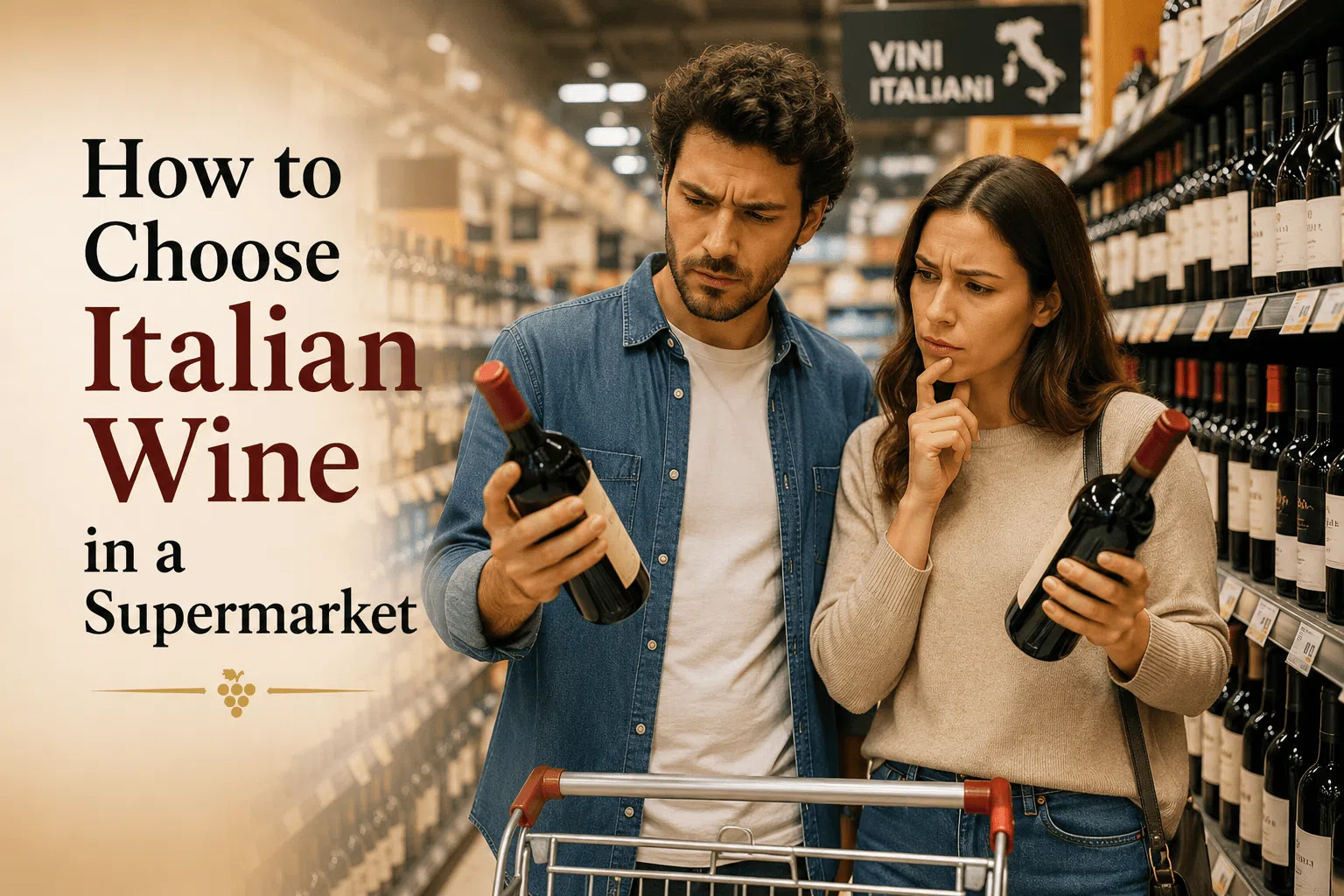
Supermarket wine aisles are designed to make you feel stupid. I’m fairly convinced of it.
Fifty bottles you can’t pronounce. DOC, DOCG, and IGT stamped everywhere like the wine sat an exam. Gold medal stickers stacked three deep, as if the bottle just came home from the Olympics. Prices ranging from “this feels illegal” to “this had better also cook my dinner.”
You don’t have a wine degree. You don’t have twenty minutes to Google every label in the aisle. You just want something Italian, decent, and not a mistake you’ll regret with dinner.
Here’s how I’d actually do it, using nothing but the shelf in front of me and a fairly low tolerance for nonsense.
First, a slightly uncomfortable truth
Most supermarket Italian wine is fine. Not thrilling. Not offensive. Just fine, in the way a lot of things are fine, thats why we named our blog, The Finest Italian Wine.
The real range sits between two extremes: at the bottom, wine that tastes like it was made from a spreadsheet rather than grapes, and at the top, honest bottles from real regions that taste like somewhere specific, rather than like marketing. Your job in the aisle isn’t to find something extraordinary. It’s to avoid the traps and land somewhere in the “actually good” middle.
The traps I’d personally avoid
The suspiciously cheap “famous name.” If I see a Chianti or a Prosecco sitting at the absolute floor price on the shelf, my expectations drop to nearly zero. It might be drinkable. It will almost certainly have nothing to do with what Chianti or Prosecco are actually meant to taste like. I’d rather cook with a bottle like that than drink it.
The sticker explosion. You know the one. Gold medal here, “Riserva Speciale” there, a “Selezione Privata” banner wrapped around the neck like a sash at a beauty pageant. Real producers do win real medals. In a supermarket, though, a label buried under stickers usually means someone spent more on the stickers than the wine. One medal, fine. An entire collage, and I start wondering what they’re covering up.
The mystery bottle. If the label just says “Italy” with no actual region named anywhere, that’s not a wine. That’s a rumour of a wine. Somewhere, some grapes, from somewhere in Italy. It might be perfectly drinkable, but if you want even a flicker of personality in the glass, look for an actual place name: Veneto, Toscana, Sicilia, somewhere real.
The one rule you actually need on DOC, DOCG, and IGT
You do not need a full lecture on Italian appellation law standing in a supermarket aisle. I’ve already written that guide properly, and it lives here rather than in the middle of this one.
The blunt, aisle-ready version is this: look for a bottle that names an actual region, and carries DOC or DOCG somewhere on the label. Is DOCG automatically better than DOC or IGT? No. Does DOC or DOCG at least tell you there’s a real system behind where the grapes came from and how the wine was made? Yes. That’s enough information to work with between the frozen pizza and the checkout line.
Let geography do the thinking for you
You don’t need to memorise grape varieties. Just remember three directions.
North (Veneto, Friuli-Venezia Giulia, Trentino, Alto Adige): fresh, crisp, built to sit next to food rather than compete with it. For a safe white, I’ll grab Soave, or a Pinot Grigio that actually names its region instead of just saying “Pinot Grigio, Italy,” which tells you nothing. For a lighter red, Valpolicella does the job at dinner without demanding anyone’s full attention.
Centre (Toscana, Umbria, Marche): Sangiovese country, and the closest thing to the platonic ideal of “Italian red with food.” Chianti, Chianti Classico if the price isn’t insultingly low, or Montepulciano d’Abruzzo, which technically comes from a bit further east but usually lives in the same section anyway.
South and the islands (Puglia, Sicilia, Sardegna, Campania): more sun in the glass, riper fruit, fuller body. Primitivo di Manduria, Nero d’Avola, Cannonau, Aglianico. If you like your red wine with some actual muscle to it, this is your aisle.
My honest rule on price
If I actually care how the wine tastes, I don’t shop at the very bottom of the shelf, full stop. My rough personal cutoff sits somewhere around €8 to €12, adjusted for wherever you actually live. Below that range, you’re mostly gambling on something industrial and anonymous. Above it, you can start finding real character, though you can also start paying for a name rather than what’s in the bottle, so don’t assume the most expensive option on the shelf is automatically the smartest choice either.
The middle is where supermarket Italian wine actually has a chance to surprise you.
If I had thirty seconds in the aisle
No overthinking, just what I’d actually grab.
Pizza night: Chianti, Chianti Classico, or Montepulciano d’Abruzzo. Named region, DOC or DOCG on the label, and nowhere near the bottom shelf.
Seafood or a light fish dish: Soave, Verdicchio, Vermentino, or a Pinot Grigio that actually names where it’s from. Recent vintage, ideally within the last year or two.
Steak or a BBQ: Primitivo di Manduria, Nero d’Avola, or Aglianico. Something with enough structure to stand up to char and fat.
Aperitivo with cheese and cold cuts: a light Valpolicella, a crisp northern white, or a dry Prosecco DOC if you want bubbles. You want something that resets your palate, not something that dominates the plate.
No, it’s not a perfect system
Could you still walk out with a disappointing bottle using all of this? Sure. Nothing’s foolproof, and I’m not going to pretend a supermarket aisle can be fully tamed by a checklist.
But the alternative is choosing wine by label design, price alone, or how convincingly Italian the name sounds, and you deserve slightly better odds than that. You don’t need to become an expert. You just need a few opinions borrowed from someone who’s spent an unreasonable number of hours thinking about this exact problem.
Wine doesn’t have to be complicated. Supermarket shelves just work very hard to make it look that way.
FAQ
What’s the best price range for Italian wine in a supermarket? Generally somewhere around €8 to €12 offers the best balance of quality and value. Below that range, wines tend to be mass-produced and generic. Above it, you’re often paying more for branding than for what’s actually in the bottle.
Does DOC or DOCG on a label guarantee good wine? No, but it does indicate the wine follows specific regional production rules, which is a reasonable baseline signal when you have no other information to go on. It’s not a guarantee of quality, just a sign that some system was followed.
What’s a safe Italian white wine to buy in a supermarket? Soave, Verdicchio, Vermentino, and Pinot Grigio labeled with a specific named region (rather than simply “Italy”) are generally reliable, food-friendly choices.
Should I avoid the cheapest wine on the shelf? If taste matters to you, generally yes. The very cheapest bottles are typically mass-produced with little regional character. They’re not harmful, just usually unremarkable.
Enjoy wine without the snobbery?
Make The Finest Italian Wine one of your Preferred Sources on Google.
Add The Finest Italian Wine to Preferred SourcesDiscover more from The Finest Italian Wine
Subscribe to get the latest posts sent to your email.