Why Barolo Can’t Be Sold for 38 Months
Most wine gets picked, fermented, bottled, and shipped inside a year. Nobody’s money sits around waiting.
Barolo doesn’t get that luxury. And it’s not because the producer is being precious about it.
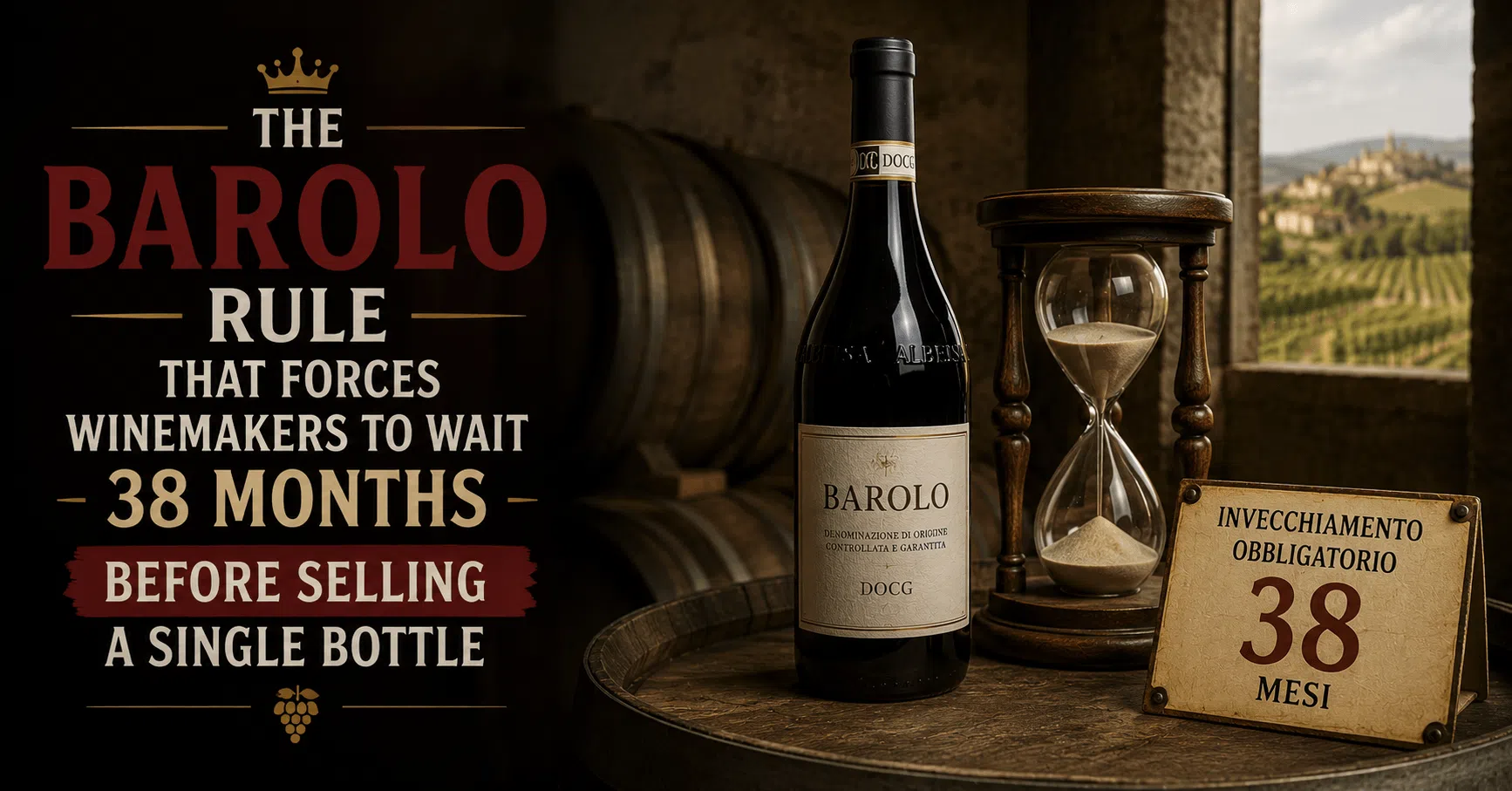
It’s the law. Italian regulation requires every bottle labeled Barolo to age a minimum of 38 months before anyone is legally allowed to sell it, and at least 18 of those months have to happen in wood. Not “until it tastes ready.” Not “when the producer feels good about it.” A specific, non-negotiable stretch of time, written into a government document, checked before a single cork gets pulled for sale.
Harvest grapes this October, and you cannot legally sell the finished wine until sometime in the fourth year afterward. That’s over three years of full barrels sitting in a cellar, earning nothing, before a producer sees a single euro back.
If we’ve already covered the full picture on Barolo for you, this is the part I wanted to slow down on, because the rule itself is stranger, and more consequential, than a bullet point on a label ever lets on.
What the Rule Actually Says
The regulation comes straight from Barolo’s DOCG production code, and it’s specific down to the calendar, not the vibe. The clock starts at harvest. The earliest legal release date is January 1st of the fourth year after that harvest. Minimum 38 months. Of that, at least 18 in wood.
Want Riserva on the label instead? Now you’re at 62 months minimum. Over five years. Same 18-month wood floor.
Here’s what that actually means for you at the shop: the Barolo on the shelf right now is never a young wine. It legally can’t be. A bottle released this year is, at minimum, four vintages behind whatever’s currently in the ground. There’s no such thing as a Barolo Nouveau. The law made sure of that.
Why 38 Months, Specifically
Barolo is Nebbiolo, and only Nebbiolo. Winemakers have a very specific complaint about this grape: brutal tannins, high acidity, even at full ripeness. A young Nebbiolo straight out of the tank is genuinely rough. Not “interesting rough.” Rough rough.
The 38-month rule didn’t invent that problem. It just made official what producers were already doing out of necessity. Barolo earned DOC status in 1966 and got promoted to DOCG, Italy’s strictest tier, in 1980, and the aging minimum went into the rulebook because winemakers were already sitting on the wine that long anyway. The law caught up to the practice. Not the other way around.
The Rule Doesn’t Care What Kind of Wood
Here’s the sentence that started a war: the regulation says wood, minimum 18 months. It does not say what kind of wood. Or what size.
That single gap is enormous. Traditional producers age Barolo in botti, huge neutral casks made of Slavonian oak, holding thousands of liters, barely touching the wine’s flavor at all. That style needs the full 38 months and then some, because the wood isn’t doing much of the softening on its own. Modernists went the other direction entirely: small 225-liter French barriques that round out tannins fast and layer in their own vanilla and toast character on top.
Same law. Same 18-month floor. Two completely different wines.
When That Gap Turned Into a War
In the late 1970s, a young Piedmont winemaker named Elio Altare took a trip to Burgundy and came home convinced his family’s methods, the same ones his father had used for decades, were actually holding Barolo back. Sometime around the early 1980s, in a story that’s become genuine wine-world legend, Altare took a chainsaw to his father’s botti to clear cellar space for smaller French barrels.
His father reportedly didn’t speak to him for years.
Altare wasn’t alone. A loose crew of young producers, later nicknamed the Barolo Boys, went hunting for a Barolo that didn’t demand a decade of patience before it made sense to open. Traditionalists were furious, and some of that fury became famous in its own right. Bartolo Mascarello, one of the era’s most respected old-guard producers, is remembered for a hand-painted sign in his cellar reading “No Barrique, No Berlusconi,” lumping the new oak trend in with the political figure he liked just as little. It was serious enough to earn its own documentary in 2014, Barolo Boys: The Story of a Revolution.
The fighting has mostly cooled. Plenty of cellars now run both botti and barrique side by side, matched to whatever a particular wine actually needs. But the fact that fight was even possible traces straight back to one sentence in a legal document that specifies time and wood, and stops there.
What This Actually Means for Your Glass and Your Wallet
Every bottle of Barolo you can legally buy has already cost its producer three-plus years of storage, barrel space, and money sitting still before a single sale. That cost doesn’t vanish. It’s baked into the price, standing right next to the fruit and the label.
It also means Barolo rewards patience in a way most wine simply never gets the chance to. By the time it’s legally allowed to reach you, it’s already spent longer in a cellar than most reds spend in their entire commercial life. Whether your bottle came from a two-hundred-year-old Slavonian cask or last year’s French barrel was one producer’s choice, made in one cellar, decades into an argument that’s still, quietly, playing out across the Langhe hills.
Prosecco plays a version of this same legal game, just with geography instead of time. We went deep on that one here, if you’re curious how a completely different set of rules can shape a completely different wine.
Quick Answers
How long does Barolo have to age before it can be sold? A minimum of 38 months from harvest, with at least 18 of those months in wood. Barolo Riserva requires a minimum of 62 months.
Why does Barolo need so much aging? Nebbiolo, the only grape allowed in Barolo, carries naturally high tannins and acidity that need time to soften. The rule formalized a practice producers were already following out of necessity.
Does the law require large barrels or small ones? Neither. It requires wood and a minimum of 18 months, full stop. Nothing about size or origin. That gap is exactly what let traditionalist and modernist producers pursue completely different styles under the same legal rule.
What were the Barolo Wars? A real, decades-long dispute between traditionalist producers, who aged Barolo in large neutral oak casks, and modernist producers, who adopted smaller French barrels for a faster, more approachable style. It started in the late 1970s and early 1980s and was serious enough to divide families and inspire a 2014 documentary.
Enjoy wine without the snobbery?
Make The Finest Italian Wine one of your Preferred Sources on Google.
Add The Finest Italian Wine to Preferred SourcesDiscover more from The Finest Italian Wine
Subscribe to get the latest posts sent to your email.