🍾 Why Prosecco Keeps Losing to Champagne… Even When It Wins
The lie we all agreed to believe
There’s a polite fiction in the wine world that nobody really questions out loud.
Champagne is “better.”
Prosecco is “easier.”
That’s the story. Clean. Simple. Wrong.
Because if you strip away branding, price rituals, and the way people whisper “Champagne” like it has diplomatic immunity… Prosecco is the one actually running the drinking world.
It just doesn’t get credit for it.
The aperitivo test nobody wants to admit
Walk into any bar in Italy around 6:30pm.
Nobody is celebrating a Nobel Prize. Nobody is closing a merger. Nobody is waiting for a speech.
They are just tired.
And what shows up?
Prosecco.
Not as a symbol. Not as a status object. Just as a solution.
That’s the part Champagne never quite wins: usefulness.
Champagne waits for the moment. Prosecco creates it.
Champagne behaves like it’s important (and we let it)
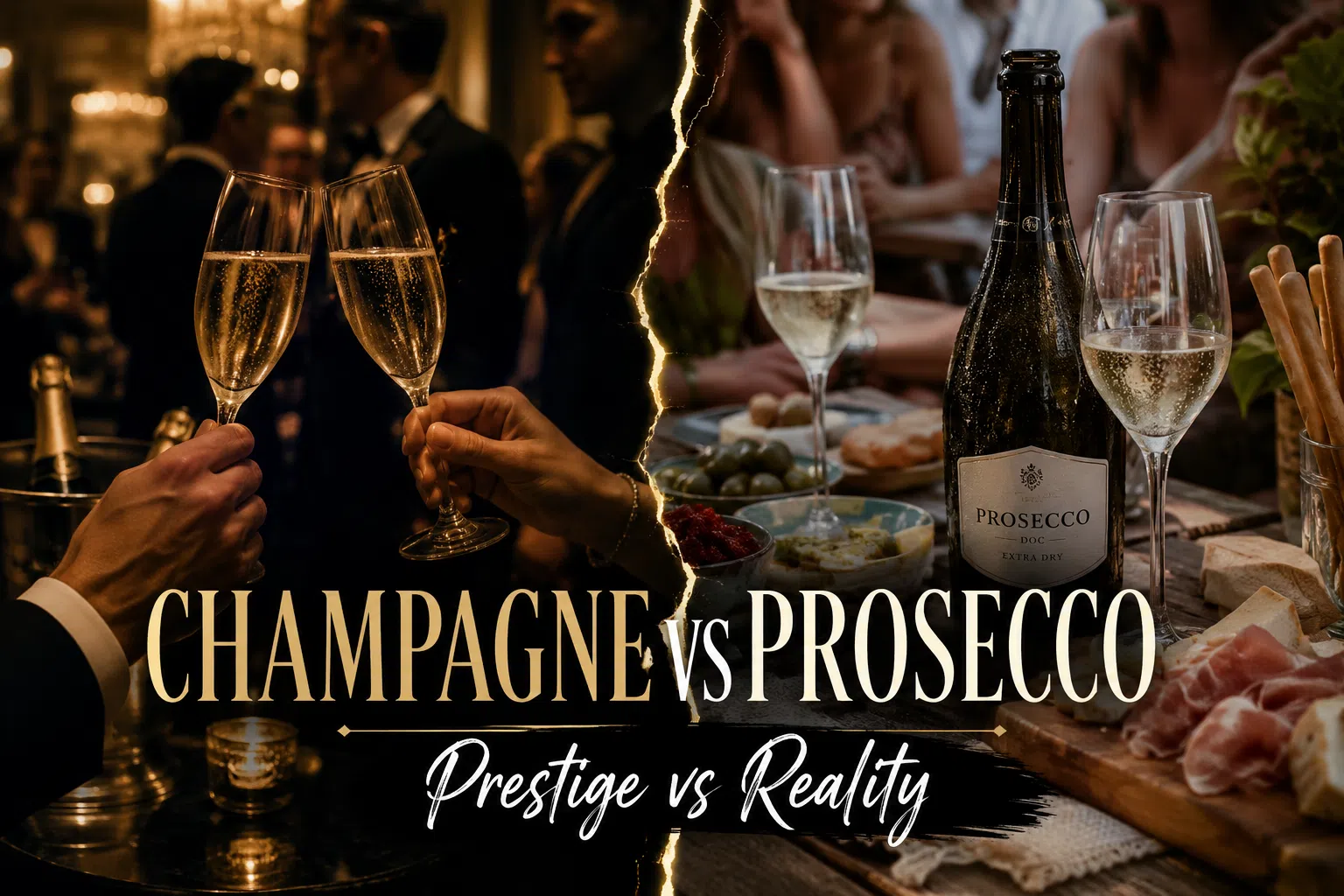
Champagne doesn’t just enter a room. It arrives with rules.
Temperature matters. Glass shape matters. Occasion matters. Even the silence around it matters.
And somewhere along the line, we all agreed:
if it feels like a ceremony, it must be valuable.
That’s not wine evaluation. That’s theatre.
And it works brilliantly.
Prosecco’s biggest “failure” is being too easy
Here’s the uncomfortable truth nobody in marketing likes saying out loud:
Prosecco is popular in the same way pizza is popular.
Which is to say: globally loved, endlessly consumed, and slightly disrespected by people who think complexity equals quality.
But complexity is not always the point.
Prosecco is designed for immediacy:
- open bottle
- pour
- drink
- repeat conversation
No ceremony required. No permission needed.
And in luxury logic, that becomes a problem.
Because luxury needs distance to feel expensive.
The production trick that became a status ladder
Let’s talk mechanics for a second — because this is where the illusion gets built.
Champagne uses the traditional method: second fermentation happens inside the bottle. Time, labour, aging, control. It is slow by design.
Prosecco uses tank fermentation. Faster. More scalable. More fruit-driven. Less “aged drama,” more “fresh energy.”
Now here’s the marketing twist:
Slow became “sophisticated.”
Fast became “casual.”
Even though fast also means: efficient, consistent, and drinkable on demand.
We didn’t evaluate the wine. We evaluated the narrative around the process.
Price is just storytelling with a receipt attached
Nobody is paying only for grapes.
With Champagne, you’re paying for:
- controlled scarcity
- aging time
- heritage branding
- luxury distribution layers
With Prosecco, you’re paying for:
- scale
- speed
- accessibility
- volume-friendly production
But consumers don’t see that breakdown.
They see €60 and think “important.”
They see €10 and think “fun.”
And that’s where perception quietly wins the argument.
The real reason Prosecco “loses”
Let’s be honest about what’s actually happening.
Prosecco doesn’t lose in taste.
It doesn’t lose in demand.
It doesn’t lose in global relevance.
It loses in storytelling hierarchy.
Because Champagne has something Prosecco doesn’t fully claim yet: ritual authority.
A wedding toast. A victory photo. A black-tie moment. A film scene.
Champagne is always “the moment.”
Prosecco is usually what happened before and after the moment.
But here’s the part nobody puts on the label
Most life is not a moment.
Most life is Tuesday.
And Tuesday drinks Prosecco.
Not because it’s cheaper.
Because it fits reality better than prestige ever will.
That’s the irony.
Champagne owns the fantasy.
Prosecco owns the calendar.
So who’s actually winning?
If winning means cultural symbolism, Champagne is still sitting at the top like it owns the building, the parking space, and the dress code.
But if winning means:
- frequency
- real-life drinking behaviour
- emotional usefulness
- and showing up when life is messy, not curated
Then Prosecco is not losing anything.
It’s just refusing to wear a suit to every occasion.
Champagne is the friend who only shows up when the cameras are on.
Prosecco is the one already in your kitchen asking, “Are we opening this or are we overthinking it again?”
And honestly… one of them sounds like fun. The other sounds like a reservation you’re scared to cancel.
The uncomfortable truth nobody says at wine tastings
If Prosecco disappeared tomorrow, people would be confused.
If Champagne disappeared tomorrow, people would start filming documentaries and pretending they “always knew it was overrated.”
That’s the difference.
One is luxury identity.
The other is emotional infrastructure.
And no, those are not the same thing.
Final thought (and slightly dangerous opinion)
The wine world loves to pretend there’s a clear hierarchy.
But the truth is simpler and a bit more embarrassing:
Champagne is what you post.
Prosecco is what you actually drink.
And if we’re being completely honest… most of life does not need a speech, a flute glass, or a slow-motion toast with violins in the background.
Sometimes it just needs bubbles and bad decisions made responsibly.
For more clarity about Prosecco, read our post on Stop Calling Prosecco “Italian Champagne” — Here’s What It Actually Is and The Complete Guide to Prosecco — Italy’s Most Joyful Wine
Enjoy wine without the snobbery?
Make The Finest Italian Wine one of your Preferred Sources on Google.
Add The Finest Italian Wine to Preferred SourcesDiscover more from The Finest Italian Wine
Subscribe to get the latest posts sent to your email.