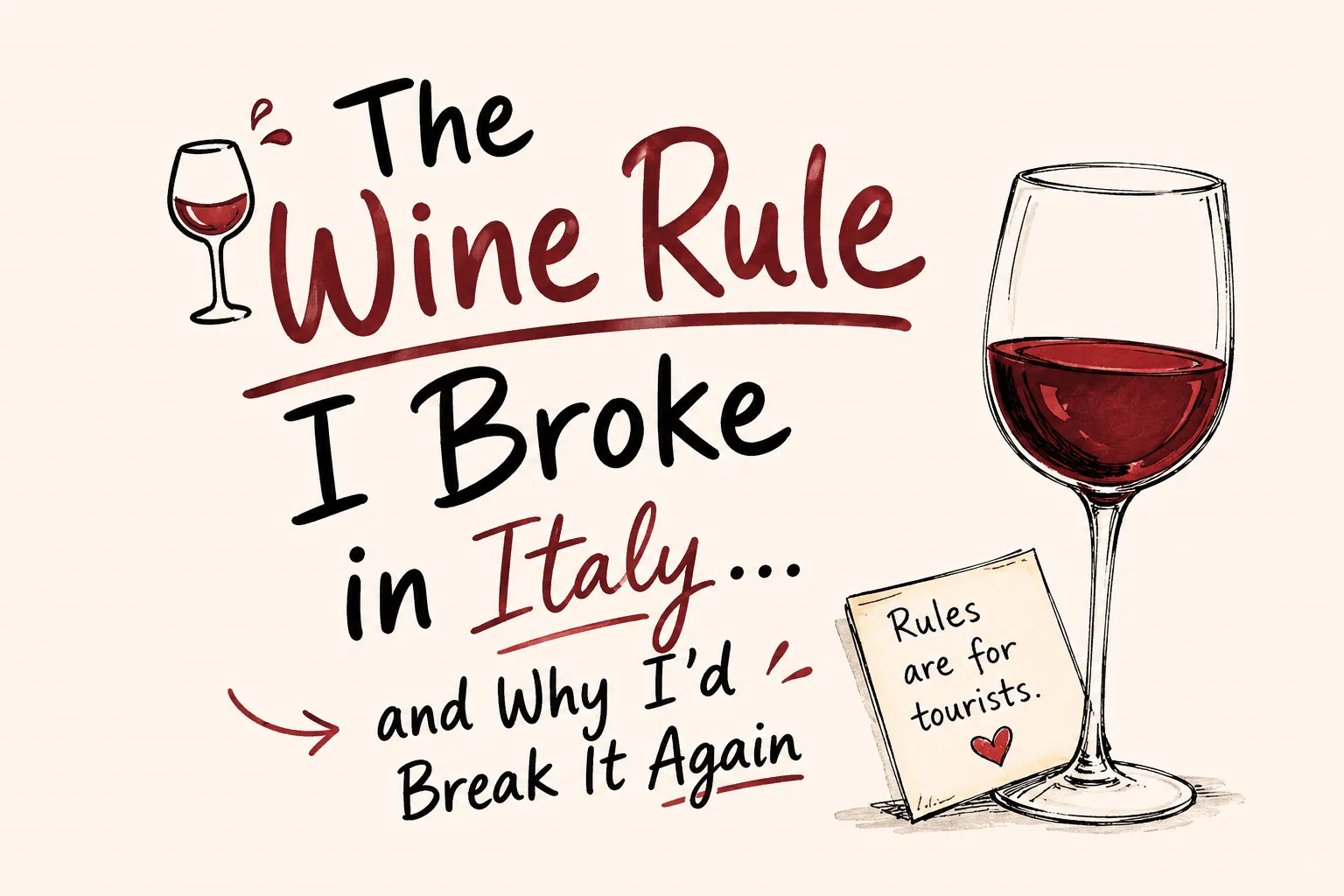
🍷 The Wine Rule I Broke in Italy… and Why I’d Break It Again
There’s a specific look people arrive in Italy with.
Not the “I’m on holiday” look.
The “I must not mess this up” look.
It shows up at restaurants first. Before the food. Before the wine. Before anyone has even opened a menu.
They sit down and suddenly become extremely careful versions of themselves.
As if Italy is quietly scoring them.
I watched a couple once in Veneto do a full performance just to order wine.
They didn’t just order it. They negotiated with it.
“Is this appropriate with pasta?”
The waiter didn’t even pause.
“In Italy,” he said, “everything is appropriate with enjoyment.”
And walked off.
That should’ve ended the story.
It didn’t.
They still looked stressed.
That’s the thing nobody tells you: a lot of tourists don’t come to Italy for food or wine.
They come to Italy for permission to enjoy food and wine correctly.
And that’s where everything starts going wrong.
I used to think there were rules too.
Not official ones. More like invisible ones you absorb from blogs, influencers, airport magazines, and that one friend who went to Tuscany once and now speaks in wine commandments.
No ice in wine.
No red with fish.
No asking for parmesan with seafood.
No mistakes.
So people behave.
They nod at wine lists like they’re decoding ancient scripture.
They whisper “is this okay?” like the waiter might confiscate their drink if they choose wrong.
It’s honestly exhausting to watch.
And a little funny, if I’m honest.
Because Italy is not sitting there judging you.
It’s sitting there eating bread with olive oil like it has nowhere else to be.
The “rule” I broke wasn’t dramatic.
There was no rebellion. No scandal. No sommelier fainting in the background.
It was just me, in a small trattoria in Veneto, ordering wine without overthinking it.
No pairing strategy. No temperature anxiety. No mental checklist of what a wine textbook would approve of.
Just: red wine, food, hunger, done.
The wine arrived slightly colder than it “should” be.
If I had been in my overthinking era, I would’ve noticed immediately.
But I wasn’t.
Because the table next to me was laughing too loudly, the bread kept appearing without explanation, and the waiter was already halfway through ignoring everyone equally, which is actually the best kind of service in Italy.
So I drank it.
And nothing happened.
No rule enforcement. No culinary alarm system. No invisible Italian committee appearing to disapprove.
Just… wine.
Here’s the uncomfortable truth most people don’t expect:
Most wine “rules” don’t exist in Italy.
They exist in nervous people trying to avoid embarrassment.
Italy itself is far less delicate than the internet makes it sound.
It’s not protecting traditions like glassware in a museum.
It’s pouring wine into whatever glass is closest and getting on with life.
I think the real mistake tourists make isn’t choosing the wrong wine.
It’s treating wine like it has a test at the end.
Most locals aren’t thinking about pairing.
They’re thinking about whether they should order another bottle before the conversation gets too good to stop.
That’s it.
No inner debate. No fear of breaking rules that don’t actually exist outside Instagram captions.
So yes, I broke a rule.
Or more accurately, I stopped pretending there was one.
And I’d do it again every time.
Because the moment you stop trying to get wine “right” in Italy, something slightly inconvenient happens:
It becomes enjoyable without your permission.
If you’re heading to Italy soon, do yourself a favour. Leave the wine rules at the airport. They’ll still be there when you land back home — right next to the anxiety and the airport Pringles. Italy will be here, pouring wine into whatever glass is closest, completely unbothered.
Enjoy wine without the snobbery?
Make The Finest Italian Wine one of your Preferred Sources on Google.
Add The Finest Italian Wine to Preferred SourcesDiscover more from The Finest Italian Wine
Subscribe to get the latest posts sent to your email.