Wine Facts: The History and Origins Every Wine Lover Should Know
Terroir isn’t mysticism — geologists proved it. Natural wine isn’t a trend — it’s 8,000 years old. And the version of wine you think is “normal” was invented about 70 years ago. Buckle up.
These wine facts about the history and origins of wine will permanently change how you think about what’s in your glass. We spend so much time debating what wine tastes like that we rarely stop to ask where it actually came from — and more importantly, why it became what it is today. Furthermore, the answers are stranger and more fascinating than most wine lists will ever tell you.
1. Wine Facts: Terroir Is Real — and Geologists Can Prove It
For a long time, the concept of terroir — the French idea that wine expresses the specific place it comes from — sat awkwardly between romance and science. Critics called it mysticism dressed up as expertise. Soil is soil, they said. A grape is a grape. Stop being so French about it.
Then the geochemists ran their tests. The critics went very quiet.
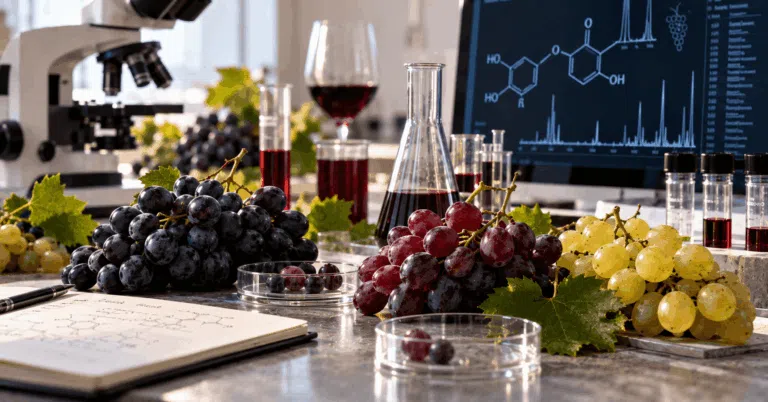
Here is the wine fact that settles the argument: grapevine roots go deep. Genuinely deep — sometimes several meters into bedrock. Along the way, they absorb trace minerals specific to that precise location: potassium, calcium, magnesium, and iron, in concentrations that vary from one hillside to the next. These minerals enter the vine’s chemistry, alter the grape’s composition, and leave measurable fingerprints in the finished wine.
For example, researchers studying wines from Sicily’s Mount Etna — where vines grow on volcanic basalt — found detectable isotopic signatures of those specific volcanic minerals in the bottle. In other words, you can chemically trace a wine back to its geology. The soil isn’t just where the vine sits. It’s an active ingredient.
Why This Makes Every Wine Label More Meaningful
Furthermore, climate adds another layer entirely. Slope angle determines how much sun the vines receive each day. Drainage affects how much water reaches the roots and when. As a result, the direction a vineyard faces can shift temperatures by several degrees across a single growing season. All of these variables combine to create conditions that genuinely cannot be replicated anywhere else on earth.
That’s not a French winemaker being poetic at dinner. That is geochemistry doing its job.
The detail that proves the point: The same Pinot Noir clone, planted 500 meters apart on different soil types in Burgundy, under identical winemaking conditions, produces wines that trained tasters and laboratory analysis can both clearly distinguish. Burgundy has been obsessively mapping this for over 500 years. Their Grand Cru classifications are, in fact, a very old and very precise geological survey. Respect it accordingly.
2. Wine Facts: Natural Wine Is 8,000 Years Old — Conventional Wine Is the New One
The natural wine movement — with its cloudy bottles, orange wines, pet-nats, and slightly evangelical enthusiasts — loves to present itself as the alternative. The rebel option. The thing your conventional wine merchant doesn’t want you to know about. However, here is the wine fact that reframes the entire conversation: natural wine is just wine. It is what wine was for the first 8,000 years of human history.
For most of recorded winemaking — from ancient Armenia to medieval Burgundy to 19th century Bordeaux — winemakers added nothing to the wine and removed nothing from it. Winemakers harvested the grapes and crushed them. Wild yeasts living naturally on the grape skins triggered fermentation on their own, without any encouragement from a packet of commercial yeast. The wine finished naturally on its own schedule. It tasted the way it tasted. Some years it was brilliant. Some years it absolutely was not.
A quick timeline — because context is everything:
4100 BCE — Oldest confirmed winery discovered in a cave in Armenia. Wild yeast fermentation. Nothing added. Completely natural by modern definition. Also, no Instagram to post it on, which seems like a missed opportunity.
1200s–1800s — Monasteries across France, Germany, and Italy refine winemaking over centuries — still entirely without commercial additives. Terroir mapping begins in Burgundy. Monks take notes obsessively. Wine gets very serious.
1950s–1970s — The industrial winemaking toolkit arrives: commercial yeast strains chosen for consistency, temperature-controlled stainless steel tanks, reverse osmosis machines, tartaric acid additions, micro-oxygenation. Global wine trade demands the same bottle taste the same every year. Science delivers.
1980s–present — The natural wine movement emerges. Not as an invention — but as a reaction. A return to what wine was before the industrial toolkit showed up and standardised everything.
So What Changed — and Why Does It Matter?
The industrial toolkit was built to solve a real and legitimate problem. In addition, it worked remarkably well. If you’re producing millions of bottles for a global market, you need consistency. You need wines that taste the same every year, ship without spoiling, and survive on a supermarket shelf for 18 months without falling apart. Commercial yeasts and stabilising additions made that possible.
However, the trade-off was significant. A lot of regional character, microbial diversity, and vintage variation got smoothed out in the process. Wines started tasting more like each other and less like somewhere specific.
As a result, the natural wine movement grew — not out of nostalgia, but out of a genuine desire to preserve what makes wine interesting. Furthermore, conventional winemaking, in the full sweep of history, is a 70-year-old industrial experiment. Natural wine predates it by roughly 7,930 years. The so-called “alternative” has been around considerably longer than the mainstream.
🍶 Calling natural wine radical is a bit like calling walking an alternative to cars. One of these things is 8,000 years old. The other was invented after the Second World War.
The honest take: Neither approach is entirely right. Industrial winemaking eliminated an enormous amount of genuinely bad, spoiled wine that plagued earlier centuries. Natural winemaking, however, preserves a sense of place and microbial complexity that is very hard to achieve any other way. In fact, the most interesting producers today work in the space between the two — using modern knowledge to make ancient methods more reliable, without erasing what makes them worth doing.
History Makes Every Glass More Interesting
These wine facts don’t change what’s in your glass. However, they do change how you think about it. Knowing that terroir is geochemically proven — not romantic guesswork — makes the soil description on a wine label actually meaningful. Furthermore, knowing that the bottle of natural wine in your hand is practicing a tradition 8,000 years older than the “conventional” alternative puts the whole conversation in a very different light.
If you haven’t read Part A of our wine facts series yet — covering what your body is actually doing when you taste wine — it’s worth the five minutes. Drop a comment below and let us know which wine fact surprised you most.
#WineFacts #WineHistory #Terroir #NaturalWine #WineEducation #WineBlog
Enjoy wine without the snobbery?
Make The Finest Italian Wine one of your Preferred Sources on Google.
Add The Finest Italian Wine to Preferred SourcesDiscover more from The Finest Italian Wine
Subscribe to get the latest posts sent to your email.