Euganean Hills Fun Facts: Poets, Spas and a Stuffed Cat
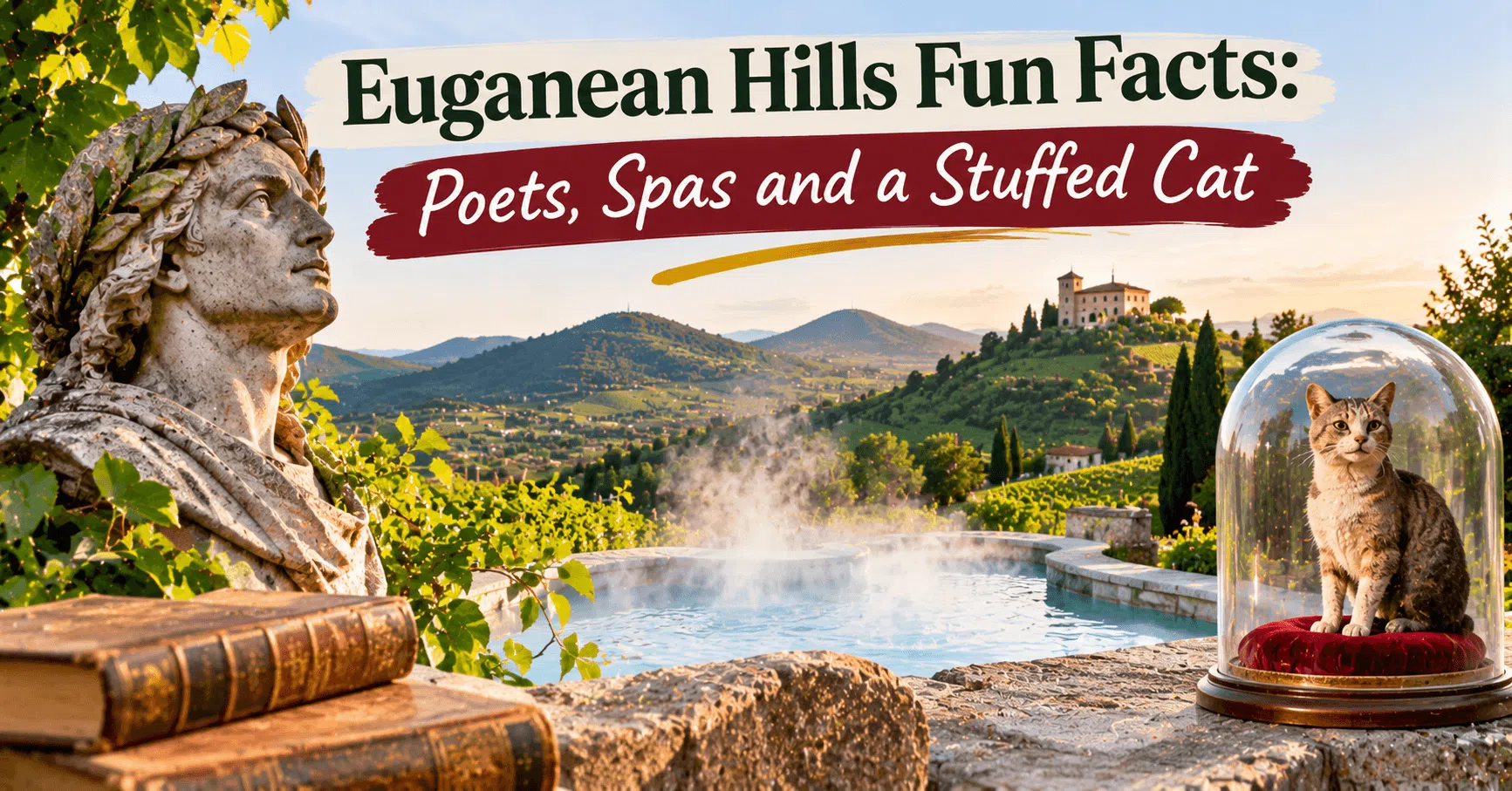
Most hills are happy just being pretty. The Euganean Hills, a short drive south of Padova, also hosted a Roman oracle, two famous English poets and a legendary stuffed cat.
They helped build Venice too. So here are the Euganean Hills fun facts that don’t fit in a wine guide, because the history is better than you’d expect.
Quick Facts
- Where: the Euganean Hills (Colli Euganei), south-west of Padova in Veneto
- Famous for: Petrarch’s last home, ancient hot springs and a stone that paves Venice
- Visiting poets: Byron and Shelley, in 1817 and 1818
- Wine: yes, but that lives in a separate guide
The Hills Are Named After a People Who Lost
The name comes from the Euganei, a loosely defined group of peoples who lived in north-eastern Italy. According to a legend that Livy passed on, the Veneti drove them out. Wikipedia adds that they retreated to the Alpine valleys.
The hills themselves got the name much later. Wikipedia says it dates to the Renaissance and isn’t an ancient ethnic label. So the hills carry the name of a people who lost, and the label only stuck centuries afterwards.
A Roman Oracle Lived in the Hot Springs
The spa towns of Abano and Montegrotto sit at the foot of the hills. According to the Abano Montegrotto tourist board, rites with sacrifices and baths in a sacred lake there date back to the 8th century BC. The cult centred on Aponus, described as the guardian god of springs.
Later, from 49 BC, the area became a Roman municipium and grew into a spa. The writer Suetonius also tells a famous story: before a battle, Tiberius threw golden dice into the spring’s oracle, and both landed on the highest score. He later became emperor. Treat it as a legend, but it’s a good one.
Then the poet Claudian visited between 396 and 399 AD and wrote a poem called “Aponus”. At the end of the 6th century, the Lombards destroyed the town, and the spas faded for centuries.
Venice Walks on Euganean Stone
Here’s the surprise. According to a regional publication on the hills, trachyte from the Euganean Hills paved much of Venice, including lanes, squares and the area around Piazza San Marco and the Riva degli Schiavoni.
The main quarries were at Monselice and Lispida. From there, barges carried the stone toward the lagoon. Its use as paving grew in the 18th century, and in the 19th century quarrying expanded so much that the same source says it badly damaged the slopes.
Venice was not the first, though. Researchers who analysed Roman road paving stones at Adria found that they came from Euganean trachyte, with Monselice among the likely quarries.
Petrarch’s House Still Has His Cat
In 1369, the poet Petrarch was old and ill, and he had a house in Arquà restored as a refuge for his last years. According to the Padova museums, his daughter Francesca, his son-in-law and his granddaughter Eletta lived there with him.
Today the house is a museum. It displays a “legendary stuffed cat” next to the poet’s chair, along with other objects that belonged to him. The rooms were frescoed in the 16th century, with scenes inspired by his Song Book and his poem Africa.
I mention the village in my Colli Euganei wine guide, but the cat deserved its own paragraph.
Byron Rented a Villa and Shelley Wrote a Poem
The hills had literary visitors too. According to Byron’s letters, quoted by the Byronico blog, he rented a villa at Este for two years as a summer home. He also visited Arquà more than once. On an early visit in 1817, he found Petrarch’s tomb in better repair than the house, and called both “ragged” and “poetical”.
Shelley was staying at Este in the autumn of 1818, and his poem “Lines Written Among the Euganean Hills” is dated October of that year. Britannica says that visions arising from the beautiful landscape, seen from a hill near Este, revived him.
To be fair, the Byronico article says Shelley wrote in a letter that the hills were less beautiful than those of Bagni di Lucca. Luckily for the hills, the poem is the one people remember.
And the Wine?
The wine has its own story, so I’ve kept it out of here. If you’d like it, start with my Colli Euganei wine guide. After that, see the wineries you can visit and the story of Fior d’Arancio.
Frequently Asked Questions
Why are they called the Euganean Hills? After the Euganei, an ancient group of peoples in north-eastern Italy. The name for the hills themselves dates to the Renaissance, according to Wikipedia.
Where are the Euganean Hills? South-west of Padova, in Veneto. Venice is further east.
Why does Venice have Euganean stone? Trachyte from quarries such as Monselice and Lispida was shipped to the lagoon and used to pave streets and squares.
Can I visit Petrarch’s house? Yes. It’s a museum in Arquà Petrarca run by the Padova museums. It’s closed on Mondays and some holidays, and opening hours change with the season, so check before you go.
Which famous writers stayed in the hills? Lord Byron rented a villa at Este, and Shelley stayed there in 1818 and wrote a poem about the hills.
What is Aponus? The ancient god of the hot springs near Abano and Montegrotto, according to the local tourist board.
One Last Thing
I love places that have more history than their tourist maps admit. The Euganean Hills have an oracle, a poet’s cat and a good share of Venice’s pavement, and most visitors only come for lunch.
Have you been to Arquà? Tell me if the cat is still sitting by the chair.
— Kelly 🍷
#EuganeanHills #ColliEuganei #Veneto #ItalyTravel
Continue Reading
- Colli Euganei Wine: A Guide to the Hills Near Padova
- Colli Euganei Wineries You Can Visit
- Fior d’Arancio DOCG
- Grape Stomping at Bacco e Arianna
Sources
- Wikipedia: Euganei
- Abano Montegrotto: the history of the thermal springs
- Le Tre Venezie: Euganean Hills trachyte
- Archaeological and Anthropological Sciences: Euganean trachyte at Adria
- Padova Cultura: Casa del Petrarca
- Byronico: In Arquà Petrarca with Foscolo, Lord Byron and the Shelleys
- Britannica: Lines Written Among the Euganean Hills
Information checked in November 2026. Museum hours and tourist details change, so confirm before you go.
Enjoy wine without the snobbery?
Make The Finest Italian Wine one of your Preferred Sources on Google.
Add The Finest Italian Wine to Preferred SourcesDiscover more from The Finest Italian Wine
Subscribe to get the latest posts sent to your email.