Where Did Wine Really Originate From?
If I asked you where wine was invented, what would you say?
France? Italy? Spain?, Maybe Greece?
Honestly, those would have been my guesses too.
After all, they’re the countries we hear about whenever people talk about great wine.
But here’s the part that completely caught me off guard.
Wine didn’t begin in any of them.
Not even close.
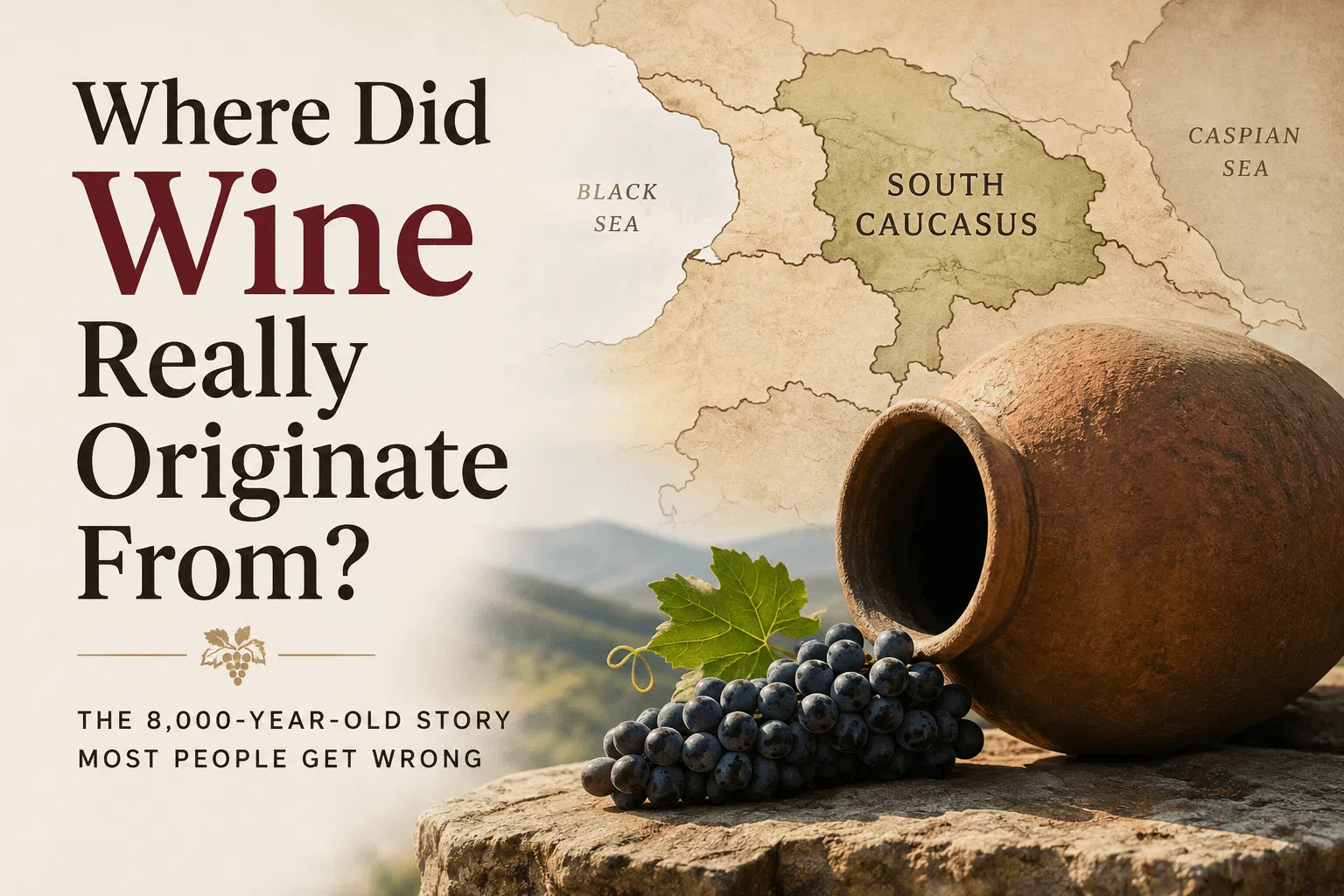
The oldest evidence of winemaking takes us somewhere most people never expect: high up in the mountains between Europe and Asia, in a region called the South Caucasus.
Long before the Romans were building roads.
Long before France became famous for Bordeaux.
Long before anyone had ever heard of Tuscany.
People were already making wine.
And somehow, more than 8,000 years later, we’re still doing essentially the same thing—crushing grapes and letting nature work its magic.
That’s a thought I can’t quite get over.
If ancient wine stories fascinate you, you’ll probably enjoy my guide to History and Origins Every Wine Lover Should Know, where I uncover even more surprising facts about how wine became the drink we know today.
It all started with a few ordinary-looking clay pots
Imagine you’re an archaeologist.
You’re digging through the remains of a tiny Neolithic village when you uncover a handful of cracked clay jars.
At first glance, they don’t look particularly exciting.
Then scientists examine what was left inside.
Tiny traces of tartaric acid—one of the strongest chemical fingerprints of grapes and wine—were still clinging to the pottery.
Eight thousand years later.
Think about that for a second.
Those jars had survived longer than entire civilizations.
Longer than the pyramids.
Longer than Ancient Greece.
Longer than the Roman Empire.
It also made me wonder what the oldest surviving wines actually look like today. Some bottles—and even liquid wine—have lasted for centuries. I rounded up the most remarkable examples in my guide to the 7 Oldest Wines in the World
“Yes… there was wine in here.”
Those remarkable discoveries came from Neolithic sites such as Gadachrili Gora and Shulaveris Gora in modern-day Georgia, dating to around 6000–5800 BCE. At the moment, they’re considered the oldest confirmed chemical evidence of grape wine ever found.
A couple of thousand years later, archaeologists uncovered something even more impressive inside Areni-1 Cave in Armenia.
This wasn’t just a few jars anymore.
There were fermentation vats.
Wine presses.
Storage vessels.
In other words, this wasn’t someone accidentally making wine.
This was a winery.
One of the oldest we’ve ever discovered.
Why did wine begin here?
It almost feels as though nature chose this place.
The forests were full of wild grapevines.
The climate helped grapes thrive.
People were beginning to settle into farming communities instead of constantly moving from place to place.
Everything wine needed was already there.
Looking back, it almost seems inevitable that someone would eventually crush a few grapes, leave them sitting in a clay jar, and come back to discover something completely unexpected.
Not grape juice.
Wine.
Sometimes history’s biggest discoveries don’t happen because someone planned them.
They happen because someone got curious.
The world’s happiest accident
No one knows exactly who made the very first wine.
In fact, they probably weren’t trying to make wine at all.
Imagine harvesting grapes, crushing them into a container, and leaving them alone for a while.
Wild yeast—already living on the grape skins—would quietly begin fermenting the juice.
Without anyone understanding the science, the sweet juice slowly transformed into something entirely different.
It tasted different.
It lasted longer.
And judging by human nature…
People probably wanted another cup.
That’s the moment I love imagining.
Someone takes a sip.
Pauses.
Looks at everyone else.
And thinks,
“We should definitely do that again.”
Whether or not it happened exactly like that, one thing is certain.
People kept repeating the process.
Generation after generation.
Eventually, what started as chance became knowledge.
Knowledge became tradition.
And tradition became one of humanity’s oldest crafts.
Wine didn’t stay in the mountains for long
Once people realized what grapes could become, the idea spread.
Wine travelled with merchants.
With migrating families.
With growing civilizations.
It reached Mesopotamia, where it became part of rituals and royal banquets.
It found its way into Egypt, where pharaohs and priests prized it.
The Greeks embraced it.
The Romans turned it into an empire of vineyards that stretched across Europe.
By the time Italy became one of the world’s great wine regions, wine already had thousands of years of history behind it.
That’s something we don’t often think about.
Italian wine didn’t invent wine.
It inherited one of humanity’s oldest traditions—and then helped perfect it.
If you’re curious how that history eventually shaped the wines we drink today, you’ll find plenty more stories over on the Italian Wine Blog.
The story almost got even more confusing
The South Caucasus currently has the strongest evidence for the birth of grape wine.
But humans everywhere seemed to discover fermentation in one form or another.
Ancient Iran shows evidence of early grape-based fermented drinks.
Greece was making wine thousands of years ago too.
Even Sicily has evidence stretching back several millennia.
And then there’s China, where people were already producing fermented drinks from rice, honey and fruit around 7000 BCE.
Different ingredients.
Different cultures.
The same wonderfully human instinct.
Wine is full of strange stories like this. If you’re the kind of person who enjoys saying, “Wait… I never knew that,” you’ll love these Fascinating Wine Facts that surprise even experienced wine drinkers.
Someone leaves fruit sitting for a while.
Something unexpected happens.
Someone tastes it anyway.
Civilisation quietly changes direction.
Every glass has a beginning
The next time someone tells you wine is an ancient drink…
They’re absolutely right.
But I don’t think most of us really appreciate what ancient actually means.
We’re talking about a drink people were making before the pyramids existed.
Before Rome.
Before Greece became famous.
Before history looked anything like the world we know today.
Somewhere in the South Caucasus, someone crushed a handful of grapes, stored them inside a clay jar, walked away…
…and accidentally changed human history.
Eight thousand years later, we still raise a glass the same way.
I think that’s pretty amazing.
If you ever get the chance to try a traditional Georgian qvevri wine, take it.
It isn’t just another bottle.
It’s about as close as you’ll ever come to tasting where this extraordinary story began.
And once you know where wine really began, you’ll start noticing just how many incredible stories are hiding behind every bottle. That’s exactly why I love uncovering unusual wine facts, forgotten history, and the little details that make every glass far more interesting than it first appears.
Enjoy wine without the snobbery?
Make The Finest Italian Wine one of your Preferred Sources on Google.
Add The Finest Italian Wine to Preferred SourcesDiscover more from The Finest Italian Wine
Subscribe to get the latest posts sent to your email.