The Roman Emperor Who Banned Vineyards (Then Backed Down)
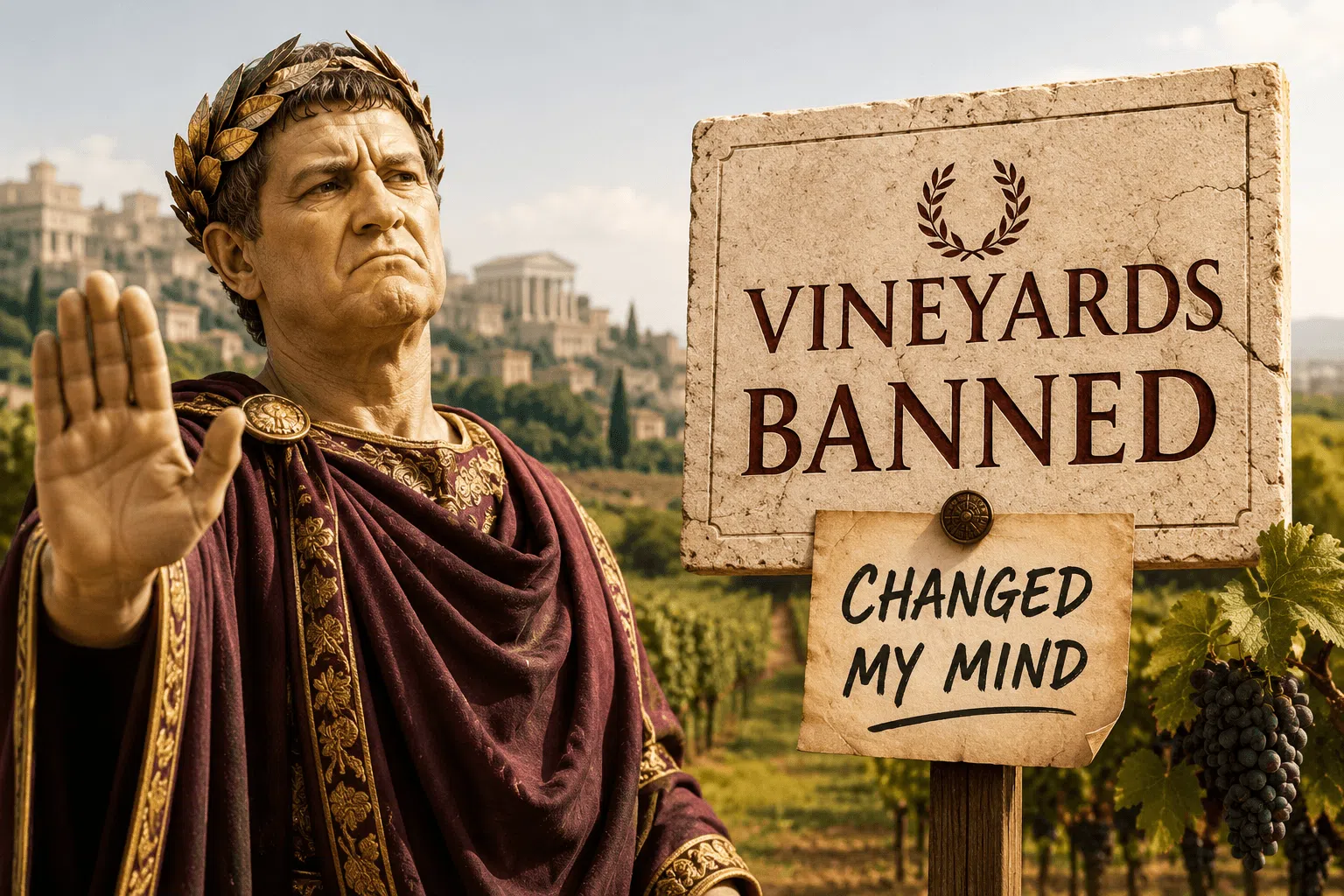
There’s a two-thousand-year-old law that technically banned people from planting new vineyards in Italy. Nobody’s enforced it in nearly two millennia. Nobody’s even tried in centuries. And here’s the part I love: the emperor who wrote it gave up enforcing it within his own lifetime.
I stumbled onto this chasing a completely different rabbit hole. It’s now the one piece of Roman history I bring up unprompted at dinner. Rome genuinely tried to legislate its own wine industry into retreat. It might be the oldest wine law on record. And it failed so completely that the failure makes a better story than the ban ever did.
An Emperor With a Grain Problem and a Grudge
In 92 CE, the emperor Domitian looked at two numbers that worried him: a bumper wine harvest and a grain shortage, happening at the same time. He concluded that Italy’s farmers were planting vines where they should have planted wheat. Rome’s food supply, he believed, was paying the price.
Whether that math held up is a fair question historians still poke at. What isn’t in question: Domitian believed it. And as emperor, believing something was most of what he needed to act on it.
This, for context, is also the man Suetonius describes catching flies alone in his private rooms and stabbing them with a sharpened stylus. I mention that not as a random aside. It’s the same personality behind the vineyard law: precise, a little unsettling, and utterly convinced that a sharp enough instrument could fix anything.
What the Edict Said, Word for Word
Suetonius is our main source for this. He says Domitian issued an edict banning any new vineyard planting in Italy. He also ordered growers in the provinces to cut their vineyards back, leaving at most half standing.
That’s a real, specific, two-part law — not folklore that wine forums passed down. It’s worth being precise about what it left alone: existing vineyards inside Italy stayed untouched. The law targeted new planting in Italy, and roughly half of what already grew out in the provinces.
So Did Anyone Comply?
Mostly, no. This is where the popular version of this story usually goes wrong — the one where a Roman emperor “destroyed Italy’s wine industry” in one dramatic stroke.
Suetonius says outright that Domitian did not persist in carrying the measure out. Historians who’ve studied what survives generally agree: Rome announced the order with far more confidence than it ever enforced it. The provinces, in particular, were a long, slow ride from anyone with the authority to check.
Put yourself in a provincial landowner’s boots for a second. Your vineyard is profitable. It’s taxed. Local trade runs on it. Then a letter arrives from a capital thousands of miles away. It orders you to rip out half your vines, for the sake of a grain supply you’ll personally never eat a bite of.
You can imagine how enthusiastically people complied.
On the Books for 188 Years, Enforced for About Five Minutes
Here’s the detail almost every retelling leaves out: Domitian’s edict technically stayed law for close to two centuries. Nobody formally repealed it for a very long time. But whether anyone still enforced it by year fifty of that stretch is a much shakier claim than the original ban.
Wine wasn’t a side hustle in the Roman economy. It ran through trade routes, tax revenue, religious ritual, and daily meals across the empire. You don’t legislate an industry that deeply embedded out of existence with one imperial memo. Apparently even Domitian figured that out faster than his own law’s paperwork did.
Two Hundred Years Later, Someone Finally Said It Out Loud
Later sources credit Emperor Probus, somewhere around 280 CE, with formally reversing the restriction. He actively encouraged new vineyard planting again — including out toward Gaul, territory that would eventually become some of France’s most important wine country.
The mechanics of exactly how that reversal happened are murkier than Domitian’s original edict, so it’s worth holding loosely rather than picturing one dramatic repeal ceremony. But the broad arc holds up: Rome tried to restrain its own wine industry, mostly failed to enforce the attempt, and roughly two centuries later formally stopped pretending otherwise.
The One Thing That Beat an Emperor
The tempting headline is “a Roman emperor tried to destroy Italy’s wine industry.” It overstates things. The smaller, truer version is more interesting anyway: an emperor with the power to execute senators tried to slow down an industry that had already gotten too big, too profitable, and too woven into daily life to legislate backward. By most accounts, he seemed to know it wasn’t working before his own reign was even over.
Wine has outlasted plague, war, phylloxera, and prohibition movements on at least three continents. Apparently it also outlasted a man who spent his afternoons stabbing flies for sport. That tells you something worth remembering: wine has never once been just a drink. It’s been land, money, ritual, and pure stubbornness, going back at least as far as the first century.
Nobody’s Counting Vines Here Anymore
I think about this law sometimes, driving past the vineyards near where I live. These hillsides stretch further than any Roman inspector could have realistically ridden in a week, let alone counted by hand. Italy doesn’t restrict vineyards today. It builds entire legal systems — DOCG, DOC — specifically to protect them. A hillside full of vines counts as heritage now, not a threat to the wheat supply.
This would probably baffle Domitian. I’d like to think that’s a little bit funny, two thousand years on.
Continue Exploring
- Where Did Wine Really Originate From?
- History and Origins Every Wine Lover Should Know (Internal link:
/wine-facts-history-and-origins-of-wine/) - The Roman Kiss That Was Actually a Wine Test (Internal link:
/did-roman-women-drink-wine/) - More Wine History
Enjoy wine without the snobbery?
Make The Finest Italian Wine one of your Preferred Sources on Google.
Add The Finest Italian Wine to Preferred SourcesDiscover more from The Finest Italian Wine
Subscribe to get the latest posts sent to your email.