
The Roman Kiss That Was Actually a Wine Test
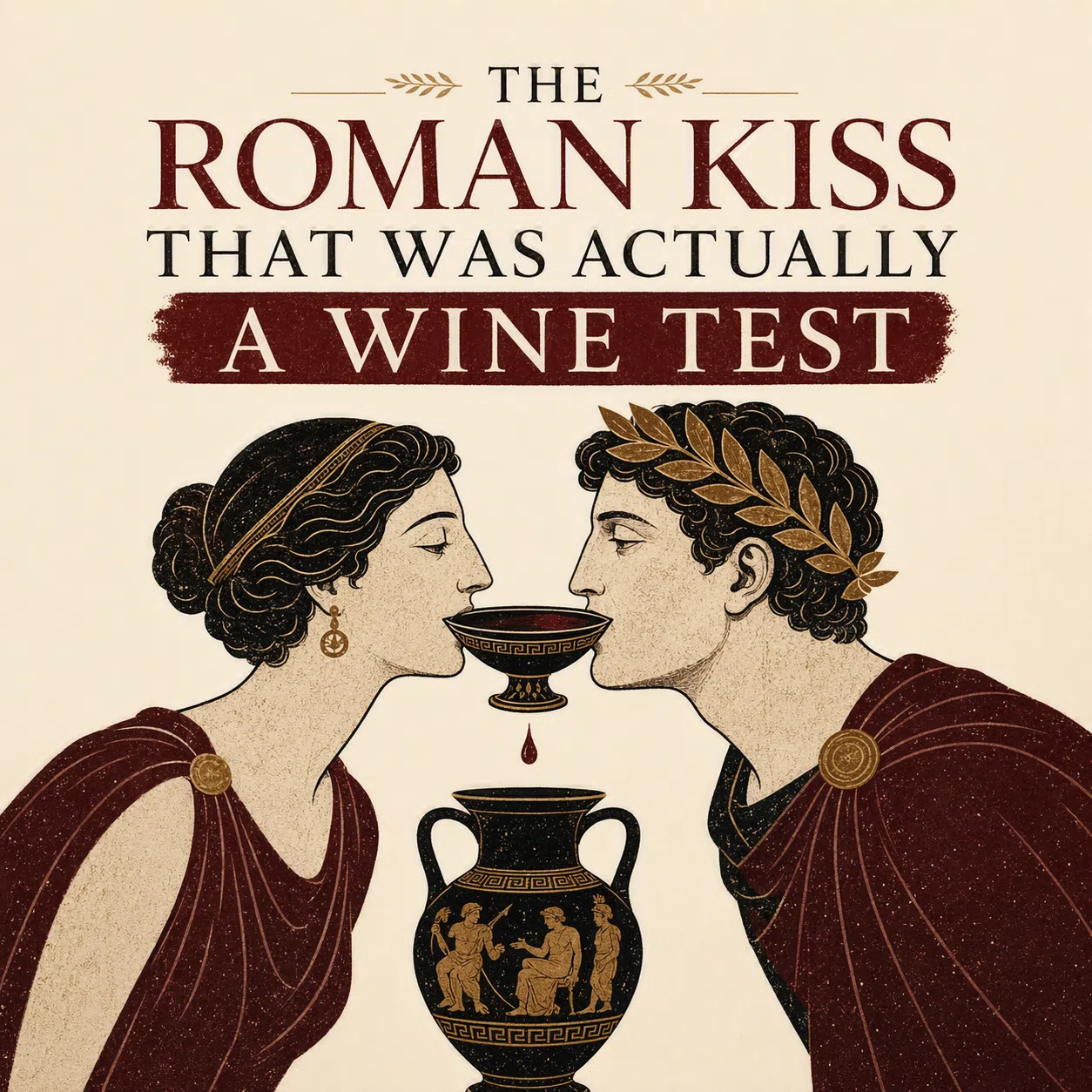
Picture coming home from dinner with friends in ancient Rome. Before your husband asks how the evening went, he leans in and kisses you. Not hello. Not because he missed you.
Because he’s checking whether you’ve been drinking.
I read that sentence three times before I believed it wasn’t a joke. Roman writers genuinely describe a custom like this, and it had a name: the ius osculi — the “right of the kiss.” Husbands got it. So did fathers, brothers, and apparently male cousins going back several degrees, which is a lot of people entitled to smell your breath on a given afternoon.
The story usually gets told as a flat rule: Roman women weren’t allowed to drink wine, full stop, and the kiss enforced it. That version isn’t wrong, exactly. It’s just missing almost everything that makes it actually interesting.
This Was Never a Romantic Gesture
The ius osculi shows up in Roman sources as a genuine social custom, not a fringe rumor — Aulus Gellius wrote about it directly, describing Cato the Elder recounting exactly why male relatives were entitled to that kiss. It wasn’t affection. It was inspection, dressed up as greeting.
Worth being honest about the evidence here: this comes from ancient writers and later Roman accounts, not from a legal tablet unearthed with the rule engraved on it. Some modern historians treat the custom’s exact enforcement with real skepticism — how literally, how often, how universally it was actually practiced is genuinely debated. But the fact that Roman writers felt the need to describe it at all tells you something on its own.
Why Wine, Specifically, Got Treated Like a Threat
Rome wasn’t worried about hangovers. It was worried about control.
Wine in Roman religious life was tied to ritual and to Bacchus, a god whose whole reputation was built on the loss of self-control. Roman society, meanwhile, was deeply preoccupied with marriage, inheritance, and family reputation — and a woman’s sexuality sat right at the center of all three. Drunkenness was linked, explicitly, to fears of adultery. Aulus Gellius records that a woman caught drinking wine could face the same severity as one caught in adultery, which tells you plainly that this was never really about the alcohol.
It was about who got to lose control in public, and who didn’t.
One Latin Word Rewrites the Whole Rule
Here’s the part almost nobody includes when they tell this story, and it’s the part that actually matters.
The Roman word for the wine women were forbidden was temetum — not the general word vinum, but a specific term for strong, unmixed wine. Recent scholarship (a 2021 study by classicist Paulina Komar builds directly on this) argues the taboo may have applied specifically to that category, not to every fermented drink a woman could put in a cup.
Gellius’ own account backs this up. Women weren’t allowed temetum — but he lists what they could drink: lora, a lighter wine pressed from the grape remains left after the main pressing, passum, a sweet raisin wine, and murrina, wine flavored with myrrh and spices. That’s not “no wine, ever.” That’s “not this particular strong, sacred category of wine.”
The headline version of this story is “Roman women couldn’t drink wine.” The truer version is “a specific, potent, ritually-loaded wine was restricted, and everything else in the cup was fair game.” One of those is a rule about alcohol. The other is a rule about status, ritual access, and who got to touch the sacred stuff.
So Did Roman Women Really Never Drink Wine?
No — and treating the absolute version as fact is where most retellings of this story go wrong.
Between the sweetened wines, the diluted styles, certain ceremonial drinks, and the lora Gellius specifically names, there’s real evidence women had wine in their lives regularly. What varied — by period, by social class, by exactly which wine was in the cup — was access to the strong, unmixed kind carrying the most ritual weight.
What Happened to the Rule?
It didn’t vanish on a specific date. It just lost its grip as Rome itself changed.
By the late Republic, even famously old-fashioned Romans were shifting position — Cato the Younger, no one’s idea of a liberal reformer, started recommending wine as a health measure for both men and women, and reportedly even for enslaved people. A custom built on strict ritual control doesn’t survive contact with a society that’s decided wine is medicine for everyone.
The Part That’s Actually Uncomfortable
The strange breath-check custom isn’t really the story. The story is what it reveals.
Wine in Rome was never only a drink. It was tied to religion, to who inherited what, to who was trusted to behave, and to which bodies were allowed to lose control in public and which weren’t. A rule about a cup of wine turns out to be a rule about almost everything else.
From a Kiss That Checked Your Breath to a Nonna Who Just Pours
What gets me, writing this from Italy two thousand years later, is the distance between that world and the one sitting at an Italian table today.
I’ve written before about what Italian grandmothers actually do with wine — and it’s the opposite of inspection. Nobody’s checking anyone’s breath. The bottle goes on the table, glasses get filled without ceremony, and the wine is just part of the meal, the way bread is. Somewhere between a Roman husband leaning in to sniff his wife’s mouth and a nonna topping up everyone’s glass without a second thought, wine stopped being a thing you had to earn access to and just became something you shared.
That’s not a small journey. It just took about two thousand years.
Continue Exploring
- Where Did Wine Really Originate From?
- What Italian Grandmothers Know About Italian Wine
- History and Origins Every Wine Lover Should Know
- More Wine History
Enjoy wine without the snobbery?
Make The Finest Italian Wine one of your Preferred Sources on Google.
Add The Finest Italian Wine to Preferred SourcesDiscover more from The Finest Italian Wine
Subscribe to get the latest posts sent to your email.