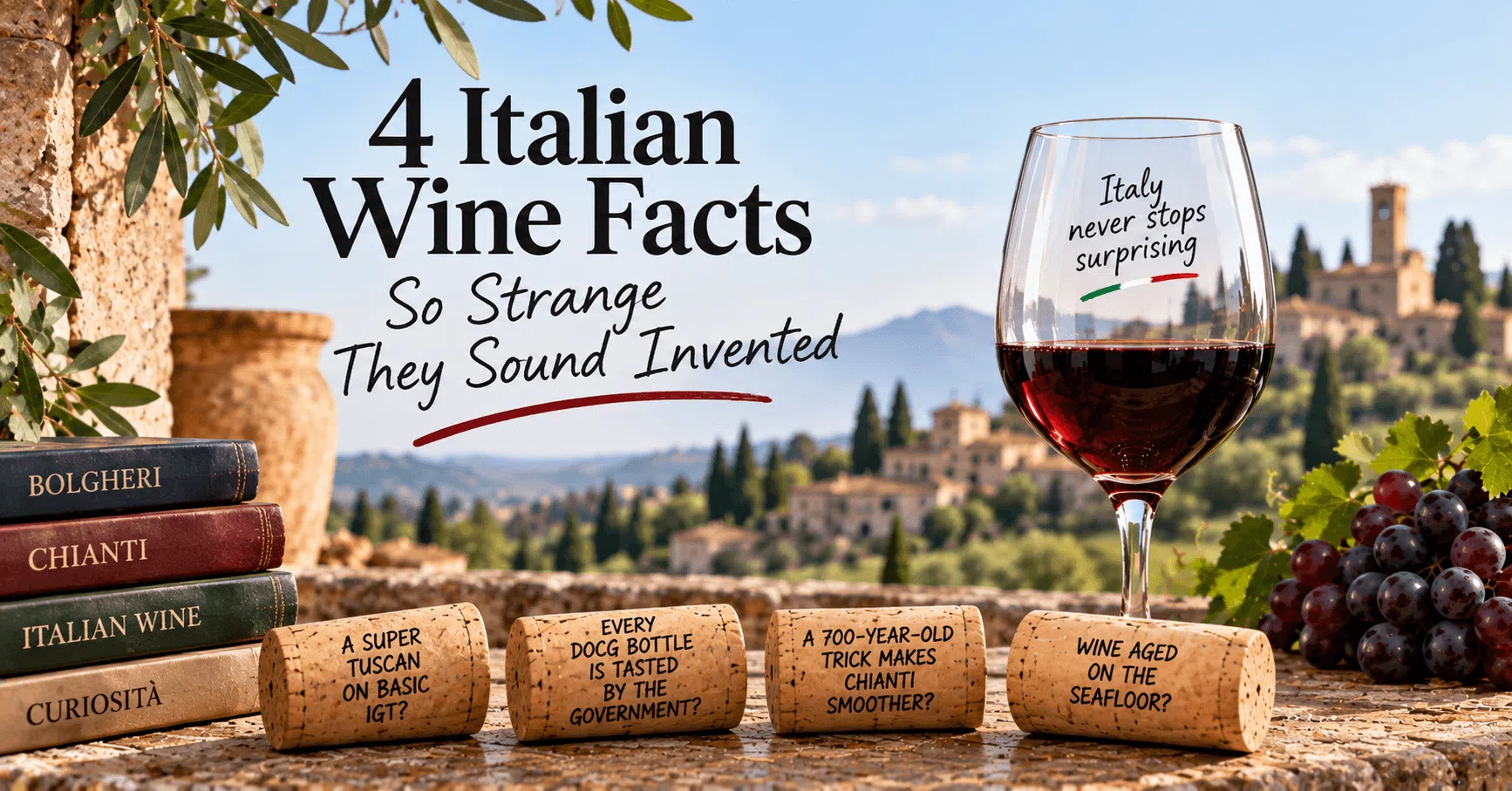
4 Italian Wine Facts So Strange They Sound Invented
Italy loves rules. Denominations, sub-zones, grape percentages down to the decimal, government seals on the cork. You’d think a country this obsessed with paperwork would produce wine that’s tidy and predictable.
It doesn’t. Some of the strangest, most rule-breaking things in Italian wine happen precisely because the country takes its own rulebook so seriously that reality keeps finding ways around it. Here are four facts that prove it, starting with the one that should annoy every wine snob you know.
Quick Facts
- One of Italy’s most famous reds, Sassicaia, was classified as basic IGT wine (just one rung above bulk wine, not even DOC) for years because it broke Bolgheri’s rules
- Every single bottle of DOCG wine has to pass a government tasting panel before it can legally use that label
- A 700-year-old Tuscan technique called governo adds a second fermentation to soften and enrich Chianti
- Several Italian wineries now age wine on the seafloor, on purpose, and it actually changes the wine
1. One of Italy’s Most Famous Reds Was Classified as Basically Bulk Wine
Sassicaia is the Tuscan cult red that now sells for hundreds of dollars a bottle and gets name-dropped by critics like it’s a minor deity. For decades, it carried a classification called IGT, just one rung above Italy’s most basic bulk-wine category. Not even DOC. Nowhere near DOCG.
Why? Because Sassicaia used Cabernet Sauvignon instead of the grapes its home region of Bolgheri actually approved. On paper, it wasn’t even trying to be a serious wine.
It was, obviously, one of the best wines Italy has ever produced. The label just hadn’t caught up yet. It took until 1994 for Bolgheri to create a dedicated sub-appellation, Bolgheri Sassicaia DOC, specifically so the paperwork could finally admit what everyone had already been saying at the table for years.
We’ve said before that you don’t need the full lecture on Italian appellation law while standing in a supermarket aisle. Sassicaia is the reason that lecture exists at all.
2. Every Single Bottle of DOCG Wine Has to Pass a Government Taste Test
Most countries let winemakers slap a quality label on their own bottle and call it a day. Italy does not trust anyone that much.
DOCG, Denominazione di Origine Controllata e Garantita, is the top tier of Italian wine classification. It was created in 1980, and the first regions to earn it were Barolo, Barbaresco, Brunello di Montalcino, and Vino Nobile di Montepulciano. Today there are around 77 DOCG zones, mostly clustered in Piedmont, Tuscany, and Veneto.
Here’s the part people don’t expect: earning DOCG status isn’t a one-time award for a region. Every single vintage, from every single producer, has to pass inspection first. That means a mandatory lab analysis, plus a government tasting panel, before the label can legally go on the bottle. Government-appointed tasters sit in a room and decide whether your wine is good enough to say what it actually is.
Fail that panel, and your wine gets bumped down to a lower category, IGT or basic table wine. It doesn’t matter how famous your vineyard is or how much you charged for the bottle. Pass, and you get a numbered paper seal called a fascetta, wrapped across the neck or cork. It exists to stop anyone from refilling an empty bottle with cheaper wine and reselling it as the good stuff. Pink seals for red wine, green for white.
It’s part quality control, part anti-fraud measure, and part bureaucratic theater. And it’s the same system that ranked a brilliant wine like Sassicaia below wines that weren’t nearly as good, simply for using the wrong grapes at the wrong address.
3. The 700-Year-Old Trick Hiding Inside Your Chianti
If you’ve ever compared a basic Chianti to a Chianti Classico Riserva and wondered why one feels so much rounder than the other, part of the answer is a trick most drinkers have never heard of.
Long before anyone argued about natural wine or minimal intervention, Tuscan producers were doing something that sounds almost like cheating. They were fermenting the same wine twice.
The technique is called governo all’uso Toscano, and it dates back to at least the 14th century. Basically, Tuscan winemakers figured out how to give a thin wine a second chance, using nothing but grapes, patience, and a bit of nerve.
Here’s how it works. Winemakers set aside a small portion of the harvest, usually 5 to 15 percent, and let it dry out for weeks on bamboo racks instead of pressing it right away. Canaiolo is the traditional grape for the job, mostly because it shrugs off rot better than its neighbors while sitting around going raisin-like for four to seven weeks. Once the main wine finishes its first fermentation, usually late November, someone presses those half-dried grapes and pours the sugary result straight back in. That restarts fermentation all over again, sometimes running clear into spring.
Why bother? Because the payoff is a wine with a touch more alcohol, softer tannins, and a rounder, silkier texture, courtesy of the glycerol that shows up along the way. It’s a fix for a wine that came out too lean or too harsh, and it doesn’t need a single additive to do it.
For most of the 20th century, governo nearly vanished. Producers chasing an international, Bordeaux-style reputation for Chianti saw it as old-fashioned, a relic from when the wine needed help. Modern Chianti DOC and Chianti Classico DOCG rules still permit it today, capped at 5 percent of the final blend, and a newer generation of traditionalist producers has quietly brought it back. Not because Chianti needs rescuing anymore. Just because some old tricks were never actually a workaround. They were just good winemaking.
4. Some Winemakers Are Aging Wine at the Bottom of the Sea
Governo sounds like a clever workaround from centuries ago. This next one sounds like a bad idea from a wine influencer with too much scuba gear. Except it isn’t a gimmick, and it works.
It started in 2009. A Ligurian winery called Bisson, run by Piero Lugano, submerged 6,500 bottles of sparkling wine off the coast near Portofino. The depth: roughly 60 meters. The inspiration wasn’t a marketing meeting. It was archaeology. Ancient Mediterranean shipwrecks kept turning up amphorae of wine that had survived astonishingly well, and Lugano wanted to know why.
Turns out the seafloor offers something almost no cellar can replicate. Total darkness. Near-zero oxygen exposure. A rock-steady temperature around 15°C. And just enough gentle wave motion to keep the wine moving without ever shaking it violently. For sparkling wine specifically, the water pressure at that depth roughly matches the pressure already inside the bottle. That’s exactly the kind of coincidence winemakers love to talk about at dinner parties.
The idea spread. A winery in Emilia-Romagna now ages Sangiovese and Cabernet blends inside a sunken 1965 oil platform. A Sardinian producer submerges Vermentino near a protected marine park. In Tuscany, one estate skips the bottles and submerges actual clay amphorae, the way the Romans did it by accident. There’s even an annual “Congress of Underwater Wine” now, because of course there is.
Does it make the wine better? That depends who you ask, and it’s still being studied seriously rather than just marketed enthusiastically. But it does make the wine different. That’s the strange part. Most of the wine industry obsesses over controlling every variable. Here’s a handful of winemakers doing the opposite: handing their best bottles to the ocean, then waiting to see what happens.
Frequently Asked Questions
Was Sassicaia the only wine that had this problem? Not even close. Tignanello and Ornellaia both started out labeled as basic table wine or IGT for the same reason: they used grapes their region hadn’t approved. The whole “Super Tuscan” category exists because enough top producers ran into that same wall.
Does the governo technique add sweetness to the wine? A little, but it’s usually subtle rather than sweet. The bigger effect is texture and alcohol, not sugar. Most governo-treated wines still finish dry.
Can any wine be aged underwater, or does it only work for sparkling wine? Sparkling wine was first because the water pressure lines up with the bottle’s internal pressure, but producers are now submerging still reds and whites too, usually in protective cages rather than relying on pressure matching.
What happens to a wine that fails its DOCG tasting panel? It gets declassified. The producer can still sell it, just under a lower label like IGT, at a lower price, no matter how much time or money went into making it.
Four facts, one pattern. Italy writes the strictest wine rules on Earth, and then its own winemakers spend centuries finding brilliant, sanctioned, occasionally soggy ways around them. That’s not a flaw in the system. That’s what happens when humans, obsessed with doing things exactly right, get to build the rules.
— Kelly 🍷
#ItalianWine #WineFacts #Sassicaia #WineEducation #ChiantiWine
Enjoy wine without the snobbery?
Make The Finest Italian Wine one of your Preferred Sources on Google.
Add The Finest Italian Wine to Preferred SourcesDiscover more from The Finest Italian Wine
Subscribe to get the latest posts sent to your email.