Prosecco Exports to China Jumped 30%. Here’s Why That Number Is Smaller Than It Sounds.
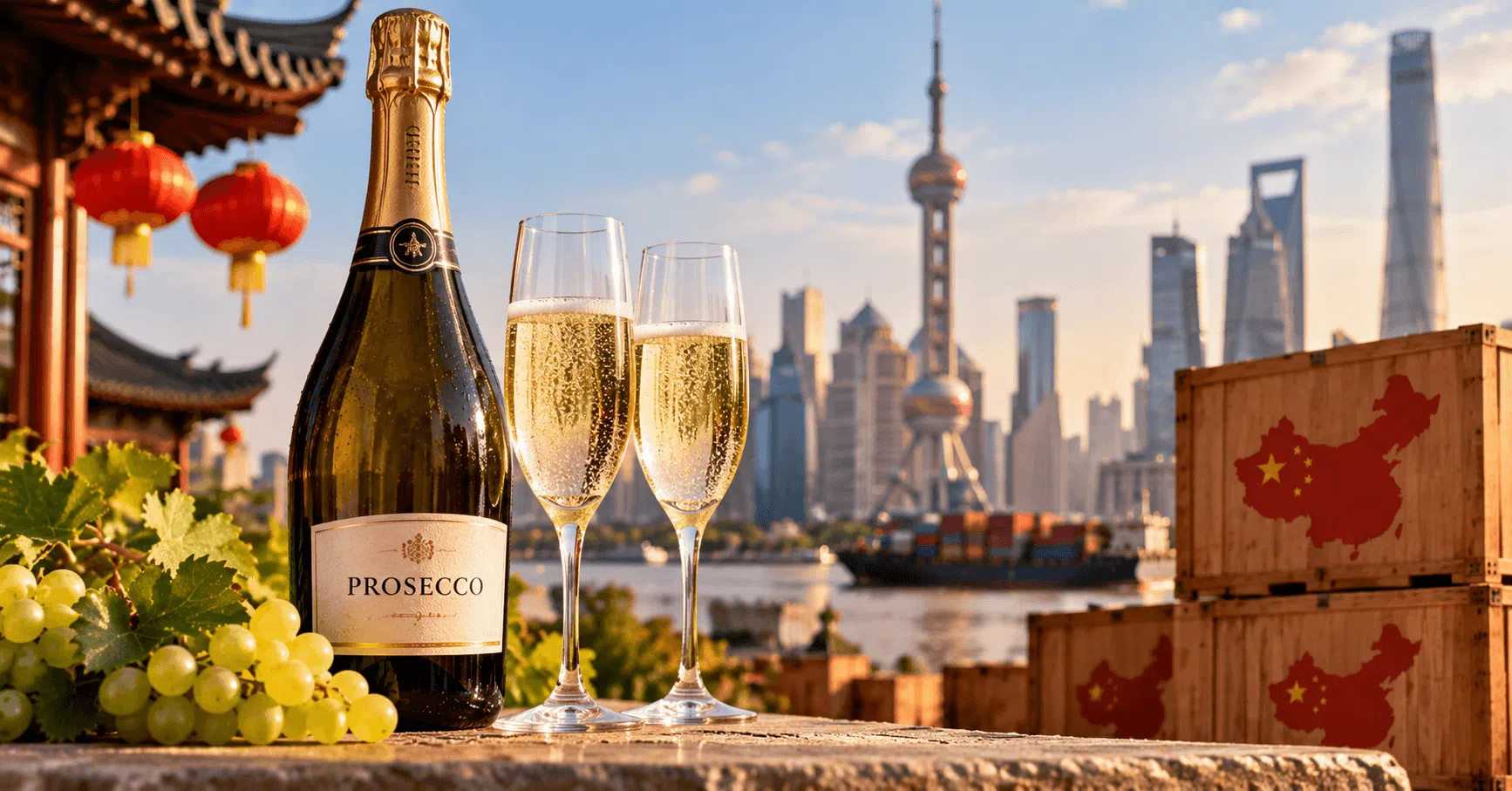
What would you do if an Italian wine consortium asked you how to sell Prosecco in China? Put a glamorous model in an advert? Show a vineyard in Veneto? A group of Beijing university students had other ideas, and the story of Prosecco in China turns out to be funnier, and more honest, than the headline suggests.
According to the Prosecco DOC Consortium, exports to China rose by more than 30% in the first half of 2026. That sounds like a triumph. But the same reports put the whole Chinese market at about one million bottles a year, which is roughly 0.2% of the denomination’s exports. So why is Italy still asking students for help? Let’s look at the number properly, because it’s the best “oh really” in the story.
Quick Facts
- Prosecco DOC exports to China grew by more than 30% in the first half of 2026 compared with the same period of 2025
- China takes about one million bottles a year, around 0.2% of Prosecco DOC’s export volume
- Prosecco DOC produced 667 million bottles in 2025
- In October 2026, the consortium ran two Beijing masterclasses with more than 100 students from two universities
- The students’ ideas are creative proposals, not confirmed campaigns
Prosecco in China: What +30% Really Means
Percentages are slippery. If a shop sells 100 bottles one year and 130 the next, that’s 30% growth, and wonderful news for whoever sold the extra 30. It doesn’t make that shop bigger than one selling a million.
Here is the scale Prosecco is dealing with:
| Prosecco DOC | Figure |
|---|---|
| Production in 2025 | 667 million bottles |
| Share of sales going abroad | About 82% |
| China, per year | About 1 million bottles |
| China’s share of export volume | About 0.2% |
| Growth in China, first half of 2026 | More than 30% |
One caution before you quote those numbers. The 30% covers the first half of 2026, while the one-million-bottle figure is an annual estimate, so they aren’t measurements of the same period. The headline takeaway is simple: China is growing fast, but from a very small base. The consortium’s president, Giancarlo Guidolin, called it an excellent +30%, and he’s right to be pleased. He’s also not pretending the job is finished.
Italy Asked 100 Students for Ideas
In October 2026, the consortium reported on two masterclasses in Beijing, organised with the University of International Business and Economics and the Beijing Language and Culture University. More than 100 students took part. The sommelier David Cheng walked them through Prosecco’s history and the Martinotti method, where the second fermentation happens in pressurised tanks. They tasted wines from 13 producers, including Bottega, La Gioiosa, Masottina and Valdo, and they learned to make a Spritz.
Then came the interesting part. The organisers asked the students how they would present Prosecco to people their own age. They didn’t reach for the usual Italian postcard. These were their ideas:
| Area | The students’ idea |
|---|---|
| The name | Chinese characters suggesting joy, effervescence and conviviality, or a guest arriving from afar |
| Media | Partnerships with wellness and slow-living TV programmes and local personalities |
| Branding | Campaigns inspired by guochao, the trend of reinterpreting Chinese culture in a contemporary way |
| Occasions | Prosecco for relaxed afternoon moments, not only for dinners and celebrations |
My favourite is the guest arriving from afar. Instead of selling Prosecco as an expensive foreign luxury, you sell it as a visitor who turns up to share a happy moment. The students weren’t just translating a name. They were translating a feeling.
Didn’t Italy Try This Before?
Yes, and that’s the second “oh really”. The consortium opened its first overseas office, Casa Prosecco, in Xi’an back in 2016. At the time, its director Luca Giavi said China represented only 1% of its exports and the consortium expected that share to triple within three years. Today, reports put China at about 0.2% of export volume.
I wouldn’t read too much into comparing those two figures, since they come from different years and sources, and Prosecco’s other markets have grown enormously. But it shows the pattern: China has looked like the next big thing for Prosecco for a decade, and it keeps being a market that needs patience. Casa Prosecco China is still active, running training, tastings, masterclasses and business meetings, so the Beijing sessions are part of a long game rather than a sudden idea.
The Spritz Question
Of course the Italians brought a Spritz. It makes sense, because a Spritz can introduce someone to Prosecco through a drink that feels more approachable than a straight glass of sparkling wine. I wouldn’t claim the Spritz explains the 30%, though, since no source connects the two. What the demonstration does show is how the consortium wants to present the wine: as a social experience rather than a bottle on a shelf.
That’s very different from selling on discount. And it connects to something I like about how Prosecco works at home: it isn’t a wine you need to study before ordering. If you want to see what makes it so easy to love, I wrote The Complete Guide to Prosecco: Italy’s Most Joyful Wine, and if you’ve ever wondered what the sweetness words on the label mean, The Biggest Lie on a Prosecco Label (Extra Dry vs Brut) sorts it out.
Has China Fallen in Love With Prosecco?
Not yet, and the honest answer is that nobody knows. The enthusiasm from the Beijing events comes from the organisers themselves, which tells us what happened in the room but isn’t independent proof of a change in Chinese drinking habits. We don’t know whether the students’ ideas will become real campaigns, whether they’ll influence sales or whether the 30% will repeat.
But I like the direction. You can export a bottle. You can’t automatically export the habits that made people love it. Instead of assuming that one message works everywhere, the consortium asked young Chinese consumers what Prosecco could mean in their lives, and they came back with relaxation, welcome and small everyday pleasures.
Frequently Asked Questions
How much did Prosecco sales in China grow in 2026? The Prosecco DOC Consortium reports that exports to China rose by more than 30% in the first half of 2026 compared with the same period in 2025.
Is China a big market for Prosecco? Not yet. Reports put it at about one million bottles a year, roughly 0.2% of Prosecco DOC’s export volume.
Why did the consortium run masterclasses in Beijing? To introduce Prosecco to more than 100 students and gather their ideas on presenting the wine to younger Chinese consumers.
What did the students suggest? Chinese names suggesting joy and welcome, partnerships with slow-living TV programmes, guochao-inspired branding and relaxed afternoon occasions.
What is Casa Prosecco China? The consortium’s information and promotion office, based in Xi’an, which supports training, tastings and business meetings in China.
Does the growth mean Prosecco is popular across China? No. The growth is encouraging, but the market is still very small compared with Prosecco’s biggest ones.
One Last Thing
What I like most about this story is that the best idea may not come from Italy. Italy brought the Prosecco, and the students brought the questions. If their ideas help more people discover the wine, the best result won’t be another percentage. It will be somebody in China reaching for a bottle without needing anyone to explain why.
Would you drink Prosecco differently if nobody had ever told you how Italians do it? I’d love to hear your answer.
— Kelly 🍷
#Prosecco #ProseccoDOC #ItalianWine #WineExports
Continue Reading
- The Complete Guide to Prosecco: Italy’s Most Joyful Wine
- The Biggest Lie on a Prosecco Label (Extra Dry vs Brut)
- Best Italian Wines Under €20
Sources
- Italia a Tavola: Prosecco Doc, in Cina vendite in crescita del 30% (in Italian)
- I Grandi Vini: Prosecco DOC cresce in Cina con export a +30% nel 2026 (in Italian)
- Qualivita: Prosecco DOP in Cina, la Gen Z di Pechino ridisegna le bollicine (in Italian)
- Wine Industry Advisor: Prosecco DOC production reaches 667 million bottles in 2025
- Beverfood: Prosecco alla conquista della Cina con la Casa del Prosecco a Xi’an (2016) (in Italian)
Enjoy wine without the snobbery?
Make The Finest Italian Wine one of your Preferred Sources on Google.
Add The Finest Italian Wine to Preferred SourcesDiscover more from The Finest Italian Wine
Subscribe to get the latest posts sent to your email.