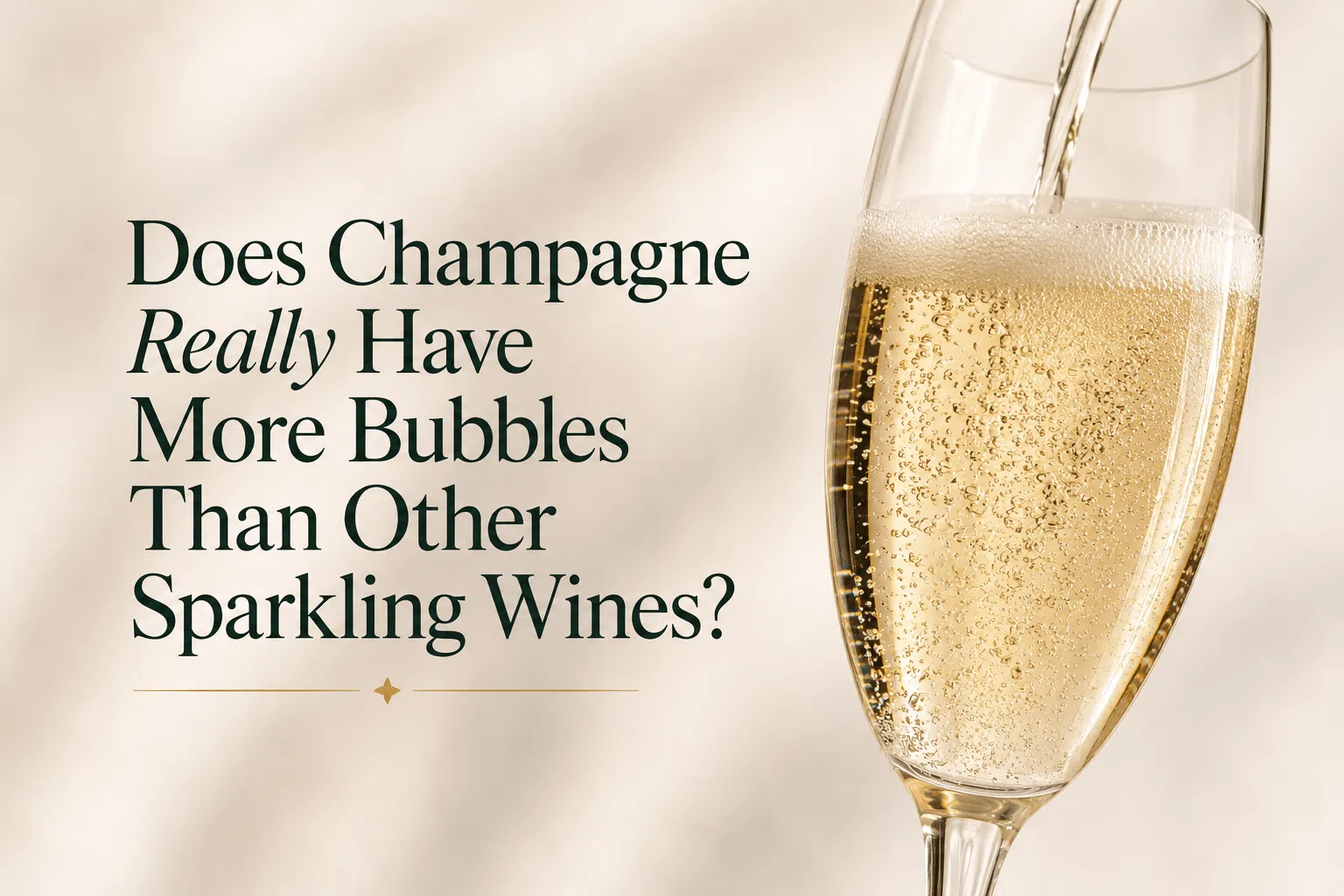
Does Champagne Really Have More Bubbles Than Other Sparkling Wines?
Quick Guide — The Bubble Myth
- The myth: More bubbles in your glass means higher quality sparkling wine
- The truth: Bubble count depends on production method, glass shape, temperature — and even tiny scratches at the bottom of your glass. It has almost nothing to do with quality.
- What actually matters: How the bubbles feel, not how many there are. Integrated and creamy beats aggressive and loud, every time.
- The real difference: Champagne and traditional-method Italian sparklers (Franciacorta, Trentodoc) use bottle fermentation and years of ageing. Prosecco uses the tank method and is built for freshness, not longevity.
Watch anyone’s face the moment a glass of something sparkling gets poured in front of them.
Nobody smells it first. Nobody looks at the colour. Nobody thinks, even for a second, about the grapes or the hillside they came from.
Everyone watches the bubbles.
I’ve seen it happen at a hundred dinner tables in Veneto — the pour goes in, and for about four seconds the whole table goes quiet and just stares at the glass like it’s about to say something. It’s a strange, lovely, slightly ridiculous human habit. And somewhere along the way, that habit turned into a belief: more bubbles must mean better wine.
It doesn’t. And once you know why, you’ll never look at a glass the same way again.
Does Champagne Actually Have More Bubbles Than Other Sparkling Wine?
Not really — not in the way people assume.
How many bubbles show up in your glass has very little to do with how expensive or prestigious the bottle is. It comes down to how the wine was made, how much carbon dioxide got trapped inside it, the temperature it’s served at, and — this is the part that surprises people every time I mention it — the actual glass you’re drinking from.
Most wine glasses have tiny imperfections etched into the bottom on purpose. Bubbles need somewhere to start from, and glassmakers know it. That perfect, elegant stream rising up through your Champagne isn’t really about the wine at all. Half the time, it’s your glassware quietly doing its job.
Which means the person confidently telling you their Champagne is superior because “look how much it’s fizzing” is, technically, complimenting their own drinkware.
I think about that more than I probably should.
So Why Does Champagne Get All the Credit?
Because Champagne isn’t really selling you bubbles. It’s selling you a story, and it’s been selling that story extremely well for a very long time.
Weddings. Promotions. New Year’s Eve. The sound of a cork popping has become shorthand for “something good just happened here,” and that association didn’t happen by accident — it happened over centuries, through royal endorsements, careful branding, and a region that protected its name fiercely enough to make sure nobody else could borrow it.
None of that is a criticism. It’s genuinely clever. But it means a lot of what people are responding to when they see those bubbles rise isn’t really about what’s happening in the glass. It’s about what’s happening in their memory of every celebration they’ve ever had.
Why Do Champagne’s Bubbles Feel Different, Then?
This is where Champagne actually earns its reputation — just not for the reason most people think.
Champagne goes through the traditional method, meaning the second fermentation happens inside the individual bottle you eventually drink from, not in a tank somewhere. The carbon dioxide gets trapped in there, and then — this is the part that costs money and patience — the wine sits. Sometimes for years. That long, slow ageing changes the texture of the bubbles completely. They stop feeling sharp and start feeling integrated, almost creamy, the kind of fizz that doesn’t announce itself so much as quietly settle into the wine.
A cheap sparkling wine shouts. A properly aged Champagne walks in and lets the room notice on its own.
That’s a real difference. It’s just not a bubble-counting contest.
Italy Has Been Making Serious Bubbles Too — Quietly
Here’s the bit that doesn’t get said enough: Italy has been playing this exact same traditional-method game for just as long, and mostly without bothering to shout about it.
Franciacorta, from Lombardy, uses the identical bottle-fermentation method as Champagne — Pinot Nero, Pinot Bianco, Chardonnay, years of patient ageing, the same integrated, silky bubble profile. Most people outside Italy have genuinely never heard of it, which honestly makes me a little smug every time I recommend it to someone who’s only ever had Champagne.
Trentodoc, up in the mountains of Trentino, does the same traditional method at altitude — cooler temperatures, slower ripening, wines with real freshness and structure. It’s the kind of sparkling wine serious collectors quietly stock up on while everyone else is still arguing about Champagne versus Prosecco.
Italy was never short on confidence about its wine. It just doesn’t feel the need to constantly remind you.
Why Does Everyone Compare Prosecco to Champagne?
Because it’s the easiest, laziest comparison available, and Prosecco has spent decades being unfairly punished for it.
Prosecco uses the Charmat method — the second fermentation happens in large steel tanks rather than individual bottles, which is faster, less expensive, and, crucially, built for a completely different goal. Champagne is chasing complexity and age-worthiness. Prosecco is chasing freshness, fruit, and the version of itself that tastes best the year it was made, not the decade after.
Asking whether Prosecco is “as good as” Champagne is a bit like asking whether your Tuesday night takeaway is as good as a five-course tasting menu. Sure, one costs more and takes longer to make. That doesn’t mean the other one isn’t exactly right for what you actually wanted that evening.
Champagne whispers elegance. Prosecco says “friends are here, open another bottle” — and honestly, most dinner tables need both of those personalities at different points in the evening.
Frequently Asked Questions — Sparkling Wine Bubbles
Do more bubbles mean a sparkling wine is higher quality? No. Bubble quantity depends on production method, glass shape, and temperature — not quality. A wine’s texture and how the bubbles feel matters far more than how many of them you can count.
Why do Champagne bubbles feel smoother than cheaper sparkling wine? Because Champagne undergoes years of ageing after its second fermentation happens inside the bottle. That extended contact with the lees integrates the bubbles, making them feel creamy and refined rather than sharp.
Is Franciacorta as good as Champagne? Many serious wine drinkers would say yes. Franciacorta uses the same traditional bottle-fermentation method as Champagne, just from Lombardy instead of France, and it’s considerably less well known outside Italy — which usually means better value for the same technique.
Why does Prosecco use a different method than Champagne? Prosecco is made using the Charmat method specifically because it’s designed for freshness and fruit character rather than long ageing. It’s not a shortcut — it’s the right technique for what Prosecco is actually trying to be.
One Last Thing
Next time someone hands you a glass and you both instinctively watch the bubbles rise before saying a word — let it happen. It’s a genuinely nice human moment and I’m not trying to ruin it for anyone.
Just know that what you’re watching is mostly glassware and carbon dioxide doing exactly what physics tells them to do. The real story is in what happens after that first sip — whether it feels sharp or silky, young or patient, a Tuesday or an occasion.
That’s the only scorecard that ever actually mattered.
Go deeper on this: Prosecco vs Champagne vs Spumante — The Real Difference and our Complete Guide to Prosecco.
#Champagne #Prosecco #SparklingWine #Franciacorta #Trentodoc #WineFacts #ItalianWine
Enjoy wine without the snobbery?
Make The Finest Italian Wine one of your Preferred Sources on Google.
Add The Finest Italian Wine to Preferred SourcesDiscover more from The Finest Italian Wine
Subscribe to get the latest posts sent to your email.