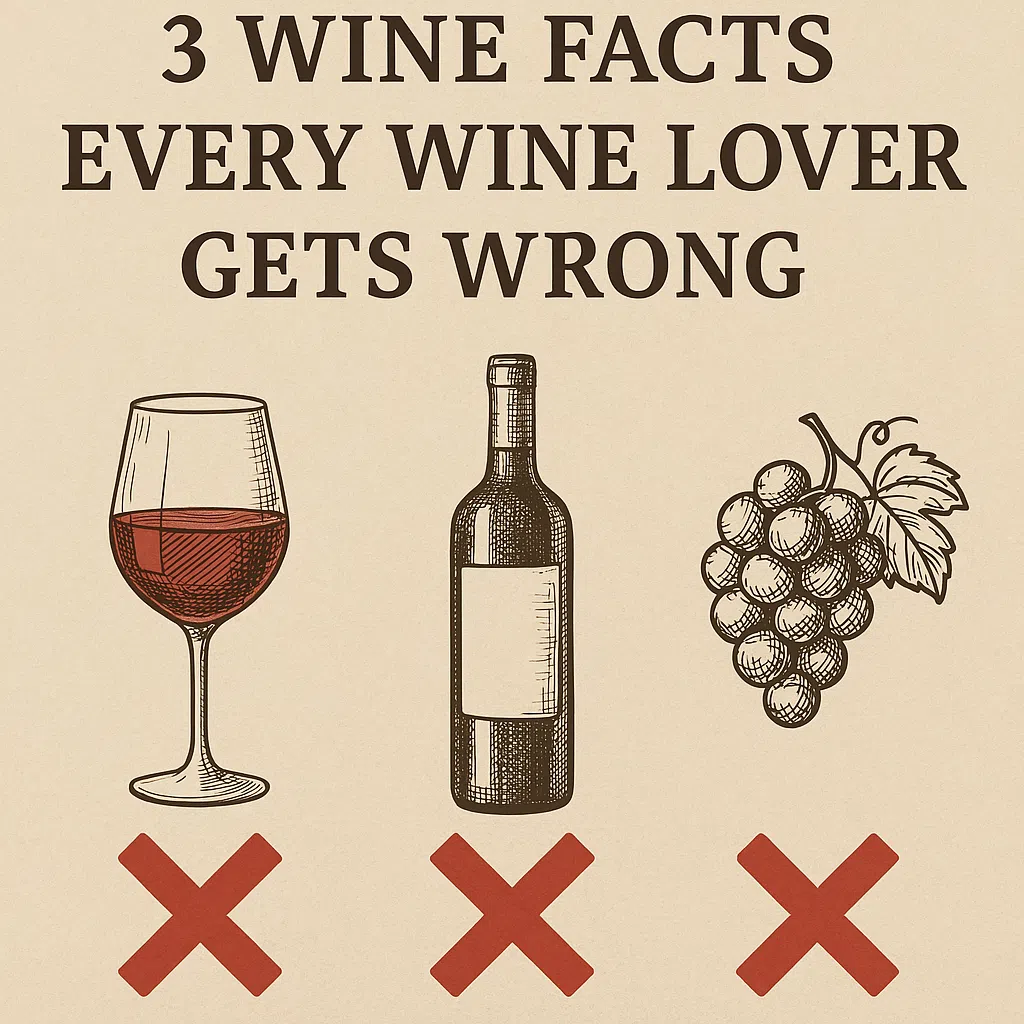
3 Wine Facts Every Wine Lover Gets Wrong
Including, probably, you.
Nobody likes being told they’ve been doing something wrong. Especially something they’ve been doing confidently, in public, for years. But here’s the thing about wine — it has a long and distinguished history of making people feel clever while quietly being misunderstood. These three wine facts won’t make you an expert. They’ll do something better. They’ll make you right.
1. That Bottle You’ve Been Saving? Open It Tonight.
Not tomorrow. Tonight.
There’s a bottle somewhere in your house right now that you’ve been keeping for a special occasion. Maybe it’s been there six months. Maybe longer. It’s standing upright on a shelf, or sitting on top of the fridge, or occupying a corner of the kitchen that gets just enough afternoon sun to feel cheerful and do absolutely catastrophic things to the wine inside.
Here’s what’s happening to it while you wait for the right moment. The cork — your only line of defence against the outside world — is slowly drying out. Corks need moisture to stay compressed and airtight. Horizontal storage keeps the wine in contact with the cork and does exactly that. Upright storage does the opposite. The cork shrinks, almost imperceptibly, and oxygen starts getting in. Not dramatically. Not all at once. Just enough, just regularly enough, to quietly flatten everything interesting about the wine.
By the time the special occasion arrives, you may be opening something that smells faintly of wet cardboard and missed opportunity.
There’s more. Over 90% of all wine made in the world is produced to be drunk within one to three years of bottling. Not ten. Not five. One to three. The wines built for long aging — the serious, expensive, cellar-worthy stuff — represent a tiny fraction of what’s actually being produced and sold. The bottle someone gave you for your birthday is almost certainly not in that category. Neither is most of what’s in the average home wine rack.
The special occasion you’ve been waiting for has a name. It’s called Tuesday.
🍾 The best time to open that bottle was six months ago. The second best time involves you, a glass, and the next ten minutes.
What Actually Keeps Wine Alive
If you do have something worth storing properly — cool temperature around 12 to 14 degrees, humidity around 70%, complete darkness, horizontal position. That’s the list. Everything else is noise. A dedicated wine fridge is ideal. A cool dark cupboard away from the oven is fine. A sunny kitchen shelf is a slow goodbye.
2. The Glass You’re Drinking From Is Changing the Wine
And probably not in your favour.
Before you assume this is something a glassware company invented to sell you eleven different glasses for eleven different grape varieties — it isn’t. Well, the eleven glasses part is. But the underlying science is completely real and has been verified repeatedly since the 1990s when Austrian glassmaker Riedel ran blind tastings that demonstrated something genuinely surprising: the same wine, poured from the same bottle, tasted measurably different depending on the shape of the glass it was served in.
Here’s what’s actually happening. A wine glass does two jobs simultaneously that most people never think about. First — it controls how aromatic compounds gather at the rim. Since roughly 80% of what you experience as flavor is actually smell, the glass is directing your entire flavor experience before the wine touches your tongue. A wide bowl lets volatile aromatics breathe and spread. A narrow opening concentrates them. The difference between the two is not subtle once you’ve noticed it.
Second — the shape determines where the wine lands on your tongue first. The tip of your tongue registers sweetness. The sides register acidity. The back registers bitterness. A wide-bowled glass delivers wine to the centre, softening acidity and emphasising fruit. A glass with a narrow opening sends the wine differently. Same wine. Different landing zone. Different first impression.
This is why a grippy, tannic red served in a large-bowled glass feels smoother than the same wine served in a small tumbler. The glass is doing work you didn’t know you were asking it to do.
The practical upshot — you don’t need a different glass for every occasion. You need one decent large-bowled glass for reds and something narrower for whites. That’s genuinely it. The rest is glassware theatre.
🥂 Somewhere out there someone is drinking a 2015 Barolo from a novelty mug and wondering why it tastes sharp. The mug is why. It’s always the mug.
3. Expensive Wine Doesn’t Always Taste Better — and Six Hundred People Proved It
This is the one that makes the wine world uncomfortable. So naturally it’s the most important one.
In 2008, economist Richard Wiseman gave 600 people wines ranging from £5 to £30 and asked them to identify which was more expensive. They got it right 53% of the time. Barely better than guessing. For reds specifically, people preferred the cheaper bottle more often than the expensive one. Not occasionally. Consistently.
This wasn’t a quirky outlier. It was confirmation of something the wine world had already been shown in 1976 — the year of the famous Judgment of Paris, when a group of French wine experts blind-tasted California wines against prestigious French ones and the Californians won. The experts didn’t know what they were drinking. Without the label to guide them, their palates told a completely different story than their reputations suggested they would.
What’s happening is straightforward once you understand it. We don’t taste wine with just our mouths. We taste it with our expectations, our memories, our assumptions about what the price on the label is supposed to mean. Show someone a £5 bottle before they drink and their brain has already decided. Show them the same wine in a different bottle with a £35 price tag and suddenly there’s complexity, there’s depth, there’s something almost mineral happening on the finish.
The wine didn’t change. The story did.
This doesn’t mean price is irrelevant. It doesn’t mean all cheap wine is good. What it means is that your own palate — your actual, honest, unbiased response to what’s in the glass — is a more reliable guide to what you’ll enjoy than the number on the label. The £12 bottle that consistently makes you happy isn’t a compromise. It’s good wine buying.
And the person at dinner who announces that cheap wine always tastes cheap? They’ve been wrong this whole time. You now have six hundred people and a blind tasting to back you up.
💸 Price is a story we tell ourselves about wine. Your palate has been trying to tell you the truth the whole time. Maybe start listening to it.
One Last Thing
Wine is one of those rare subjects where knowing less often makes you more confident and knowing more makes you more relaxed. The people who enjoy wine most aren’t the ones performing expertise at the dinner table. They’re the ones who opened the bottle instead of saving it, used the right glass without making a ceremony of it, and ordered the second-cheapest red on the menu without a flicker of self-consciousness.
That’s the move. That’s always been the move.
Which of these three got you? Drop it in the comments. And if someone in your life is still standing their bottles upright on a warm shelf and waiting for a special occasion — do them a kindness and share this post.
#WineFacts #WineLovers #WineEducation #WineTips #WineBlog #ItalianWine
Enjoy wine without the snobbery?
Make The Finest Italian Wine one of your Preferred Sources on Google.
Add The Finest Italian Wine to Preferred SourcesDiscover more from The Finest Italian Wine
Subscribe to get the latest posts sent to your email.