Lambrusco Isn’t the Wine You Think It Is
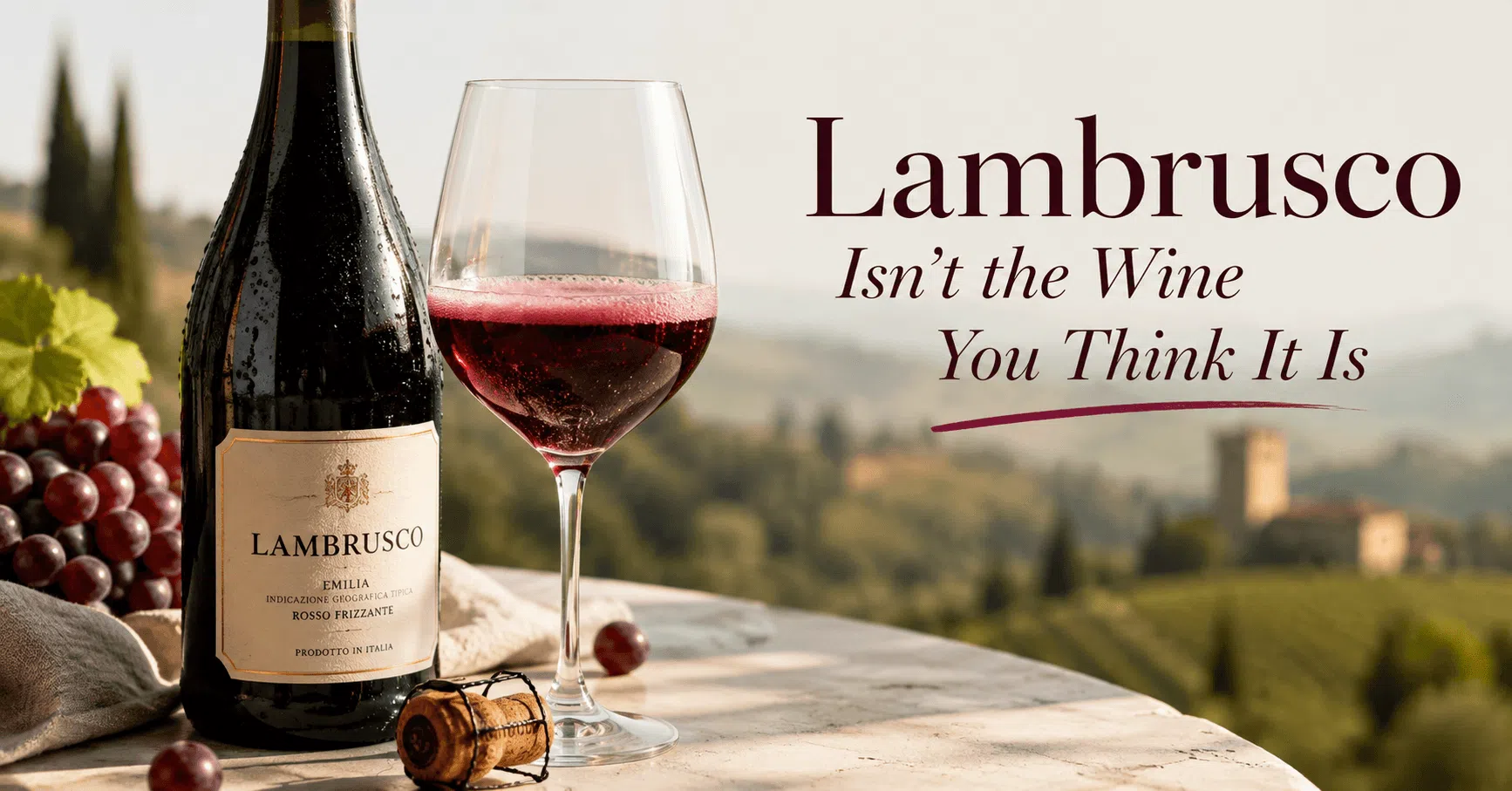
In 1985, Americans bought 11.5 million cases of a fizzy, sweet, pink-tinged Italian wine called Riunite. That’s still a record. Nobody’s broken it since.
For over three decades, it held the title of best-selling imported wine in the United States. Not just from Italy. From anywhere. “Riunite on ice, that’s nice” was one of the most recognizable jingles in American advertising. An entire generation grew up thinking that soft, syrupy glass of pink fizz was what Lambrusco tasted like.
Here’s the part nobody selling it ever mentioned: that’s not really what Lambrusco tastes like in Italy. It’s what one company specifically built for the American market. It worked so well that it quietly became the only version most Americans ever knew existed.
The Wine That Was Built for America, Not Italy
Riunite started in 1950 as a small cooperative of growers in Reggio Emilia. They pooled resources the way a lot of Italian wine regions did after the war. Nothing unusual there.
Everything changed in 1967. That’s when the cooperative found real traction in the American export market with an amabile style of Lambrusco, off-dry to medium-sweet, built specifically for American tastes of the time.
It worked better than anyone could have guessed. By 1973, Riunite was the top-selling wine import in the country. Sales kept climbing through the ad campaign years and peaked at that 11.5-million-case record in 1985. Riunite held the number one spot among imported Italian wines in America all the way until 2002.
A single bottle runs about 8% alcohol and 58 grams of sugar per liter. For comparison, that puts it well into dessert-wine sweetness territory, even though people drink it like an everyday table wine. I’m not going to pretend that’s a serious wine. It’s a soda-adjacent good time, and if that’s what you’re after on a Friday night, have at it. But calling it “Lambrusco” and stopping there is like judging all of Italian coffee off a single gas-station espresso.
What Lambrusco Actually Is, Once You Leave the Import Aisle
Lambrusco is ancient. Archaeologists have found evidence the Etruscans were cultivating the vine long before Rome existed. That makes the 1970s import boom a genuinely tiny sliver of this grape’s story. The wine comes from eight officially recognized DOC zones across Emilia-Romagna and one corner of Lombardy. Those zones center on Modena, Parma, Reggio Emilia, and Mantua.
And in that region, the wine people actually pour with dinner is usually dry. Secco Lambrusco carries less than 15 grams of sugar per liter, a fraction of what’s in a bottle of Riunite. It brings a slight fizz, real acidity, and soft tannins built to cut through rich food. Walk into a trattoria in Modena or Parma and you’ll find it slightly chilled next to prosciutto, parmigiano, tagliatelle alla bolognese, or bollito misto. It’s not a novelty pairing. It’s the region’s everyday house wine. It does exactly the job a good wine should do at a table full of cured meat and cheese.
The sweet stuff didn’t vanish, and it doesn’t need to. It just isn’t the whole story. For most of the last fifty years, though, it was the only chapter Americans knew about.
How to Actually Buy the Real Thing
Next time you’re standing in front of a shelf of Lambrusco, here’s the fast version:
- Look for secco on the label. That’s your dry, food-friendly style.
- Amabile or semisecco means off-dry to medium-sweet, closer to what Riunite popularized.
- Check for a DOC zone name, like Lambrusco di Sorbara or Lambrusco Grasparossa di Castelvetro. Skip the generic regional blends.
- Serve it with a slight chill, and don’t be afraid to put it next to something rich and salty. That’s the whole point of the acidity.
None of this makes the sweet version a mistake to have made. It made Riunite a fortune. It also got an entire country curious about Italian wine at a time when most Americans couldn’t have named a second one. I just think it’s a shame that, for most people, it was also the last stop. Asti’s got a version of this same story, which I mentioned briefly in my rundown of fun Italian wine facts. Lambrusco’s far from the only one carrying an outdated reputation.
Quick Answers
Is Lambrusco always sweet? No. Sweetness ranges from bone-dry (secco) to sweet (dolce), depending on the producer and style. The sweet, sparkling version most Americans know is one style among several. Decades of a specific export brand popularized it. That doesn’t make it the wine’s default character.
Why does Lambrusco have a cheap reputation in the US? Largely because of Riunite. The brand dominated American imports from the late 1960s through the early 2000s with a sweetened style made for the American palate of the time. It was hugely successful commercially. But it left most American drinkers with a narrow idea of what the wine can be.
What does “secco” mean on a Lambrusco label? Bone-dry, under roughly 15 grams of sugar per liter. It’s the style most commonly drunk in Emilia-Romagna itself and the one to look for if you want the wine locals actually pour at dinner.
What food does Lambrusco pair with? Rich, fatty, salty food. Prosciutto, parmigiano, cured meats, and heavier pasta dishes like tagliatelle alla bolognese. The acidity and light fizz cut through exactly that kind of plate.
Enjoy wine without the snobbery?
Make The Finest Italian Wine one of your Preferred Sources on Google.
Add The Finest Italian Wine to Preferred SourcesDiscover more from The Finest Italian Wine
Subscribe to get the latest posts sent to your email.