Montepulciano d’Abruzzo vs Vino Nobile di Montepulciano: Same Name, Completely Different Wine
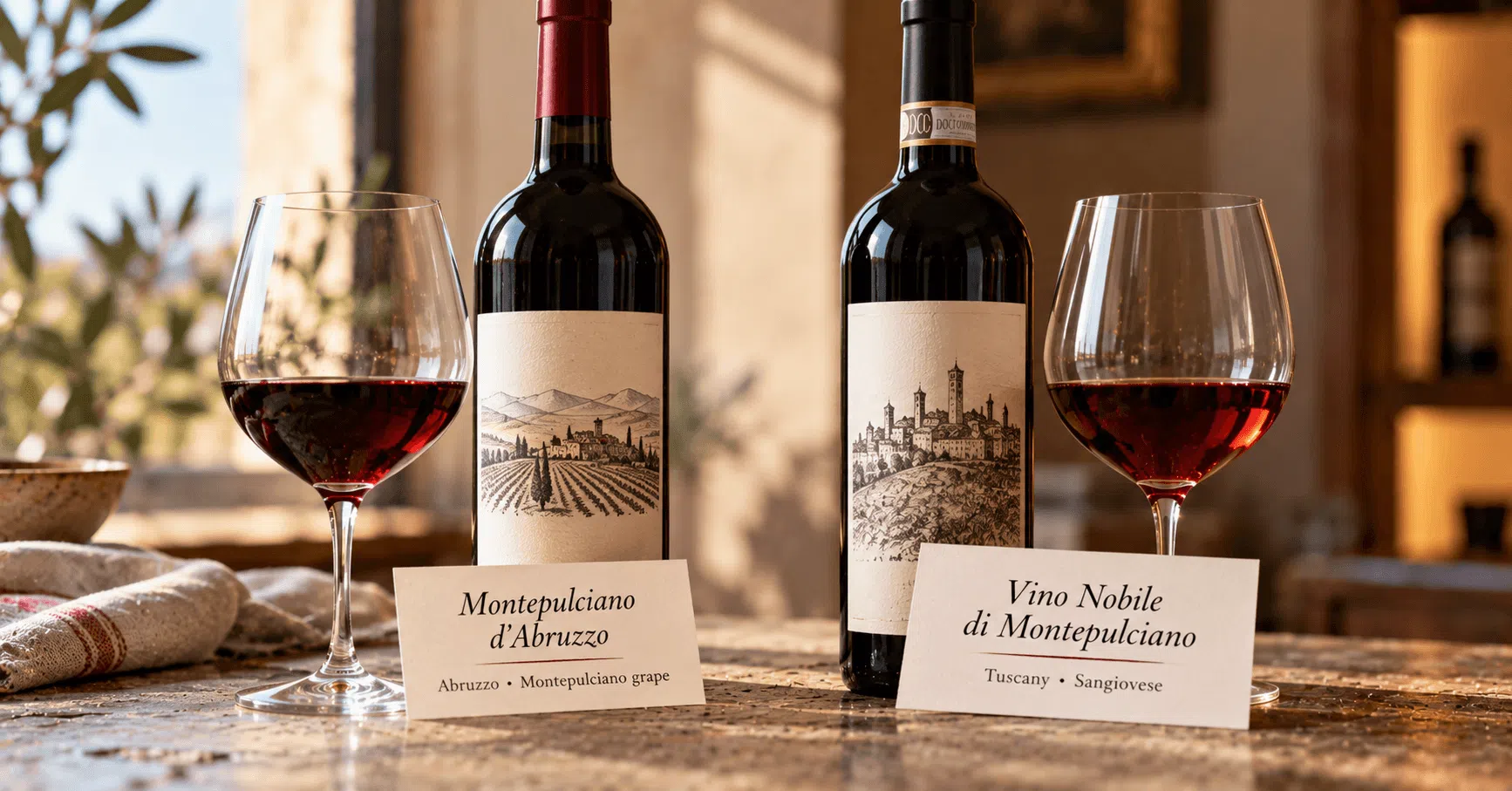
A friend of mine once brought a bottle of Vino Nobile di Montepulciano to dinner and spent the entire meal insisting it was “basically the fancy version” of the Montepulciano d’Abruzzo we usually drink. I let her enjoy the theory for about an hour before I ruined it. She wasn’t wrong to be confused. Italy built her a trap and she walked straight into it, the same way most people do.
Here’s the trap. Montepulciano d’Abruzzo and Vino Nobile di Montepulciano share a word, sit near each other on a wine shop shelf, and cost roughly similar money at the mid range. So the brain does the sensible thing and assumes they’re cousins. One grape, two versions, maybe a regional dialect situation. Except they’re not cousins. They’re barely acquainted. Different regions, different main grapes, different styles, made about 250 kilometres apart. The entire confusion comes down to one word doing two jobs. In one bottle, Montepulciano is the grape. In the other, Montepulciano is the town. Nobody warned you, so let’s fix that now.
The Whole Confusion, Solved in One Sentence
Montepulciano d’Abruzzo means the Montepulciano grape, grown in the Abruzzo region. Vino Nobile di Montepulciano means a Sangiovese wine from the Tuscan town called Montepulciano. Write that on your hand before your next wine shop trip. I’ll still give you the long version, because the short version is exactly what got my friend into trouble in the first place.
Abruzzo: Where Montepulciano Actually Is the Grape
Start on the Adriatic side of the country, in Abruzzo. This is home turf for Montepulciano d’Abruzzo DOC, one of the region’s flagship wines and one of the biggest DOC reds in Italy by volume. The grape is genuinely called Montepulciano, and the production rules require a minimum of 85% of it in the blend, topped up with other approved red grapes grown locally. So far, everything about this wine’s name makes sense. Montepulciano, grown in Abruzzo, called Montepulciano d’Abruzzo. Enjoy the logic while it lasts, because we’re about to leave it behind entirely.
It doesn’t stop at 85% everywhere, either. Several subzones, Colline Pescaresi, San Martino sulla Marrucina, Teate, Terre Aquilane, Terre dei Vestini and Terre di Chieti among them, push the minimum up to 90%. Alto Tirino and Terre dei Peligni ask for 95%. Abruzzo clearly takes its own grape very seriously.
In the glass, this is often a generous, immediately likeable wine. Dark cherry, plum, blackberry, a bit of spice, enough grip to handle a plate of real food without demanding a decade in your cellar first. Some bottles are cheap and cheerful, built for a Tuesday. Others are structured, aged and genuinely serious. That range is part of the charm. Montepulciano d’Abruzzo is one of the rare Italian reds where curiosity doesn’t automatically cost you money.
Now Cross Into Tuscany, Where the Rules Change Completely
Drive west and eventually you’ll reach the actual town of Montepulciano, a hilltop gem in the province of Siena. This Montepulciano is a place, full stop, and the wine made around it is Vino Nobile di Montepulciano DOCG. If you’ve just absorbed everything about Montepulciano d’Abruzzo, you’d reasonably expect these hillsides to be covered in Montepulciano vines. They are not.
Vino Nobile di Montepulciano requires a minimum of 70% Sangiovese, called Prugnolo Gentile locally. Somewhere, centuries ago, Italy named one of Tuscany’s most historic wines after a town that happens to share a name with an entirely unrelated grape from the other side of the country, and then quietly went about its business as if that was a perfectly reasonable thing to do.
It gets better. Vino Nobile di Montepulciano was Italy’s very first DOCG, awarded back in 1980, before Barolo, before Brunello, before anyone else earned the title. So the wine that started Italy’s whole top tier classification system is also the one most likely to be mistaken for a completely different grape from another region. I find that genuinely funny. Italian wine bureaucracy has a sense of humour, it just never tells you when the joke lands.
So Where’s the Montepulciano Grape in a Vino Nobile Bottle?
Nowhere. That’s the part that catches nearly everyone, including my dinner guest. On this label, Montepulciano isn’t naming an ingredient, it’s naming an address. Think about Brunello di Montalcino. Nobody goes looking for the Montalcino grape, because Montalcino is a town and Brunello is Sangiovese under a local nickname. Vino Nobile di Montepulciano works exactly the same way. Noble wine, from the town of Montepulciano, built on Sangiovese. If you already love Chianti or Brunello, you already know this grape intimately. It’s just been travelling under a different name.
Do They Actually Taste Different?
Genuinely, yes, though producer and vintage always have the final word. Montepulciano d’Abruzzo tends to lean dark and ripe: plum, black cherry, blackberry, sometimes a herbal or earthy edge, tannin that can be substantial but is often approachable early. Vino Nobile, being Sangiovese at heart, shifts the whole picture toward red cherry, sour cherry, dried herbs, violet, earth and that bright, mouthwatering acidity Sangiovese is known for everywhere it grows.
If I had to sum it up for someone in the wine aisle with thirty seconds to decide, I’d say Montepulciano d’Abruzzo usually feels darker and more fruit forward, Vino Nobile usually feels brighter and more savoury. That’s a generalisation, and good producers will happily break it in both directions. Wine has never once respected my tidy summaries.
And the Price Tags Aren’t on the Same Ladder Either
This is where the confusion gets an extra push, because people assume one of these is simply the budget version of the other. Montepulciano d’Abruzzo can be remarkably affordable, plenty of honest, enjoyable bottles sit well under what you’d pay for an equivalent Tuscan red. Vino Nobile di Montepulciano generally costs more, driven by stricter production rules, longer required ageing, and the general economics of being a well known Tuscan appellation.
Resist the urge to read that as cheap Montepulciano and expensive Montepulciano. That framing is exactly the trap this whole article is trying to get you out of. They’re not tiers of the same thing. They’re two different answers to two different questions.
So Which One Do You Actually Buy?
Forget the classifications for a second and think about what’s on the table. Lasagna, grilled sausages, a pizza with everything on it? A juicy Montepulciano d’Abruzzo handles that beautifully, enough fruit and structure to stand up to rich food without turning dinner into a formal tasting nobody asked for.
Vino Nobile is where I reach for something with Sangiovese’s acidity and savoury backbone: roast meat, a long simmered ragù, aged pecorino, mushrooms, or an evening where the bottle has time to breathe and open up properly. I’ve written before about pairing Chianti with pasta, and the logic carries straight over, since you’re working with the same grape wearing a different regional outfit. If you already love Chianti Classico and want another side of Tuscan Sangiovese, Vino Nobile is the obvious next stop. If you want a generous, crowd pleasing Italian red that rarely disappoints for the money, Montepulciano d’Abruzzo is very hard to argue with. My honest answer, the one my friend eventually accepted, is to keep both in the house and let the meal decide.
Why Does the Grape Even Have That Name?
This is the question I hoped would tie everything up neatly. It doesn’t, not completely. The exact origin story behind the Montepulciano grape’s name isn’t fully settled, and the overlap with the Tuscan town appears to be one of those historical coincidences nobody flagged before it was far too late to rename anything. What we do know is that the grape became firmly rooted in central Italy, particularly Abruzzo, while the town of Montepulciano built an entirely separate wine identity around Sangiovese. Two unrelated stories, one shared word, and a few centuries later, shoppers everywhere left to sort out the mess.
The confusion got serious enough that Vino Nobile di Montepulciano is now required to carry “Toscana” on its label, the first Italian DOCG ever given that rule. When the regulators start adding extra words to a label just to stop people guessing wrong, you know the situation escaped them a while ago.
Does DOCG Automatically Beat DOC?
No, and this is where I’d actively push back on assuming the fancier acronym wins. Montepulciano d’Abruzzo is generally DOC, Vino Nobile di Montepulciano is DOCG, and DOCG does carry tighter regulatory requirements on paper. But tighter rules on paper don’t automatically translate into a better glass. A well made Montepulciano d’Abruzzo will out drink a mediocre DOCG any day of the week. Classification tells you about origin and production standards. Your palate still casts the deciding vote.
If you want proof that these classifications refuse to sit still, look at Casauria. It used to be one of Montepulciano d’Abruzzo’s own subzones, required to hit a higher Montepulciano percentage than the base DOC. In 2025, it left home entirely and became its own independent DOCG, now requiring a minimum of 90% Montepulciano, comfortably above the base DOC’s 85%. Even a subzone got tired of being lumped in with everyone else. I respect the ambition.
And Vino Nobile Just Got Even More Specific
Tuscany wasn’t going to let Abruzzo have all the reorganising fun. In 2025, Vino Nobile di Montepulciano introduced Pieve, a new designation tied to twelve specific geographic zones within the denomination, each one named after a historic medieval territory. Wines carrying a Pieve designation need a minimum of 85% Sangiovese, up from the standard 70%, along with three years of ageing instead of the usual two.
You don’t need to memorise twelve zone names before buying a Tuesday night bottle. But it tells you something real about where serious Italian wine is heading. Place matters more with every passing vintage, which is a little poetic considering a place name is exactly what caused this whole mess to begin with.
The Trick That Actually Works
Next time you’re standing in front of the shelf, skip the fancy language and look at what follows the word Montepulciano. See d’Abruzzo, think Abruzzo, grape, Montepulciano. See Vino Nobile di Montepulciano, think Tuscany, town, Sangiovese. One bottle tells you what’s in the glass. The other tells you where you’d be standing if you went looking for the vines.
There. Consider Italy briefly untangled. It won’t last, something else will confuse you by next week, but that’s honestly half the fun of drinking your way through this country.
My Final Verdict
Montepulciano d’Abruzzo and Vino Nobile di Montepulciano sound like siblings and behave like distant acquaintances who happen to share a surname. One comes from Abruzzo and is built on the Montepulciano grape. The other comes from a Tuscan hill town and is built on Sangiovese. They taste different, come from different landscapes, follow different rules, and neither one is a lesser version of the other.
So if you’ve ever bought Montepulciano d’Abruzzo expecting Tuscany, or turned a bottle of Vino Nobile around looking for a Montepulciano grape that was never going to be there, you weren’t drinking badly. The label was built to trip you up. Now it can’t.
My friend, for the record, has since become insufferable about the difference at every dinner party she attends. I take full responsibility.
Salute.
Kelly’s Wine Note
Montepulciano d’Abruzzo DOC requires a minimum of 85% Montepulciano grapes. Several subzones raise that bar: Colline Pescaresi, San Martino sulla Marrucina, Teate, Terre Aquilane, Terre dei Vestini and Terre di Chieti require 90%, while Alto Tirino and Terre dei Peligni require 95%. Casauria, once a subzone of Montepulciano d’Abruzzo DOC, became its own independent DOCG in 2025 and now requires a minimum of 90% Montepulciano. Vino Nobile di Montepulciano DOCG requires a minimum of 70% Sangiovese, locally called Prugnolo Gentile, from vineyards between 250 and 600 metres elevation around the Tuscan town of Montepulciano, with a minimum two years of ageing and 12.5% ABV. It was Italy’s first DOCG, awarded in 1980, and the first Italian DOCG required to carry “Toscana” on its label. Its newer Pieve designation, introduced in 2025 across twelve Unità Geografiche Aggiuntive, requires a minimum of 85% Sangiovese and three years of ageing.
Quick Questions
Is Montepulciano d’Abruzzo the same as Vino Nobile di Montepulciano?
No. Montepulciano d’Abruzzo is an Abruzzo wine made primarily from the Montepulciano grape. Vino Nobile di Montepulciano is a Tuscan wine from the town of Montepulciano, made primarily from Sangiovese.
What grape is Vino Nobile di Montepulciano made from?
Vino Nobile di Montepulciano DOCG must contain at least 70% Sangiovese, locally called Prugnolo Gentile. Wines carrying the newer Pieve designation require at least 85% Sangiovese.
What grape is Montepulciano d’Abruzzo made from?
Montepulciano d’Abruzzo must contain at least 85% Montepulciano grapes under the base DOC rules. Several subzones require more, ranging from 90% up to a full 100% historically in Casauria, which is now its own separate DOCG requiring a minimum of 90%.
Which is better, Montepulciano d’Abruzzo or Vino Nobile di Montepulciano?
Neither is inherently better, they’re different wines built for different moods. Montepulciano d’Abruzzo tends to offer dark fruit, generosity and strong value, while Vino Nobile shows the brighter acidity, red fruit and savoury character typical of Tuscan Sangiovese.
Continue Exploring
- Pairing Chianti with Pasta: The Ultimate Italian Wine Guide
- How to Choose Italian Wine in a Supermarket
Enjoy wine without the snobbery?
Make The Finest Italian Wine one of your Preferred Sources on Google.
Add The Finest Italian Wine to Preferred SourcesDiscover more from The Finest Italian Wine
Subscribe to get the latest posts sent to your email.