Scientists Just Fingerprinted 126 Wine Grapes. Apparently, Grapes Have Chemical Personalities.
Years ago, at a blind tasting with a few other wine obsessives, I confidently guessed the same grape for two glasses that turned out to be nothing alike. Different country, different colour, different everything on paper. I blamed it on a long day and moved on. I think about that evening differently now, because it turns out my palate wasn’t necessarily broken. It may have just noticed something science only got around to proving this year.
Researchers in Trentino spent four vintages taking hundreds of grape varieties apart at the molecular level, and the results are stranger and more entertaining than I expected from a study with a title like a pharmaceutical report. Moscato, it turns out, smells like Moscato before anyone has even turned it into wine. And a handful of grapes that look like total strangers on a label are, chemically speaking, close family. I needed to know everything.
Scientists Basically Put 126 Grapes in a Line-Up
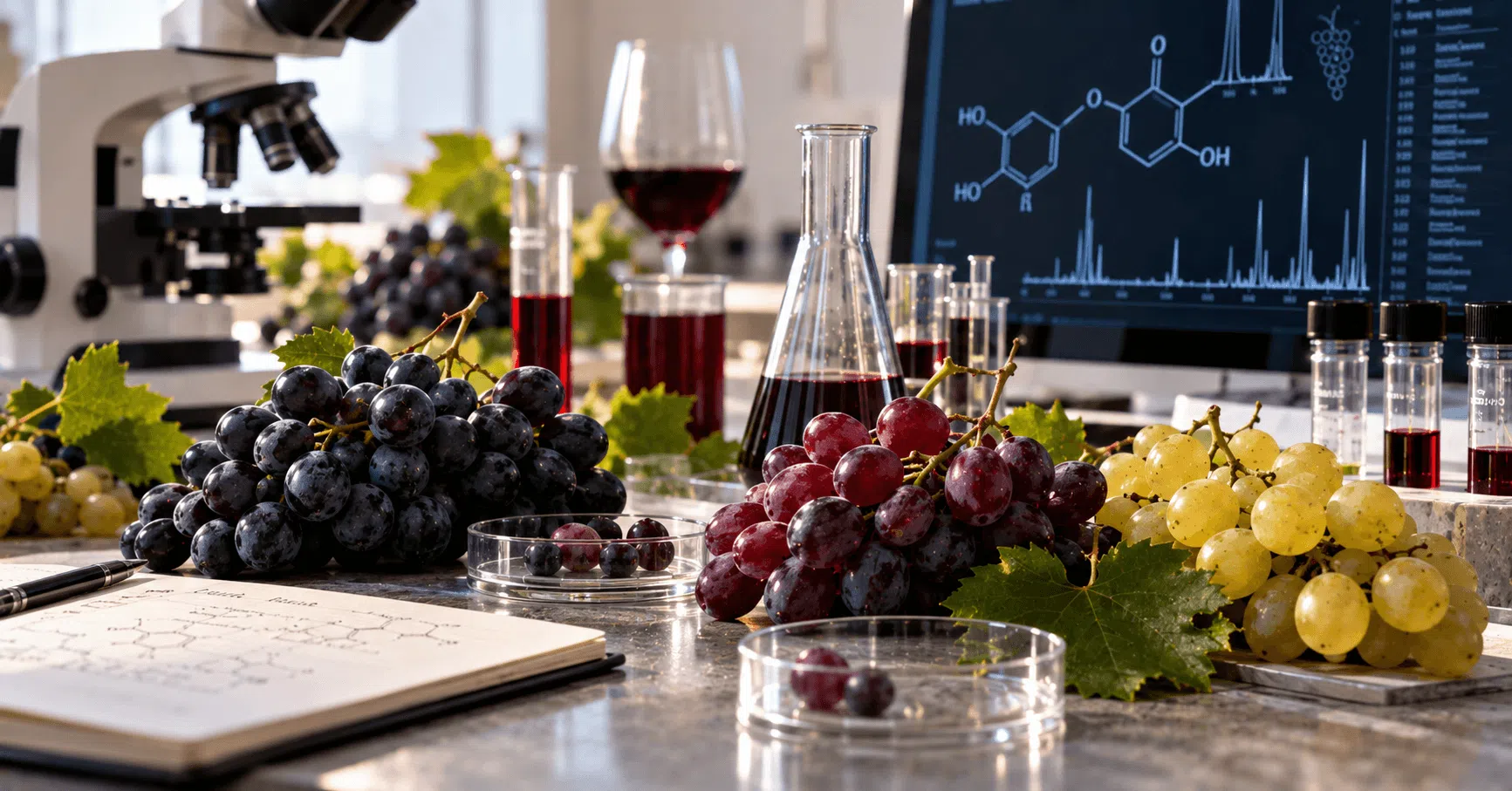
The team behind this is Fondazione Edmund Mach in Trentino, led by director general Riccardo Velasco and Panagiotis Arapitsas, who heads the foundation’s metabolomics unit. Together they built what they’re calling the world’s first large scale metabolomic atlas of grapevine biodiversity, working through 462 samples across 126 grape varieties and accessions, collected over four separate vintages. The study landed in the Journal of Agricultural and Food Chemistry in September 2026, which is a slightly dry name for a paper that essentially outed a bunch of grapes for their secret friendships.
They weren’t interested in what the grapes looked like. They wanted to know what was actually happening inside them: sugars, acids, polyphenols, colour compounds, tannins, aroma precursors, the full chemical guest list hiding inside every berry. All of that together is called the metabolome. Think of DNA as the instruction manual and the metabolome as what genuinely turned up in the kitchen once someone started cooking. And once researchers started comparing kitchens across 126 different grapes, some unexpected dinner parties started revealing themselves.
Some Grapes Have Clearly Been Hanging Out Together
A few of the pairings make instant sense. Teroldego, Lagrein and Marzemino turned up chemically close, and all three are practically neighbours in north eastern Italy, so that’s just old friends sharing a postcode. Cabernet Franc and Merlot showed up as chemical relatives too, which tracks, given how often the two get compared, confused and blended together in Bordeaux. Centuries of sharing a bottle will apparently do that to a grape.
Then it gets genuinely interesting. Vermentino, an Italian coastal white, and Xarel·lo, a Catalan grape best known for holding up Cava, turned out to be chemically close. So did Manzoni, a twentieth century Veneto cross, and Riesling, which has no business being anywhere near an Italian vineyard. This is where the study stopped confirming what I already suspected and started rearranging my mental filing cabinet entirely. We sort grapes by country, by colour, by region, by whatever story the label is trying to sell us. The molecules inside the berry were clearly never consulted on any of that. They’ve been quietly running their own classification system the whole time, and nobody thought to ask them.
The Aromatic Grapes Were Particularly Bad at Hiding
Moscato, Malvasia and Gewürztraminer grouped together too, and if you’ve ever stuck your nose anywhere near a glass of Moscato, this will not rock your world. Subtlety has never been its strong suit. According to the research, these aromatic varieties were so chemically loud that they clustered together regardless of berry colour, meaning a white grape, a pink one and a darker skinned one could all be carrying essentially the same aromatic signature underneath. We tend to assume aroma is something that develops in the glass, after fermentation, after the winemaker has had their say. Apparently a serious chunk of it was already sitting in the berry before any of that began. The winemaker hasn’t even clocked in yet, and Moscato has already put on its perfume.
So Is This Why Nebbiolo Doesn’t Taste Like Sangiovese?
Partly, and here’s where the study stops being a chart for scientists and starts being genuinely useful for the rest of us. We talk endlessly about terroir: soil, altitude, sun, rainfall, how cold the nights get, which way the hillside faces. All of it matters. Then there’s everything the winemaker decides on top of that: when to pick, how long to ferment, oak or steel, how much skin contact, how long the wine sits before it’s released. Also matters, enormously. But somewhere in all that reverence for hillsides and barrels, it’s easy to forget the most obvious ingredient in the entire chain, the grape itself. Different varieties simply don’t walk into the winery carrying the same chemistry. They arrive with their own combinations of acids, phenolics, aroma compounds and pigments already built in, long before anyone’s decided what barrel they’re heading into. That’s a decent chunk of why you can’t plant Nebbiolo next to Sangiovese, treat them identically, and expect two wines that taste like siblings. The vineyard matters. The winemaker matters enormously. But the grapes showed up to the party as completely different people.
Before Anyone Gets Carried Away
No, scientists can’t run a grape through a machine and have it print out “black cherry, leather, tobacco, 94 points, drink between 2032 and 2041.” That would put every wine critic I know out of a job and several of them into early retirement from sheer panic. A grape’s chemical fingerprint doesn’t tell you exactly what the finished wine will taste like, because everything that happens after harvest still gets a say. Grow the same variety somewhere hotter or cooler, pick it earlier or later, swap the vintage, change the fermentation, age it in oak instead of steel, and you can land somewhere completely different with the exact same starting grape. I’ve made this argument before about why Italian Pinot Grigio refuses to taste the same from bottle to bottle, and this study is really the molecular version of the same lesson. Chemistry deals the hand. The vineyard and the winemaker still have to decide how to play it.
Where This Actually Gets Useful
My first instinct was that this was an extremely sophisticated way of confirming that different grapes are, shockingly, different. Interesting over a glass of wine, maybe not interesting enough to bring up twice. Then I reached the applications section and changed my mind completely. This chemical atlas could eventually help with grape breeding, authenticity checks, smarter vineyard decisions, and finding alternative varieties for regions whose climate is shifting faster than their traditions can keep up. That last one is the one I keep coming back to.
What Happens When a Famous Grape Stops Loving Its Own Weather?
Wine regions are already dealing with hotter summers, drought and growing seasons that no longer behave the way they used to, something I’ve written about at length before, and vines have no particular loyalty to a hillside just because they’ve grown there for three hundred years. If conditions shift far enough, producers eventually face a genuinely uncomfortable choice. You could plant something better suited to the new climate, except that just creates a different problem: what happens to the wine people actually travelled there to drink? If researchers can identify varieties that share real chemical ground with a struggling grape but handle heat or drought with more grace, producers get a way to adapt without quietly erasing the identity of the wine itself. A database of grape chemistry stops being an academic curiosity at that point and starts looking a lot like insurance.
And Yes, This Could Help With Wine Fraud Too
Authenticity is another application worth taking seriously, mostly because wine fraud sounds like a problem from a black and white film until you remember what certain bottles actually sell for. I’ve written before about Rudy Kurniawan, who built an entire career faking rare bottles convincingly enough to fool people whose entire job was not getting fooled. If grape varieties carry recognisable chemical signatures, metabolomic data becomes one more tool for checking whether a wine genuinely contains what the label promises. Nobody’s built a machine that shrieks the moment a suspicious eight euro Barolo rolls past, wine authentication is considerably messier than that, but a reliable chemical reference map hands investigators another real piece of evidence. When someone is trying to sell a supposedly rare bottle for a five figure sum, another piece of evidence is never nothing.
What I Actually Love About This Study
For centuries we’ve tried to understand grapes through what we could see and taste: berry colour, leaf shape, where the vine grew, what eventually landed in the glass. Genetics came along and exposed family relationships nobody had guessed at. Now scientists can look inside the berry itself and find an entirely new layer underneath both of those. Sometimes that layer simply confirms what wine drinkers already suspected, of course the aromatic grapes have something chemically loud going on, have you met Gewürztraminer. But some of these relationships are genuinely unexpected, and that’s the part that keeps pulling me back in. Wine has spent centuries building borders around itself: France, Italy, Spain, region, DOC, DOCG, red, white, native, international. The molecules inside the grapes never once agreed to respect any of them.
Does the Grape Matter More Than Terroir, Then?
No, and I’d push back hard on anyone trying to stretch this study that far. Wine refuses to be tidy about anything, ever. The grape matters, the place matters, the weather matters, the vintage matters, the winemaker matters, and that exact combination is precisely why the same grape can produce wildly different wines depending on where it lands. What this research does is give the grape itself a little more credit before any of those other factors even enter the room. Before the oak, before fermentation, before the ageing cellar, before someone swirls a glass under a bad restaurant light and announces minerality with total confidence, there was a berry. And that berry had already arrived with quite a lot going on.
My Final Verdict
I love this study because it finally gives a scientific backbone to something wine drinkers have always said half as a joke. We talk about grapes like they have personalities: Nebbiolo can be difficult, Moscato walks into the room already wearing perfume, Cabernet tends to have strong opinions, Pinot Noir can break your heart before lunch is even over. Grapes obviously don’t have personalities in any real sense. But chemically, they are clearly not blank canvases either, and now there’s a proper atlas to prove it. Scientists worked through 462 samples across 126 grapevine varieties and accessions over four vintages and found real, recognisable chemical patterns, including a few relationships nobody would have guessed just by looking at the label. Those fingerprints could eventually help with everything from catching fraudulent bottles to helping entire wine regions adapt as the climate keeps shifting beneath them, all because somebody finally looked closely at what was already sitting inside the berry.
As for that blind tasting years ago, I still don’t know exactly what I picked up on that night. But I like to think my palate was onto something the scientists only caught up with recently. So next time someone tells you wine is just fermented grape juice, technically, sure. Just know the grapes would like a little more credit than that, and apparently they’ve got the paperwork to prove it now.
Salute.
Research Note
Fondazione Edmund Mach in Trentino, led by director general Riccardo Velasco and metabolomics unit head Panagiotis Arapitsas, built the world’s first large scale metabolomic atlas of grapevine biodiversity, analysing 462 grape samples across 126 varieties and accessions over four vintages. The study was published in the Journal of Agricultural and Food Chemistry in September 2026. Notable chemical groupings identified include Teroldego, Lagrein and Marzemino; Cabernet Franc and Merlot; Vermentino and Xarel·lo; and Manzoni and Riesling, alongside a distinct aromatic cluster of Moscato, Malvasia and Gewürztraminer that grouped together regardless of berry colour. Researchers note potential applications in grape breeding, vineyard decisions, wine authenticity verification, and identifying alternative varieties better suited to a changing climate. The study does not claim that a grape’s chemical fingerprint alone determines how the finished wine will taste.
Quick Questions
What is a grape’s chemical fingerprint?
It’s the specific combination of compounds inside a grape berry, including sugars, acids, polyphenols, pigments and aroma precursors. Together these form what researchers call the metabolome, which can help distinguish between grape varieties and reveal unexpected relationships between them.
How many grapes did the scientists actually study?
Researchers at Fondazione Edmund Mach analysed 462 samples representing 126 grapevine varieties and accessions, collected across four separate vintages.
Which grape varieties turned out to be chemically similar?
Notable groupings include Teroldego, Lagrein and Marzemino, Cabernet Franc and Merlot, Vermentino and Xarel·lo, and Manzoni and Riesling. Aromatic varieties like Moscato, Malvasia and Gewürztraminer also formed their own distinct chemical cluster.
Can this chemical data predict what a wine will taste like?
No. The grape’s chemistry is the starting material, but climate, vineyard conditions, ripeness, vintage, fermentation and ageing decisions all shape the finished wine. A chemical fingerprint describes potential, not the final result.
Why does this research matter for climate change?
Identifying grapes with similar chemical profiles could help producers find alternative varieties that tolerate heat or drought better, while still preserving the character the original wine was known for.
Continue Exploring
- Does All Italian Pinot Grigio Taste the Same? The Real Answer
- The Con Artist of Corks: Unveiling the Intriguing Saga of Rudy Kurniawan
Enjoy wine without the snobbery?
Make The Finest Italian Wine one of your Preferred Sources on Google.
Add The Finest Italian Wine to Preferred SourcesDiscover more from The Finest Italian Wine
Subscribe to get the latest posts sent to your email.