Everyone Does the Prosecco Day Trip From Venice Wrong. Here’s How to Actually Do It.
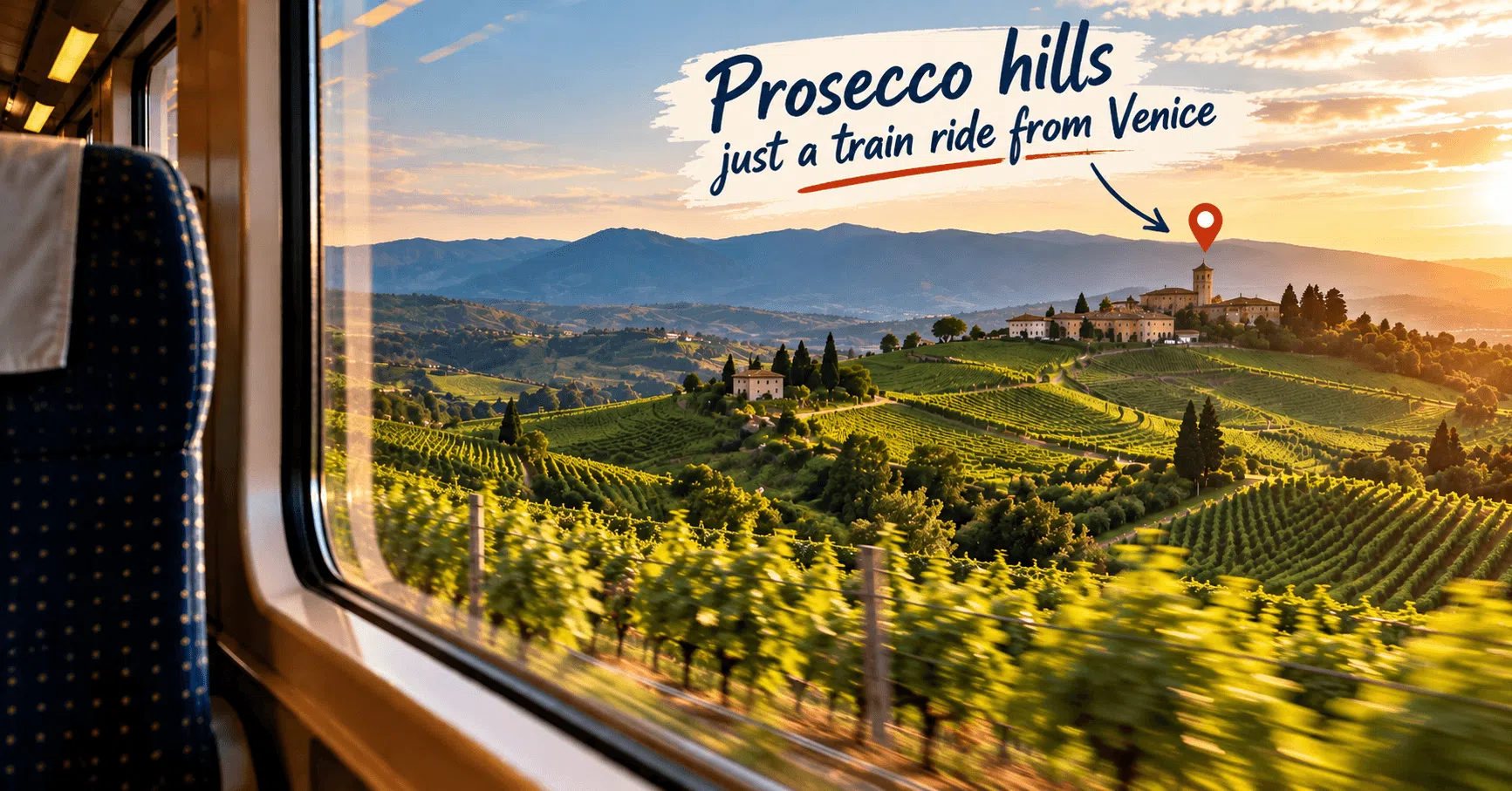
Most guides to this day trip start with the same assumption: you have a rental car waiting. You don’t. You’re in Venice. Nobody drives in Venice. Renting a car just to sit in it for a day, on roads full of hairpin turns, sounds like a strange way to spend a vacation.
Good news. You don’t need one.
The Prosecco hills are closer to Venice than most people think, and the train does almost all the hard work. What’s left is a short, spectacular stretch of road through a UNESCO-protected landscape, a thousand-year-old church with bizarre opening hours, and the single most expensive patch of dirt in the entire region. Here’s how the day actually goes.
Quick Facts
- The Prosecco hills sit roughly 60-80 kilometers north of Venice, and trains to Conegliano take as little as 36 minutes
- About 50 trains run the Venice-Conegliano route daily, with one-way tickets starting around €7 when booked ahead
- The Strada del Prosecco, Italy’s oldest dedicated wine road, winds between Conegliano and Valdobbiadene through steep, hairpin-heavy terrain that takes longer to drive than any GPS estimate
- Cartizze, the most prized sliver of Prosecco vineyard anywhere, covers barely 108 hectares and is worked almost entirely by hand
Why Everyone Assumes You Need a Car
Nearly every “Prosecco day trip” article online is written for someone who drove into Veneto with their own car. Fair enough, if that’s you. But if you’re staying in Venice itself, you already know driving isn’t part of the plan. There’s nowhere to park. Half the city is on water. The other half is tourists wheeling suitcases over bridges, looking faintly betrayed that their GPS gave up an hour ago.
Renting a car solely for this one day adds cost, parking stress, and an unfamiliar mountain drive, right before an afternoon built entirely around wine tasting. Think about that order of operations for a second. None of it is necessary. The train solves most of the distance problem before you’ve even finished your coffee.
The Train Does Almost All the Work
Venice Santa Lucia to Conegliano is a straight shot on regional rail. The fastest trains make it in 36 minutes. The average run is closer to 44. Roughly 50 trains cover this route every single day, starting before 5:30am and running past 11pm. Tickets booked in advance start around €7 one way, which is less than you’ll spend on the cappuccino you drink while waiting for it.
That’s the hard part of “getting to wine country,” solved before most people have left their hotel.
What to Do Once You’re Off the Train
Conegliano isn’t the destination. It’s the gateway. The real hills, villages, and vineyards stretch out from there toward Valdobbiadene, and that’s where a car stops being optional and starts being a bad idea. Wine tasting and unfamiliar hairpin roads don’t mix well.
Three better options exist. Join one of the small-group day tours that pick up near the station, many of which include several winery stops and lunch. Hire a private driver for the day, which gets surprisingly affordable once split between two or three people. Or rent an e-bike and ride the hills at your own pace, if you don’t mind some effort on the climbs.
Any of these beats white-knuckling hairpin turns in a rental car you picked up an hour earlier, on roads that look like they were designed by someone who’d never once drawn a straight line.
The Route Itself: Hairpins, a Thousand-Year-Old Church, and Expensive Dirt
The Strada del Prosecco runs through a string of small villages between Conegliano and Valdobbiadene, each one worth a slow look rather than a drive-by. Early on sits the Pieve di San Pietro di Feletto, a Romanesque church built around the year 1000. Byzantine-influenced frescoes inside date back to the 13th century, including one depicting Christ surrounded by tools, warning against working on the Sabbath. It’s striking, strange, and completely worth the stop. Check the schedule first, though, because whoever set its opening hours was clearly not thinking about tourists. Sundays and holidays only, 3 to 7pm. Show up on a Tuesday afternoon, camera ready, and you’ll be photographing a locked door.
Further along sits Follina, home to a 12th-century Cistercian abbey with a quiet Romanesque cloister. It’s free to enter and usually close to empty, which feels like a mistake someone will eventually correct. Then the road climbs toward Cartizze, barely 108 hectares of the steepest, most prized vineyard land in the region. The slopes are too steep for machines, so almost everything here still gets harvested by hand, by people apparently unbothered by the concept of gravity. That’s exactly why a bottle labeled Cartizze costs noticeably more than everything around it. Watch someone work that slope for five minutes and the price tag stops feeling like a markup and starts feeling like hazard pay.
Timing It So You Don’t Miss the Last Train Home
The roads through this region are narrower and curvier than they look on a map. They take longer to drive than any GPS accounts for. Build in real buffer time, especially if a guide or driver is handling stops rather than following a fixed schedule.
Take the earliest reasonable train out of Venice. A full loop through the villages, a church visit, a few winery stops, and lunch fills a day easily. Arriving by mid-morning instead of noon is the difference between relaxed and rushed. Plan dinner in Conegliano before heading back, rather than racing the clock on the way down from Valdobbiadene. Double-check the return train times before committing to one last stop. The trains run until nearly midnight, but nobody wants to end a great day sprinting through a station platform, wine-tasting notes flapping in one hand, dignity trailing somewhere behind.
Frequently Asked Questions
Can you really do this entire trip without renting a car? Yes. The train covers the distance from Venice, and a day tour, private driver, or e-bike rental covers the hills themselves. A personal car isn’t necessary, and it’s arguably the harder option once hairpin roads and wine tasting both enter the picture.
Do you need to book winery visits in advance? Many smaller, family-run wineries along the Strada del Prosecco expect a booking rather than walk-ins, especially outside peak season. A guided day tour handles this automatically. Going independently means calling or emailing ahead.
Is one day actually enough to see the Prosecco hills properly? Enough to get a real feel for it, yes. Enough to see everything, no. One day covers the train ride, a handful of villages, one or two wineries, and a proper look at Cartizze. Nobody does this trip once and calls it settled. People who fall for the region come back, usually with excuses about “research.”
What’s the best time of year for this trip? Early autumn, during harvest, shows the hills at their most alive, with pickers working the steepest Cartizze slopes by hand. Spring and early summer bring quieter roads and greener views, with fewer crowds.
Most people picture a Prosecco day trip as something that requires a car, a confident driver, and a bit of luck with mountain roads. It actually requires a train ticket, some planning around opening hours, and the willingness to let someone else handle the hairpin turns. The wine tastes the same either way. Only one version lets you enjoy the glass in your hand instead of the drive to get there.
Continue Reading
- Wine Vacation: Sleeping in a Castle in the Prosecco Hills — CastelBrando, Veneto
- The Veneto Wine Vacation Nobody Tells You About
- Where to Stay for a Veneto Wine Vacation: Castle, Valley, City or Lake?
Enjoy wine without the snobbery?
Make The Finest Italian Wine one of your Preferred Sources on Google.
Add The Finest Italian Wine to Preferred SourcesDiscover more from The Finest Italian Wine
Subscribe to get the latest posts sent to your email.