Wine Jokes #11: What the Sommelier Is Actually Thinking
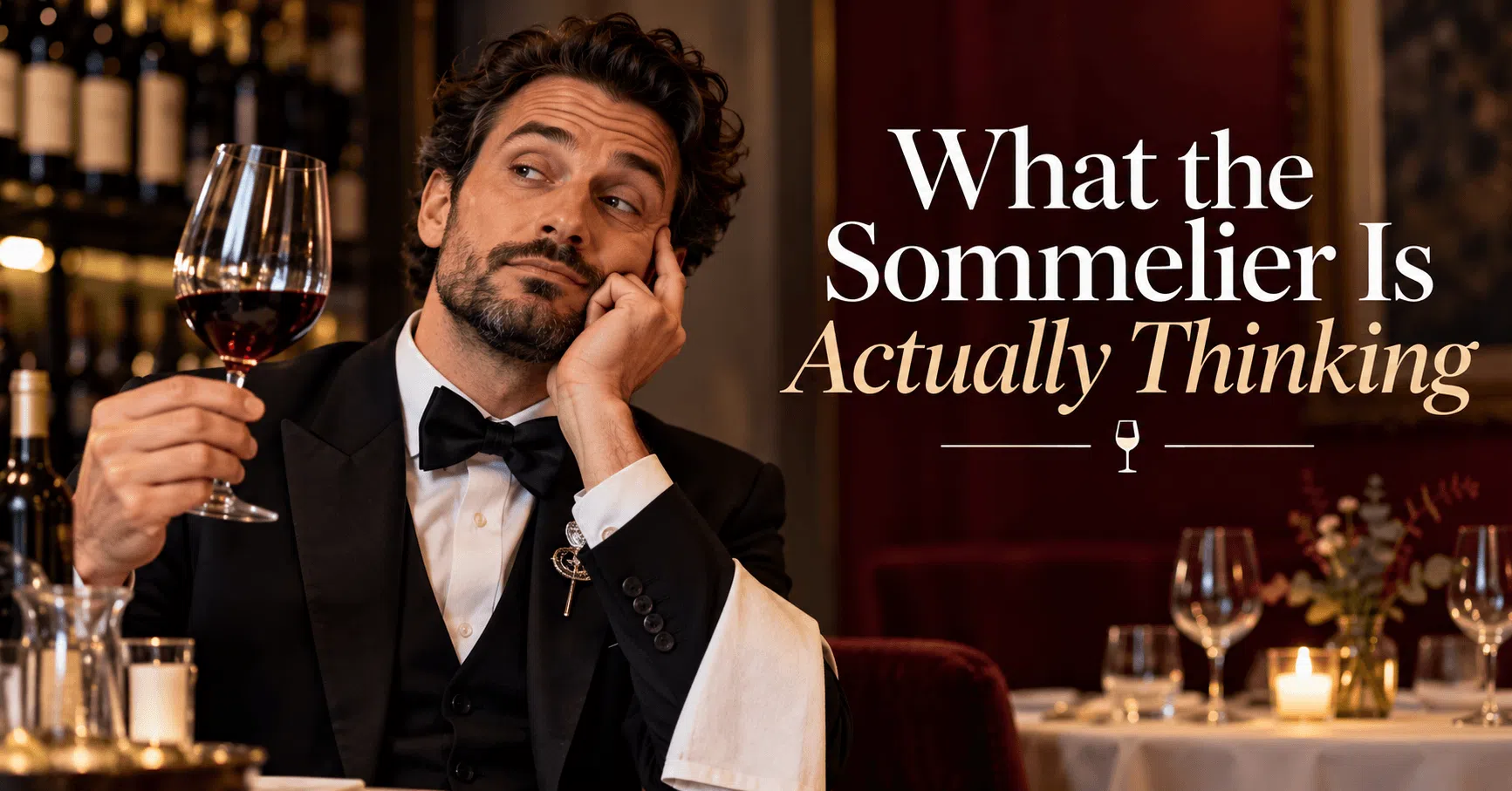
A transcript. He would like it noted that he has a Level 3 WSET and did not spend four years studying tannin structure for this.
The Evening Begins
19:04 Table seven has arrived. Four people. They’ve asked for the wine list immediately. No phones out, no checking the menu first, straight to the wine list. These are my people. Furthermore, I am going in with genuine hope for the first time this week.
19:06 One of them has pointed at the second cheapest bottle on the list and said, “we’ll have the good one.”
He did not read the label. The region was also ignored. He simply found the second cheapest bottle and concluded that the gap between it and the cheapest represents quality. That is not how wine works. That is not how anything works.
I smiled. I took the order. I died a little. In that order.
The Questions Begin
19:09 They’ve asked if the Barolo is dry.
The Barolo. Is dry. A 2019 Barolo DOCG from Serralunga d’Alba, aged 38 months in Slavonian oak, 14.5% alcohol, tannins that will outlive the restaurant, the building, and probably this conversation.
Is it dry.
I said “yes, it’s quite structured.” I used the word “structured” because the word I actually wanted to use is not on the menu and would end my career.
19:12 Someone has picked up their glass by the bowl.
I watched their warm hand wrap around the entire lower half of the glass, undoing six years of careful cellar temperature in approximately four seconds.
There is a protocol for this moment — say nothing, keep smiling. In fact, that protocol is the only thing standing between me and a very honest conversation about hand placement that would make everyone uncomfortable and help absolutely no one.
I am the protocol.
The Brief
19:16 They want “something red, not too heavy, pairs with everything, nothing too expensive, but nice.”
Not too expensive. But nice. As though “nice” is a price bracket. As though somewhere between the house red and the Amarone there is a wine that is simultaneously cheap, impressive, versatile, and good enough that they’ll remember it. A wine that, if it existed, would be sitting on a list starting at €28, waiting patiently for this exact table.
I recommended the Montepulciano d’Abruzzo. Honest, generous, criminally underrated. Exactly right.
One of them Googled it. They found a review from someone called WineDave1987 on TripAdvisor. WineDave1987 gave it three stars because it was, and I need you to understand I am quoting directly, “a bit purple.”
A bit purple. The wine was a bit purple. I have a Level 3 WSET. WineDave1987 has a TripAdvisor account and strong feelings about colour. As a result, we are not having the same experience of this industry.
19:21 I’ve poured the tasting portion. The gentleman at the head of the table has swirled it, sniffed deeply, and announced with complete confidence: “hints of blueberry and fresh cut grass.”
Fresh cut grass. In a Montepulciano d’Abruzzo.
I nodded. “Interesting,” I said. Still nodding now. Forty seconds in, and my body has made a decision to continue indefinitely. My brain has agreed that this is the safest option for everyone involved.
The Cellar Interlude
19:26 They want to taste the Barolo. “Just to compare.”
The Barolo is €95 a bottle. They have ordered the €28 Montepulciano. They would like to compare these two things as though comparison is free, as though opening a 2019 Serralunga is something that happens casually between courses, as though the word “just” belongs anywhere near a Barolo DOCG.
“Of course,” I said. Then I walked to the cellar and stood in the dark for three minutes. Just me and the wines. They don’t judge me. They’ve never judged me. The 2009 Barolo in the far corner has been down here for seventeen years and has never once asked me anything unreasonable. I respect that about it enormously.
19:33 Back at the table, I poured a taste. The woman to the left — who has been regarding the wine like it owes her money — has just said:
“I prefer the other one. This one’s a bit much.”
The Barolo. Is a bit much.
Serralunga d’Alba. 38 months in oak. One of the most complex, age-worthy, structurally magnificent wines produced anywhere on earth. Poured in a restaurant by someone who studied for years to be able to introduce it correctly.
A bit much.
“Completely understandable, it’s a very serious wine,” I said. What I meant was: this bottle took longer to make than some of your relationships and your feedback is that it is a bit much. Look at me. Smiling. Everything is completely, entirely, professionally fine.
The Lambrusco Incident
19:38 They’ve asked if we have anything “like Prosecco but red and a little fizzy.”
I know exactly what they want. They want Lambrusco. We have a Lambrusco Grasparossa from Emilia-Romagna that I have been trying to get someone — anyone — to order for seven months. It is outstanding. Nobody orders it because it sounds like a sports car and people are scared of sparkling red wine, which is a tragedy I think about regularly.
This is my moment. This is what I have been training for.
They ordered a third glass of the Montepulciano.
I brought the Lambrusco anyway. I told them it was a gift from the kitchen. It was not a gift from the kitchen. Chef has no idea. I simply needed that wine to be drunk tonight by someone while I stood close enough to watch.
19:47 They’re asking about the sediment in the Barolo I left on the table.
“Is something wrong with it?”
Nothing is wrong with it. Sediment in an aged red wine is not a defect. Rather, it is a sign of age, of natural winemaking, of a wine that has not been stripped and filtered into a shadow of itself. It is exactly what you want to see, because it means the wine is real.
What I said: “Not at all, completely natural in a wine of this age, just a sign of excellent winemaking.”
What I wanted to say: “That sediment has more complexity than the question you just asked me and I say that with the utmost respect.”
The Close
19:52 They’re leaving. Wonderful time. Great evening. One of them shook my hand and said “you really know your stuff, mate.”
I do. I genuinely, deeply, unreservedly do.
They will never know how much. And that, I have decided, is the job. Knowing everything. Saying almost none of it. Smiling the entire time. Nevertheless, I would not change a single thing.
19:55 Table seven is gone. I’ve decanted an Amarone della Valpolicella for myself. I’m giving it two hours. I’m sitting in the cellar with it in the dark, which is exactly where I want to be right now, surrounded by wines that have never once told me they prefer the Montepulciano.
The Lambrusco, for the record, was exceptional. Whoever from that table drank it will never know what they had. That is their loss and I have consequently made my peace with it.
WineDave1987 has 214 reviews on TripAdvisor. Moreover, I have a Level 3 WSET, seven years of experience, and a 2009 Barolo downstairs that will still be extraordinary long after WineDave1987 has forgotten every wine he has ever rated.
I hold no grudges. I bear no ill will. I simply choose to acknowledge that we are on very different journeys.
The sommelier would like it noted for the record that he does not regret his career choice.
He would, however, like WineDave1987’s home address.
Continue Exploring
If the sommelier’s pain resonated, you might want to meet the wines that caused it.
- Barolo — 38 months in oak. Not for the impatient.
- Montepulciano d’Abruzzo — criminally underrated. WineDave1987 disagrees.
- Lambrusco — sparkling, red, misunderstood. The gift from the kitchen.
- Amarone della Valpolicella — currently being decanted in a dark cellar. Do not disturb.
Enjoy wine without the snobbery?
Make The Finest Italian Wine one of your Preferred Sources on Google.
Add The Finest Italian Wine to Preferred SourcesDiscover more from The Finest Italian Wine
Subscribe to get the latest posts sent to your email.