Venice Has Its Own Wine Ritual, and Most Tourists Walk Right Past It
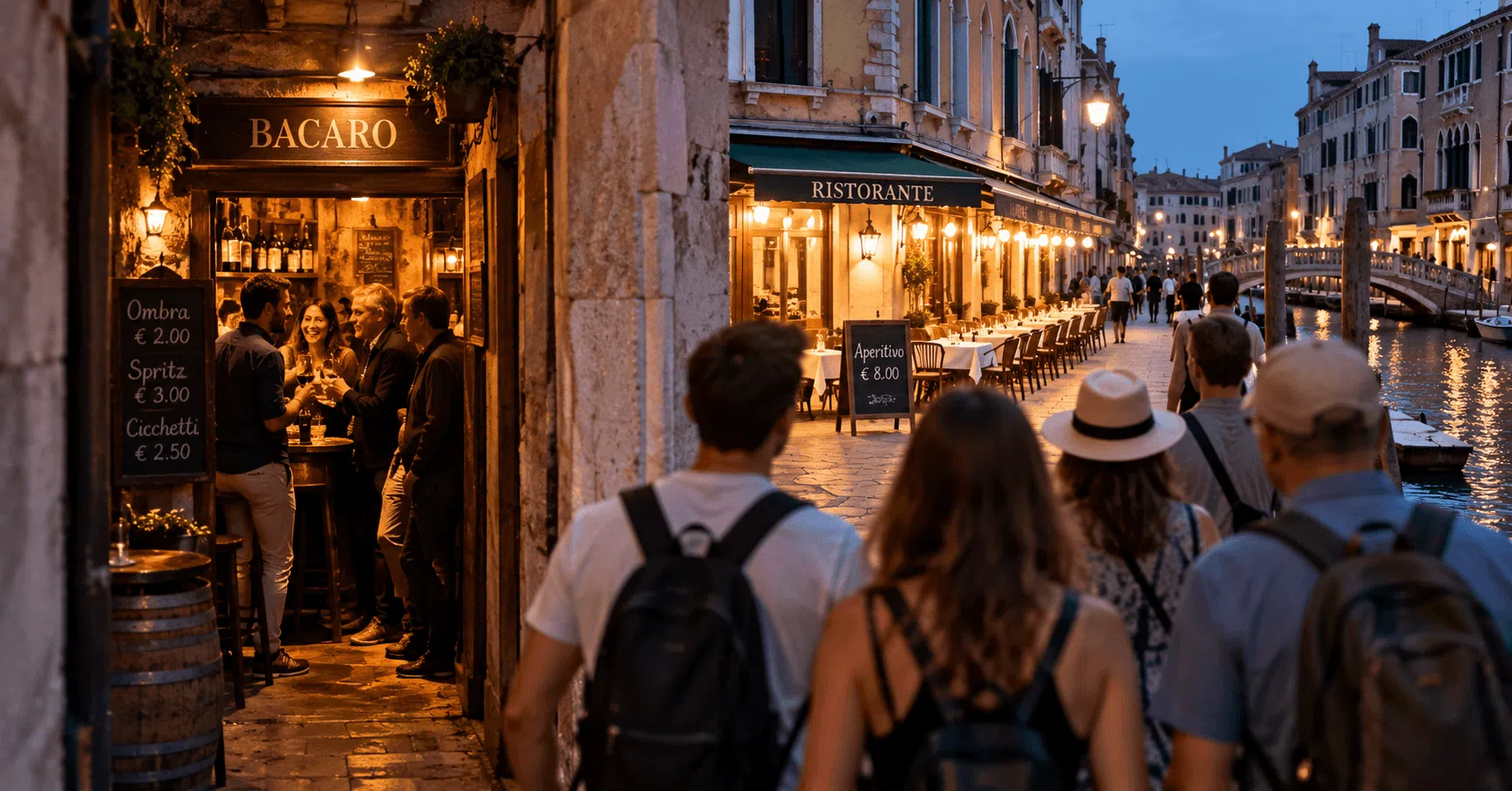
Sit down at a café in Piazza San Marco with the orchestra playing, and a single glass of wine can run you €20 or more, plus a €6 per person charge just for the music. Walk two streets back from the square, and locals are paying €2 to €4 for a glass of wine standing at a bar counter, usually with a small plate of something salty in the other hand. Most visitors never find out the second option exists.
It has a name. It’s called ombra, and it comes with its own food, its own etiquette, and its own slightly shaky origin story.
Quick Facts
- An ombra is a small glass of wine, traditionally priced between €2 and €4, served standing at a bar counter rather than at a table
- Cicchetti are small Venetian bar snacks, priced roughly €1.50 to €3 each, eaten with fingers or toothpicks rather than cutlery
- Both are served in a bacaro, a style of Venetian wine bar distinct from a restaurant or café
- The popular story behind the word “ombra” (shade) is repeated constantly and confirmed by almost nobody
What Ombra Actually Means, and the Myth Nobody Can Prove
The usual story goes like this. Centuries ago, wine sellers in Piazza San Marco kept their barrels in the shadow of the Campanile bell tower to keep the wine cool, and moved their stalls through the day to stay in that shade. Order a small glass today, and you’re ordering “a shadow.” It’s a great story.
It’s also one that even the people repeating it can’t fully back up. Dig into it and the phrase that keeps surfacing is “legend has it,” not “historical record shows.” One investigation into the term turned up no actual documentation behind the bell-tower version. It concluded the simpler explanation is probably the real one. Ombra likely just refers to the small size of the pour, nothing more poetic than that. Nobody can say for certain either way. What’s certain is that Venetians have been ordering small glasses of wine standing up for a very long time, whatever the word originally meant.
Cicchetti: Older Than Tapas, and Built Differently
Cicchetti are Venice’s bar snacks, and calling them “Venetian tapas” undersells them slightly. The word traces back to Latin, roughly meaning a tiny portion, and that’s exactly what they are. Think small open-faced bites on bread or polenta, often seafood or cured meat. Think halved eggs, marinated vegetables, a few olives. Nothing plated, nothing fussy.
The point was never a full meal in one stop. A proper cicchetti crawl means one or two bites and an ombra at one bacaro, then moving to the next, sampling a different specialty at each. Three or four stops in, you’ve had a real dinner, spent less than you would on one glass of wine at Piazza San Marco, and seen more of the city than the inside of one dining room.
Why Everyone’s Standing Up
There’s no table service in a proper bacaro, and that’s the point, not an oversight. You order at the counter, eat standing, and move on. It keeps things fast, keeps prices low, and keeps the whole thing feeling like a quick break in the day rather than an event you have to plan around.
That’s also exactly why most tourists miss it entirely. Sit-down restaurant culture trains people to look for a table and a menu. A bacaro often has neither. Just a glass case of food on the counter, a chalkboard of wines by the glass, and a crowd of locals who already know what to point at.
How to Actually Do This Like a Local
Skip anywhere with a hostess, a laminated menu in four languages, or outdoor seating facing a landmark. Those are built for the orchestra-and-€20-wine crowd. Look instead for a small counter, a glass case of cicchetti, and no empty tables, because the regulars aren’t sitting down either.
Order an ombra and point at two or three things that look good. Eat standing at the counter or just outside the door. Pay, and move to the next place rather than settling in for the whole evening at one spot. Repeat until you’ve had dinner without ever sitting down once.
Frequently Asked Questions
Is ombra a specific type of wine, or just a small glass of any wine? Just the size. An ombra can be whatever the bacaro is pouring that day, usually a simple local white or a glass of Prosecco, not a specific grape or style.
Do you tip at a bacaro? Not in the way you would at a sit-down restaurant. A few extra coins are appreciated but not expected, especially if you’re drinking and eating standing at the counter.
How many bacari should you visit in one evening? Three or four is a realistic, enjoyable crawl without the night turning into a blur. Each one usually has a specialty worth trying rather than a full menu, so the stops go quickly.
Can you find real bacari near the main tourist areas, or do you have to go further out? Both exist close to San Marco and Rialto, but the ones further into Cannaregio or Dorsoduro tend to skew more local and less aimed at tour groups.
A €20 glass of wine and an orchestra is one version of Venice. A €3 ombra at a counter, standing shoulder to shoulder with people who live there, is another. Both are real. Only one of them has been part of the city for centuries, standing up the whole time.
— Kelly 🍷
#ItalianWine #Veneto #Venice #WineCulture #Cicchetti
Continue Reading
- Everyone Does the Prosecco Day Trip From Venice Wrong. Here’s How to Actually Do It.
- How to Drink Wine Like an Italian
- The Veneto Wine Vacation Nobody Tells You About
Enjoy wine without the snobbery?
Make The Finest Italian Wine one of your Preferred Sources on Google.
Add The Finest Italian Wine to Preferred SourcesDiscover more from The Finest Italian Wine
Subscribe to get the latest posts sent to your email.