It Was Never the Wine’s Fault
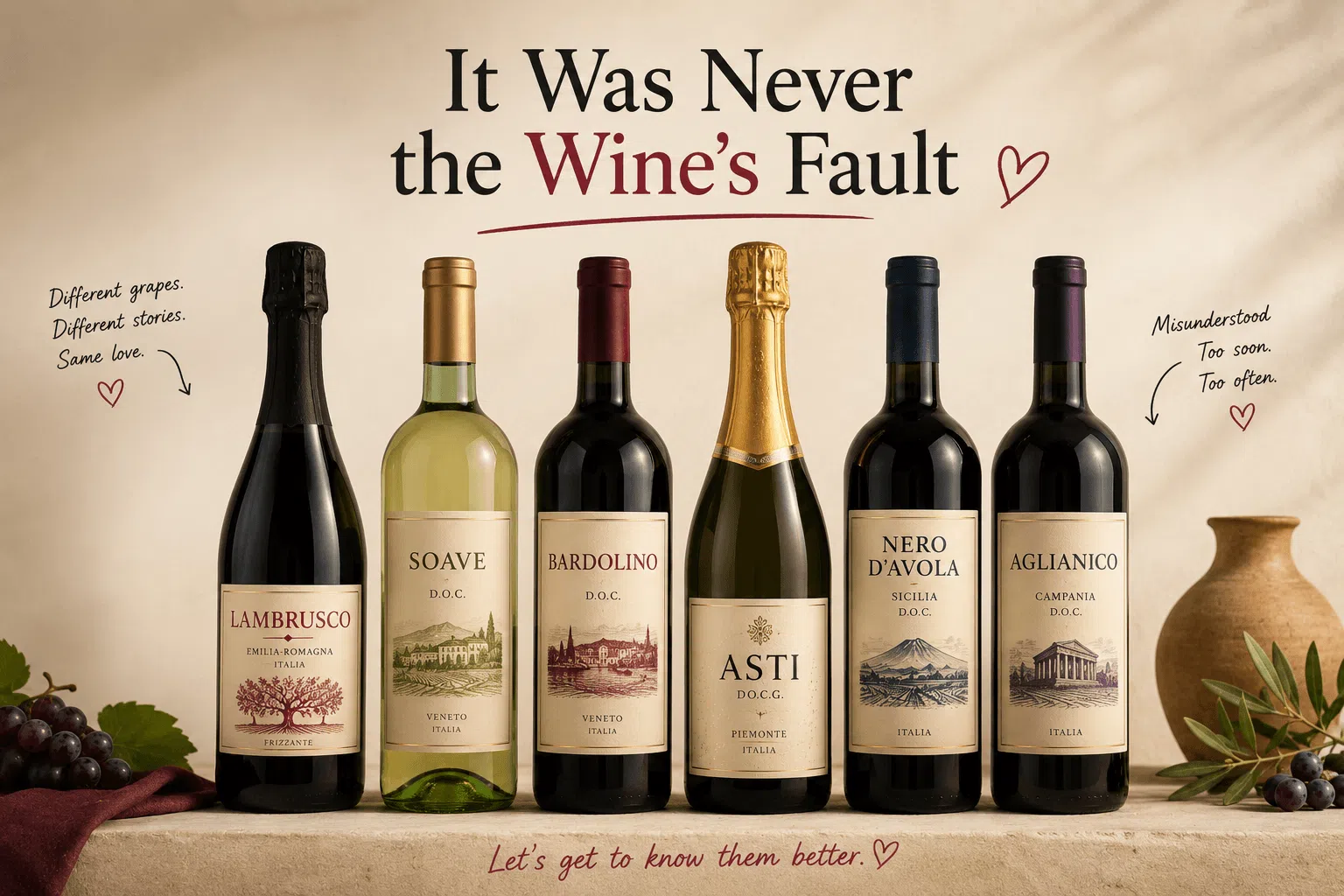
A sweet red from Emilia-Romagna nobody takes seriously. A crisp white with a reputation it can’t shake. A pale, pretty red from a lake, dismissed by critics who like their wine louder. A sparkling wine so light it once didn’t legally qualify as wine in America. A Sicilian red bulk-shipped north for a hundred years without its own name on the label. An ancient red from Campania stuck wearing another wine’s nickname.
Six wines. Different colors, different regions, different centuries, wildly different price points. On paper, they share almost nothing.
Except one thing. Every single one of them got cheapened, dismissed, or erased by something that had absolutely nothing to do with what was actually in the glass.
I spent the last few months writing about each of these wines one at a time: Lambrusco, Soave, Bardolino, Asti, Nero d’Avola, and Aglianico. Somewhere around the fourth one, I noticed I kept typing a version of the same sentence. The wine didn’t do this to itself. Something else did.
Six Ways to Ruin a Wine’s Reputation Without Touching the Wine
Here’s the fast version, before I walk through each one properly.
| Wine | What People Assume | What Actually Happened |
|---|---|---|
| Lambrusco | Cheap, fizzy, unserious | One American brand sweetened it for export and became the whole category’s reputation |
| Soave | Watery, forgettable | A 1968 law expanded the growing zone and let volume drown out quality |
| Bardolino | A tourist trap wine | Critics in the 80s and 90s rewarded big, oaky reds and punished anything light |
| Asti | A cheap shortcut sparkler | Its production method is the correct choice for the grape, not a corner cut |
| Nero d’Avola | Generic, characterless | It spent a century as an anonymous bulk grape, never bottled under its own name |
| Aglianico | A knockoff of Barolo | It predates Barolo’s modern style by roughly 2,000 years and never needed the comparison |
Six wines. Six completely different mechanisms. Not one of them is about quality.
The Brand That Became the Whole Category
Start with Lambrusco, because it’s the cleanest case. One company, Riunite, sweetened it and shipped it to America by the tanker-load. It became the best-selling imported wine in the country by the mid-1980s. Millions of Americans met Lambrusco exactly once, through exactly one brand, and assumed that was the whole story.
It wasn’t. Real Lambrusco is made dry and food-friendly, the way it’s been made in Emilia-Romagna for generations. It has almost nothing to do with what showed up on American shelves. One company managed to do to an entire wine region what one bad blind date does to your opinion of an entire dating app. Fair? No. Common? Extremely. One export deal wrote the reputation. Everyone downstream just accepted the verdict. Read the full story here.
The Law That Let Quantity Win
Soave’s problem was never a marketing decision. It was paperwork, which is somehow worse. Nothing kills a good wine’s reputation faster than a well-meaning committee redrawing a map. A 1968 law expanded the official growing zone far beyond the original hillside vineyards. Suddenly a lot more grapes could legally call themselves Soave, most of them grown on flatter, easier, less interesting land. Quality didn’t collapse because the grape got worse. It collapsed because the definition got looser, and cheap, high-yield Soave flooded a market that used to be smaller and better.
The good stuff never left. It just got outnumbered. Read the full story here.
The Wrong Decade to Be Light
Bardolino’s problem is almost comic in hindsight. Through the 1980s and 90s, critics led by Robert Parker built an entire era of wine writing around rewarding big, dense, oak-heavy reds. Bardolino is the opposite of that by design: light, food-friendly, meant to be chilled and enjoyed rather than analyzed. It got dismissed not because it was made badly, but because it showed up to a party that had decided pleasant wasn’t a compliment.
Taste changes. Bardolino didn’t need to. I still think that whole era of wine criticism owes a lot of light, pleasant reds a formal apology. The critics eventually moved on. The reputation took longer to catch up. Read the full story here.
The Right Answer, Marked Wrong
Asti gets treated like a cheap sparkling wine using a shortcut method instead of Champagne’s more prestigious one. Except the shortcut framing is backward. Champagne’s method, with months of contact with dead yeast, would strip Moscato Bianco of the exact fresh, floral aromatics that make it worth drinking. The single-tank method Asti actually uses protects those aromatics on purpose.
Nobody built a lesser wine here. Somebody built the correct wine for this specific grape, and it got graded against a method that was never meant for it. That’s the wine equivalent of getting marked down on a test for showing your work in a way the teacher didn’t recognize. Read the full story here.
The Grape With No Name
For most of the 20th century, Nero d’Avola’s job wasn’t being a wine. It was fixing other wines. Sicilian co-ops shipped it north by the tanker to add color and body to thinner reds in France and northern Italy. Its name almost never made it onto a label. You could drink gallons of it across Europe and never once know what you were tasting.
A grape can’t build a reputation if it’s never allowed to introduce itself. Imagine being the single most-planted red grape on an entire island and still needing a name tag at your own party. Nero d’Avola didn’t get a bad reputation. It got no reputation at all, which turned out to be its own kind of erasure. Read the full story here.
The Hand-Me-Down Name
Aglianico gets called the Barolo of the South constantly, which sounds like a compliment until you check the math. People have grown wine in Aglianico’s home region since roughly 800 BC. Barolo’s structured, age-worthy modern style didn’t take shape until the 1800s. Aglianico was doing the tannic, age-worthy thing while Barolo was still a pleasant, semi-sweet regional wine nobody outside Piedmont had heard of.
It never needed to borrow anyone’s name. Somebody handed it one anyway, a few thousand years after it had already earned its own. Calling a 2,800-year-old wine “the Barolo of the South” is a little like calling the Colosseum Rome’s answer to Wembley Stadium. Read the full story here.
The Actual Pattern, If You Want It
Here’s the thing that ties all six of these together, and it took writing about every single one before I saw it clearly. Not one of these reputations was ever set by someone tasting the wine in front of them.
Lambrusco’s reputation was set by an ad campaign. Soave’s was set by a law. Bardolino’s was set by a critic’s fashion cycle decades ago. Asti’s was set by a misunderstanding of how a production method actually works. Nero d’Avola’s was set by the simple absence of a name on a label. Aglianico’s was set by a nickname somebody handed it long after the fact.
Every single verdict got inherited, not tasted. Somebody made a call once, for reasons that had nothing to do with what was actually in the glass. Everybody after that just repeated it, generation after generation, without ever checking whether it still held up.
Build Your Own Misunderstood Wines Tasting
If you actually want to test all this yourself, here’s the fun way to do it. Pour a flight of all six, lightest to boldest: Asti first, then Soave, then Lambrusco, then Bardolino, then Nero d’Avola, then Aglianico to finish. That order roughly follows body and intensity, so nothing gets flattened by whatever came before it.
Pair it loosely with food that spans the same range. Something salty and fried for the Asti, a simple seafood pasta for the Soave, a charcuterie board that can carry you through the two reds in the middle, and something grilled or roasted for the Aglianico at the end. You don’t need six separate dinners. You need one long table and people willing to argue about which reputation was the most undeserved.
That’s the actual test. Not whether a critic, a law, or an ad campaign said these wines were lesser. Whether they hold up in your glass, tonight, on their own terms.
Pour all six side by side sometime and here’s what you’ll actually find. The sweet red that isn’t sweet at all when it’s made properly. The crisp white that never lost its nerve, just its exclusivity. The pale lake red that was only ever guilty of showing up in the wrong decade. The sparkler that solved a problem no other method could. The Sicilian red finally allowed to say its own name out loud. The ancient one that never needed anybody else’s name to begin with.
None of that was ever a mystery. Nobody just checked.
Quick Answers
What makes an Italian wine “misunderstood” rather than just cheap? A misunderstood wine has a reputation that doesn’t match its current quality. Usually that’s because of an outside factor: a single brand’s marketing, an outdated law, a critical fashion cycle, or a lazy comparison to a more famous wine, rather than any real flaw in the wine itself.
Are underrated Italian wines actually good value? Often, yes. Because the reputation lags behind the reality, many of these wines are priced well below what the best examples deserve. That usually means more character for the money compared to Italy’s already-famous names.
Which misunderstood Italian wine should a beginner try first? Lambrusco made properly and dry is the easiest entry point, since the gap between its reputation and the real thing is the widest and easiest to taste immediately. Asti and Soave are close seconds for the same reason.
Do these wines age well, or are they meant to be drunk young? It depends on the wine. Lambrusco, Soave, Bardolino, and most Asti are built to be drunk young and fresh. Aglianico is the clear exception, needing a decade or more to show what it’s actually capable of.
Enjoy wine without the snobbery?
Make The Finest Italian Wine one of your Preferred Sources on Google.
Add The Finest Italian Wine to Preferred SourcesDiscover more from The Finest Italian Wine
Subscribe to get the latest posts sent to your email.