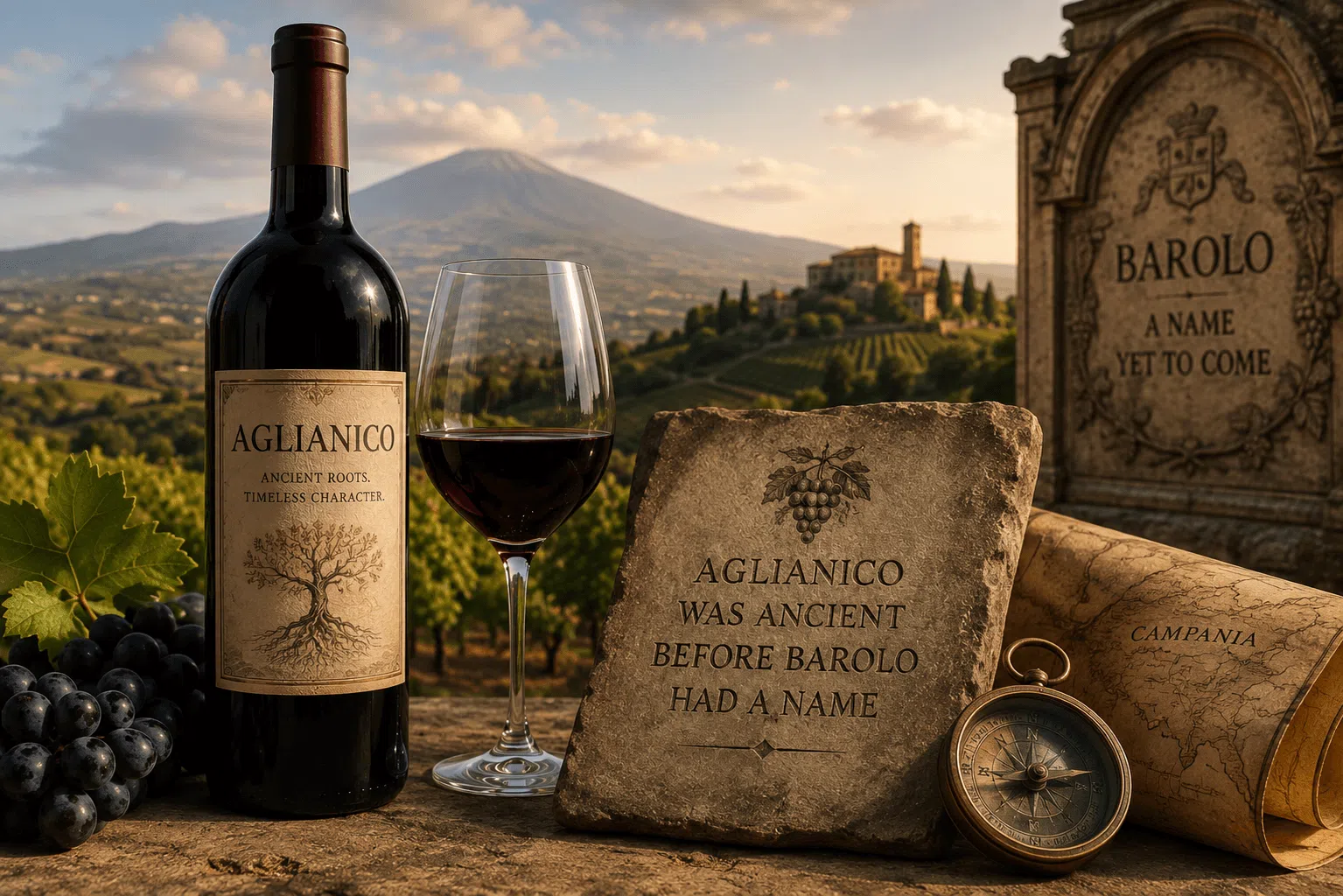
Aglianico Was Ancient Before Barolo Had a Name
Every write-up of Aglianico eventually says the same thing: it’s the Barolo of the South. I read close to fifteen wine guides while researching this piece, and every single one reached for that exact phrase within the first paragraph. At some point that stops being a description and starts being a copy-paste job.
Here’s what that comparison quietly skips over. People have grown wine grapes in Aglianico’s home region since roughly 800 BC. The Roman poet Horace was born right in the middle of what’s now Aglianico del Vulture country. He wrote odes praising the local wine and landscape. Barolo, as the structured, age-worthy wine people know today, wasn’t really shaped into that identity until the 1800s.
So when someone calls Aglianico the Barolo of the South, they’ve got the timeline backward. It’s closer to calling Rome the Los Angeles of Italy.
The Nickname That Gets the History Backward
I get why the comparison exists. It’s not baseless, and it’s not lazy in the sense of being wrong. Both wines share real DNA in style. High acid, serious tannin, a grape that needs years in the bottle before it shows what it’s actually capable of. But it is lazy in a different sense: it’s shorthand that lets a writer skip explaining what actually makes Aglianico good, and just borrow Barolo’s reputation instead.
But “the Barolo of the South” frames Aglianico as the follower. The regional stand-in for something more important happening up north. That framing doesn’t hold up once you look at the actual timeline. Wine has been made in Aglianico’s home territory for close to 2,800 years. Barolo’s modern identity, dry, structured, built for long aging, only really took shape in the 19th century. That’s when winemakers started deliberately fermenting it fully dry instead of leaving it sweet.
Aglianico didn’t need to borrow anyone’s playbook. It was doing the age-worthy, high-tannin thing while Barolo was still just a pleasant, semi-sweet regional wine. Nobody outside Piedmont had even heard of it yet.
Even Its Name Might Be a Myth
Most sources will tell you Aglianico’s name comes from “Ellenico,” the Italian word for Hellenic. Supposedly it got twisted into its current form under Spanish Aragonese rule of Naples in the 1400s. It’s a tidy story. Greek grape, Greek name, Greek origin, all wrapped up neatly.
It’s probably not true.
Linguists who’ve actually traced the word found a problem. The Italian term “ellenico” wasn’t even coined until around 1580, borrowed from the French “hellénisme.” That’s decades after Aglianico had already started showing up as a grape name. You can’t get a word from a source that doesn’t exist yet. Geneticists have found the same dead end from a different angle. DNA analysis shows no meaningful link between Aglianico and any Greek grape variety at all.
So the tidy Greek origin story shows up in nearly every wine guide, including, I’ll admit, an early draft of this one before I bothered chasing down the actual sourcing. It appears to be built on a coincidence of sound rather than actual history. Nobody currently knows where the name Aglianico really comes from. That’s a strange kind of mystery for one of Italy’s most important grapes to still be carrying around.
One Family Kept It From Disappearing
Here’s the part of the story that deserves more credit than it gets. For most of the 20th century, one family was responsible for roughly 90% of all Taurasi production. Not a leading producer. Nearly the entire category.
Antonio Mastroberardino took over his family’s Irpinia estate in the late 1940s, into a landscape actively working against him. Government agricultural policy at the time pushed growers toward international varieties like Sangiovese and Montepulciano, betting they’d sell more easily. Mastroberardino refused. He kept replanting Aglianico, along with the nearly extinct white grapes Fiano and Greco. Most of his neighbors moved on to something the market found easier to sell.
His 1968 Taurasi riserva became legendary. More than fifty years later, people who’ve tasted it still talk about how well it’s held up. Until the early 1990s, Mastroberardino was essentially the only winery in the region making serious wine from these indigenous grapes. If he’d made a different call in 1948, there’s a real chance Taurasi as we know it simply wouldn’t exist today. That’s not a nice footnote in a family history. That’s one man’s stubbornness standing between an ancient wine and the wood chipper, which is an enormous amount of weight to put on a handful of decisions made in a single decade.
The DOCG That Took Its Time
Taurasi finally earned DOC status in 1970. It moved up to DOCG in 1993, the first red wine DOCG anywhere in southern Italy. Aglianico del Vulture, the Basilicata expression grown on the volcanic slopes of Monte Vulture, got its own DOC in 1971. Its top tier, Aglianico del Vulture Superiore, wasn’t promoted to full DOCG status until 2010.
Other producers eventually joined Mastroberardino in proving this wasn’t a one-family fluke. Feudi di San Gregorio arrived in 1986. Terredora di Paolo followed in 1994. It only took the rest of the industry about forty years to notice what one family had been doing the entire time. Between them, Taurasi stopped being one family’s solo act and became an actual category with real depth.
How to Actually Buy It
Two regions, two expressions, both worth knowing. Taurasi, from Campania, tends to be warmer and more fruit-forward, softer tannins, more approachable earlier. Aglianico del Vulture, from Basilicata’s volcanic slopes, runs cooler and more mineral. It’s more austere in youth and often needs more patience before it opens up.
For Taurasi, Mastroberardino’s Radici is the benchmark, alongside strong bottlings from Feudi di San Gregorio and Terredora. For Aglianico del Vulture, look for Elena Fucci’s Titolo. It’s made from a six-hectare plot her grandfather planted in the 1960s, one she chose to save rather than let the family sell. D’Angelo offers a reliable, well-priced entry point, and Paternoster and Cantine del Notaio both deliver serious, age-worthy examples.
Whichever you pick, budget patience along with your money. Young Aglianico can be tight and tannic enough to seem closed off entirely. If you open a bottle at two years old and think this is aggressive and a little mean, you’re not wrong. You’re just early. Give the good ones ten years and they turn into something completely different. Leather, tobacco, dried fig, a savory depth that simply isn’t there in the first few years. Expect $20 to $40 for a solid bottle. Prices climb well past $80 for top single-vineyard riservas built to be cellared for decades.
Twenty-Eight Hundred Years, and Nobody Owed Barolo Anything
If you’ve been following along, this closes out a run that’s included Lambrusco, Soave, Bardolino, Asti, and Nero d’Avola. Six wines Italy somehow talked itself into underrating.
So the next time a wine list or a label calls this “the Barolo of the South,” order it anyway. It’s usually still very good wine. Just don’t repeat the line back to the sommelier like you learned something. Aglianico was already old when Barolo was still finding its footing. It never needed the comparison. Somewhere along the way, somebody handed it one anyway, and everyone’s been copying the homework ever since.
Quick Answers
Why is Aglianico called the Barolo of the South? Both wines share high tannin, high acidity, and serious aging potential, which invites the comparison. The nickname overlooks something important. Aglianico’s home region has documented winemaking history going back roughly 2,800 years. Barolo’s modern structured style only really developed in the 19th century.
Does Aglianico’s name actually come from the Greek word for Hellenic? Probably not, despite how often the claim gets repeated. Linguists have shown the Italian word “ellenico” wasn’t coined until around 1580, after Aglianico already existed as a grape name. Genetic testing has also found no meaningful link between Aglianico and any Greek grape variety.
What’s the difference between Taurasi and Aglianico del Vulture? Both come from the same grape. Taurasi, grown in Campania, tends to be warmer and more fruit-forward with softer tannins. Aglianico del Vulture, grown on Basilicata’s volcanic Monte Vulture, is typically more mineral-driven and austere, often needing more time to open up.
How long should you age Aglianico before drinking it? The best examples generally need at least 10 years to soften their considerable tannins and reveal secondary flavors like leather, tobacco, and dried fruit. Lighter, less structured bottlings can be approachable within 2 to 5 years.
Enjoy wine without the snobbery?
Make The Finest Italian Wine one of your Preferred Sources on Google.
Add The Finest Italian Wine to Preferred SourcesDiscover more from The Finest Italian Wine
Subscribe to get the latest posts sent to your email.