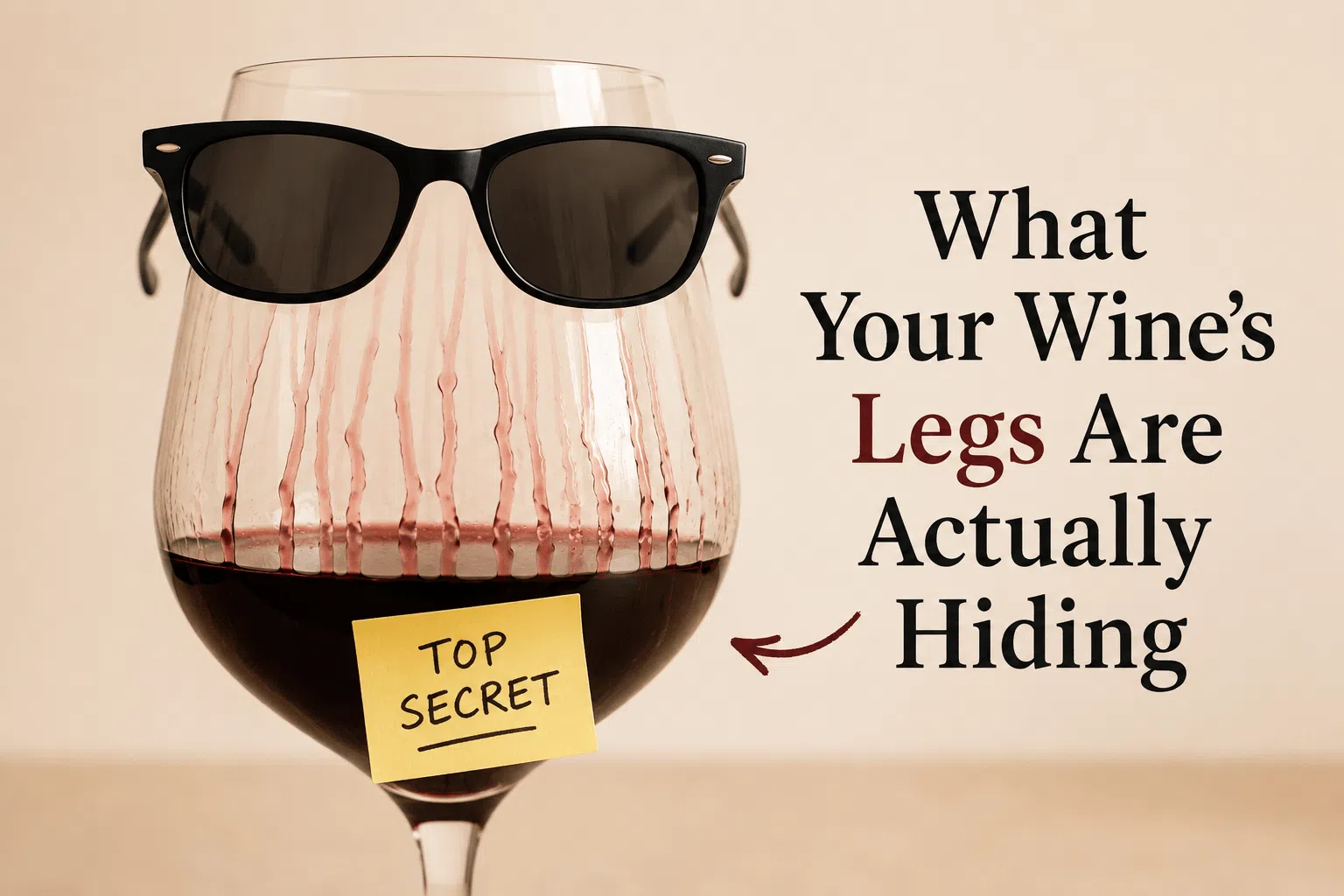
What Your Wine’s Legs Are Actually Hiding
Try this the next time you’re at a wine bar. Order two glasses — one big, boozy red, one light, crisp white — and swirl them side by side. Watch closely.
One will throw slow, heavy streaks down the glass like it’s confessing something. The other barely leaves a mark. Most people watching that side-by-side would tell you the first wine is “better.” Richer. More serious. More expensive, probably.
They’d be wrong, and they’d be wrong for a very specific, very physical reason that has nothing to do with quality at all.
Picture a glass of Amarone thick enough to nearly coat the glass, sitting next to a Soave so light it barely leaves a mark. Two completely different wines, two completely different “verdicts” swirling in front of everyone at the table. Only one of those verdicts had anything to do with quality, and it wasn’t the one people usually think.
What actually causes wine legs?
Physics, not talent in the vineyard.
Wine is a mix of alcohol and water, and the two evaporate at different speeds. When you swirl the glass, a thin film clings to the inside, and the alcohol in that film evaporates faster than the water does. That imbalance changes the surface tension of the liquid clinging to the glass, and the wine gets pulled upward in a thin sheet before gravity drags it back down as those familiar streaks. Wine folks call this the Gibbs-Marangoni effect, which is a wildly fancy name for “alcohol evaporates faster than water and drama ensues.”
That’s genuinely the whole mechanism. No terroir. No winemaker’s secret technique. No correlation whatsoever with how good the wine is going to taste in about four seconds.
Do wine legs tell you anything at all?
A little, just not what people assume.
Legs correlate loosely with alcohol content and, to a lesser degree, sugar. A high-alcohol wine tends to throw slower, thicker legs than a lighter one, which is why that Amarone would put on a much bigger show than the Soave sitting next to it. Higher alcohol, more dramatic streaks. That’s it. That’s the entire secret.
Here’s the part almost nobody says out loud, though: you already know the alcohol percentage. It’s printed on the label, four inches from where you’re squinting at the glass. Legs are essentially a slow-motion, mildly theatrical way of re-confirming information you could have read in half a second.
Can you actually guess a wine’s alcohol from its legs?
Loosely, yes, and this is the one place legs earn their keep as a party trick rather than a performance.
As a rough rule of thumb: thin, fast streaks that vanish quickly usually mean something under 12% alcohol, like a crisp Soave or a Prosecco. Slower, thicker legs that take their time sliding down usually mean you’re somewhere north of 14%, which is exactly where a big Amarone or a ripe Primitivo tends to sit. It’s not precise enough to bet money on, but it’s precise enough to win a small argument at a dinner party, which honestly might be the more valuable currency anyway.
There’s one place legs get genuinely more informative, and almost nobody mentions it: sweet and fortified wines. Sugar behaves similarly to alcohol in this effect, so a Recioto or a Fior d’Arancio will often show thick, slow, almost syrupy legs from the sugar content alone, regardless of alcohol level. In that specific case, the legs are quietly telling you something real about the wine’s residual sugar. It’s just still not telling you anything about whether it tastes good.
So why does everyone still act like legs mean quality?
Because it looks like insight, and looking like insight is most of what wine snobbery actually runs on.
Swirling, staring, nodding slowly — it’s a performance that signals “I know what I’m looking at,” even when what you’re looking at is just alcohol doing what alcohol does in a glass. I don’t think anyone’s being dishonest when they do it. I think most people genuinely believe there’s more information in those streaks than there is, because the ritual has been repeated so consistently, for so long, that nobody stopped to check whether it was ever true.
This is where I’ll actually push back gently on my own argument, though, because dismissing legs entirely isn’t quite fair either. Watching them can occasionally flag something worth noticing, like a wine sitting at a much higher alcohol level than you expected for its style, which might explain why a wine tastes hotter or more full-bodied than the label led you to picture. That’s a small, genuinely useful observation. It’s just a very different claim from “this wine is good,” and the two get conflated constantly.
Is this the same thing as the cork-sniffing ritual?
More or less, yes, and I’d argue it’s part of the same pattern.
I’ve already written about why people smell the cork before tasting, and it turns out to be another gesture people perform with total confidence while having no idea what they’re actually checking for. Wine has built an entire language of small rituals — the swirl, the sniff, the nod, the nose in the glass — that look like expertise from across the room but mostly just look like expertise. I’ve broken down the cork ritual here, if you want to see the pattern repeat itself with a completely different prop.
Legs are simply the visual version of the same performance. Alcohol pretending to be insight.
Should you still swirl your wine?
Absolutely, just for a better reason than judging quality.
Swirling genuinely does open up a wine’s aromas by exposing more surface area to air, which helps you actually smell what you’re about to taste. That part’s real and worth doing every time. Just do it to smell the wine, not to read tea leaves in the streaks afterward. The legs will still show up. They just won’t be telling you anything you didn’t already know from the label in your other hand.
Next time someone at your table swirls, stares, and nods knowingly at their glass, don’t argue with them. Just quietly guess the ABV before you check the label, using nothing but the streaks. Say it out loud. Then flip the bottle around and see how close you got.
That’s the only version of this ritual actually worth performing. Not nodding at the glass like it told you something profound. Betting on it, and finding out if you were right.
FAQ
Do wine legs indicate a wine’s quality? No. Wine legs are caused by the different evaporation rates of alcohol and water in the glass, a phenomenon known as the Gibbs-Marangoni effect. They correlate loosely with alcohol and sugar content, not with how good the wine actually tastes.
Why do some wines have more pronounced legs than others? Higher alcohol content generally produces slower, thicker legs, and higher sugar content can have a similar effect. A big, high-alcohol red will typically show more dramatic legs than a light, crisp white, regardless of which one is the better wine.
What’s the actual scientific name for wine legs? The Gibbs-Marangoni effect, named after the physicists who described the underlying surface tension phenomenon. It’s also sometimes called “wine tears” or, in older writing, “church windows.”
Should I still swirl my wine if legs don’t mean anything? Yes. Swirling releases aroma by increasing the wine’s surface area, which genuinely helps you smell it better before tasting. Just swirl for the aroma, not to read the legs afterward as a quality signal.
Do wine legs mean something different in sweet or fortified wines? Somewhat. Sugar affects the same surface tension mechanism as alcohol, so sweet and fortified wines often show thick, slow legs from their sugar content alone. It’s a genuine signal about residual sugar, but it still isn’t a signal about quality.
Enjoy wine without the snobbery?
Make The Finest Italian Wine one of your Preferred Sources on Google.
Add The Finest Italian Wine to Preferred SourcesDiscover more from The Finest Italian Wine
Subscribe to get the latest posts sent to your email.