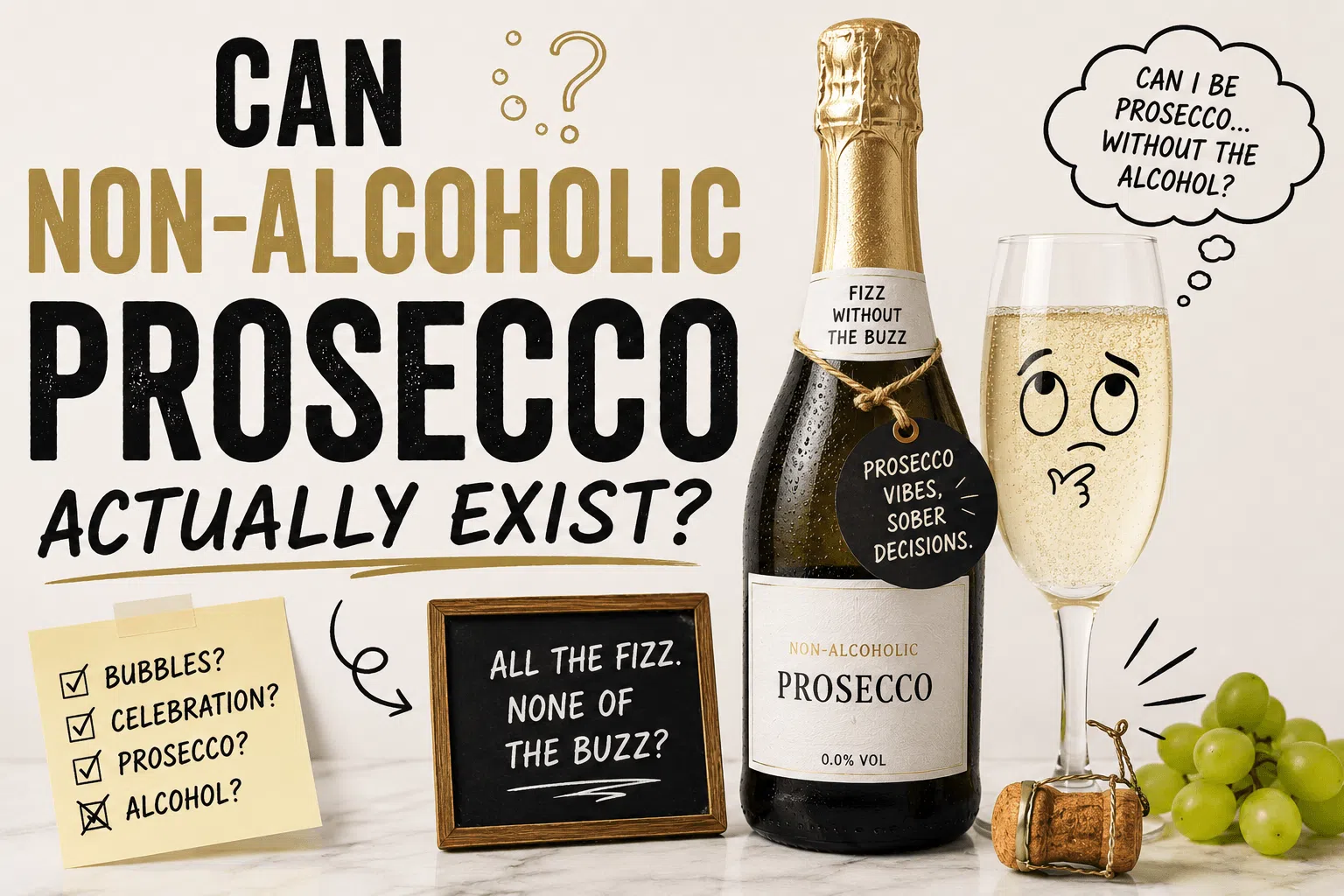
Can Non-Alcoholic Prosecco Actually Exist?
I’ve seen bottles described as non-alcoholic Prosecco. Alcohol-free Prosecco. Zero-alcohol Prosecco. Prosecco alternatives. Prosecco-style sparkling wine.
At some point I started wondering whether Prosecco itself had been informed about any of this. Because Italy has rules. Lots of rules. You cannot grow some Glera grapes wherever you fancy, put bubbles in the bottle, and announce that you’ve made Prosecco. The name is protected, the production area is defined, and the finished wine has legal requirements it must meet. Alcohol content is one of them.
I looked into this earlier in the year and concluded that a true 0.0% Prosecco DOC legally couldn’t exist under that name. As of March 2026, that answer changed. Here’s the whole story, including the part almost nobody’s caught up with yet.
Prosecco Isn’t Just the Name of a Drink
This is the most important part, first: Prosecco is not Italian shorthand for sparkling wine. It’s a protected denomination.
Prosecco DOC can only be produced under specific rules in designated areas of Veneto and Friuli-Venezia Giulia. Glera must be the principal grape. The regulations govern where the grapes come from, how the wine is produced, and what the finished wine must be like. Even the alcohol is part of the deal. Under the current Prosecco DOC specification, finished still and frizzante wines must reach a minimum total alcoholic strength of 10.5%, while Prosecco spumante must reach 11%.
Make something with less alcohol than that, and you’ve made a very nice sparkling wine. Whether you get to keep calling it Prosecco DOC used to depend on rules that just shifted under everyone’s feet.
The Rule That Was True Until Very Recently
For years, EU wine law drew a hard line. Wines with a protected designation of origin or protected geographical indication, Prosecco DOC included, could only be partially dealcoholized. Full dealcoholization simply wasn’t permitted for wines carrying a protected name. That’s what I found when I first researched this question, and it was accurate at the time.
It also created a genuinely strange outcome. A producer could dealcoholize a Prosecco DOC partway, but taking it all the way to 0.0% meant giving up the Prosecco DOC name entirely. Same grapes, same hills, same producer, different legal identity, just because the alcohol dropped below a certain line.
What Changed in March 2026
Here’s the part that flips the whole story. EU Regulation 2026/471 took effect on March 18, 2026, and it reversed that restriction. PDO and PGI wines can now be fully dealcoholized and keep their protected geographical name, Prosecco DOC included. The label just has to clearly disclose what happened, language like “produced through dealcoholization” is required, along with the same nutrition and ingredient disclosures every dealcoholized wine now needs.
So the legal door that used to be shut is now open. A genuinely zero-alcohol Prosecco DOC, properly labeled, is no longer a contradiction in terms.
So Is Anyone Selling It That Way
Here’s where it gets more interesting than a simple “yes, now it’s legal” headline suggests.
Villa Sandi, one of the more established Prosecco-region producers, launched a dealcoholized sparkling wine made from Glera in late 2025, timed well for Dry January. It’s a real, commercially available product that genuinely tastes like Prosecco. What it isn’t doing, at least as of this writing, is calling itself Prosecco DOC on the label. It’s marketed as dealcoholized Glera.
That gap is worth sitting with. The law changed months ago. Producers who could reasonably start labeling a dealcoholized bottle as Prosecco DOC mostly haven’t rushed to do it yet. That could be caution while the new disclosure requirements get sorted out in practice. Or it could be a genuine hesitation about attaching a century of reputation to a product category still finding its footing. Either way, “legally possible” and “actually happening” are turning out to be two different timelines here.
What If I Use Glera Grapes?
Glera is the principal grape behind Prosecco, so it’s tempting to assume using it settles the question on its own. It doesn’t. A grape variety and a denomination are not the same thing. Prosecco DOC isn’t Prosecco merely because Glera turned up. The grapes have to come from the permitted production area. The wine has to satisfy the denomination’s full production specification, alcohol rules included, even under the new, more flexible dealcoholization framework.
This is why Italian wine labels can seem unnecessarily serious until you understand what they’re protecting. Words like DOC, DOCG, Classico, Riserva, and Superiore aren’t decorative compliments. If you’ve ever wondered what those words are doing on the bottle, my guide to what Classico, Riserva, and Superiore really mean on Italian wine labels explains why Italy takes these classifications so seriously. Prosecco is no different. The name means something, even now that it’s allowed to mean something with zero alcohol in the glass.
And Please Don’t Call Every Italian Bubble Prosecco
While we’re here, can we settle something else? Not every Italian sparkling wine is Prosecco. This was already true before anybody started removing alcohol, and it’s still true now.
Italy has Franciacorta. Trentodoc. Asti. Alta Langa. Lambrusco in sparkling forms. Prosecco. And plenty of other sparkling wines with their own grapes, regions, and production traditions. I’ve already made this case with Alta Langa, the Italian sparkling wine that isn’t trying to be Prosecco. Same country, same bubbles, completely different identity, dealcoholized or not.
Prosecco Is Also Working the Other Angle
There’s a second track worth knowing about, separate from dealcoholization entirely. The Prosecco DOC Consortium has been developing a lower-alcohol version of Prosecco itself, aiming for roughly 8 to 9% through vineyard and winemaking adjustments rather than removing alcohol after the fact. As of early 2026, the Consortium confirmed that work is still ongoing.
That’s a genuinely different approach solving a similar problem: less alcohol in the glass, arrived at through farming and fermentation choices instead of a dealcoholization tank. Between this and the newly legal full-dealcoholization route, Prosecco now has two separate paths toward lower-alcohol versions of itself, and it’s genuinely unclear yet which one producers, or drinkers, will prefer.
Why the Old Rule Existed, and Why Loosening It Isn’t Reckless
The whole point of a protected denomination is that the name tells you something specific. When you buy Prosecco DOC, you’re not supposed to be buying a vague idea of Italian bubbles. You’re buying wine connected to defined grapes, places, and production rules.
Lifting the dealcoholization ban didn’t abandon that principle, it just moved where the protection lives. Instead of protecting the name by keeping dealcoholized wine out entirely, the new rule protects it through mandatory disclosure. You still can’t quietly pass off a dealcoholized bottle as ordinary Prosecco DOC. You just have to say what it is on the label. That’s a real shift in philosophy, and whether it holds up as well as the old hard line remains to be seen.
Quick Answers
Can Prosecco legally be made alcohol-free now? Yes, as of March 2026. EU Regulation 2026/471 allows PDO and PGI wines, including Prosecco DOC, to be fully dealcoholized and keep their protected name, provided the label clearly discloses the dealcoholization.
Is dealcoholized Prosecco DOC available to buy? Not labeled that way yet, as far as I’ve found. Producers like Villa Sandi have launched dealcoholized Glera-based sparkling wines, but they’re marketed under the grape name rather than as Prosecco DOC, even though the law would now technically allow it.
What’s the minimum alcohol content for regular Prosecco? Prosecco DOC still and frizzante wines require a minimum total alcoholic strength of 10.5%, and Prosecco spumante requires 11%, under the Consortium’s own production specification.
Is every Italian sparkling wine technically Prosecco? No. Franciacorta, Trentodoc, Asti, Alta Langa, and sparkling Lambrusco are all distinct Italian sparkling wines with their own rules and identities, separate from Prosecco DOC.
Salute.
Continue Exploring
- Stop Calling Prosecco “Italian Champagne” — Here’s What It Actually Is
- Classico, Riserva, Superiore: What They Really Mean on Wine
- The Italian Sparkling Wine That Isn’t Trying to Be Prosecco
- How Do They Take the Alcohol Out of Wine?
- Non-Alcoholic Wine Explained: What Exactly Are We Drinking?
Enjoy wine without the snobbery?
Make The Finest Italian Wine one of your Preferred Sources on Google.
Add The Finest Italian Wine to Preferred SourcesDiscover more from The Finest Italian Wine
Subscribe to get the latest posts sent to your email.