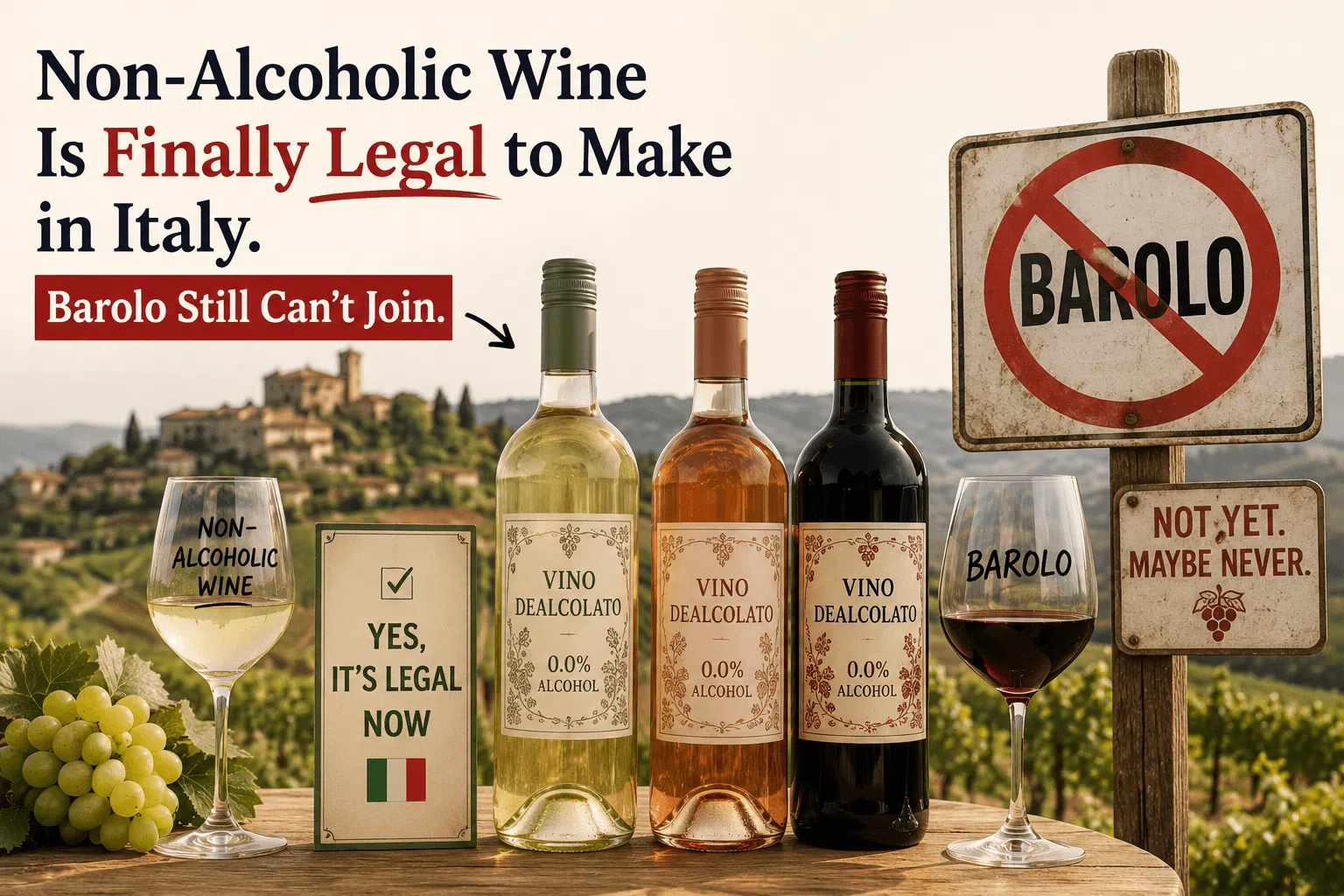
Non-Alcoholic Wine Is Finally Legal to Make in Italy. Barolo Still Can’t Join.
For most of 2025, an Italian winery that wanted to remove the alcohol from its own wine had to ship it to Germany. Someone else took the alcohol out. Then it came back. Not because the technology didn’t exist here. Because it was illegal to do it on Italian soil.
That changed in December, when a new decree finally broke years of legislative deadlock. Italian producers can now dealcoholize wine at home for the first time. At Vinitaly this year, industry watchers were projecting Italian production of alcohol-free wine to grow by roughly 90% in the next twelve months alone.
Here’s the part that makes this a genuinely Italian story, not just an industry footnote. Barolo still isn’t allowed to come to the party. Neither is Chianti, Prosecco, or anything else carrying a DOC, DOCG, or IGT label. Only Italy’s classified wines got left out of their own country’s biggest wine shift in years. Once you understand why, it explains almost everything else about how seriously Italy takes what a name on a label means.
What Non-Alcoholic Wine Really Is, Before Anyone Gets Offended
Here’s the distinction that solves most of the confusion in one sentence: dealcoholized wine is wine first.
Grapes get picked, crushed, fermented the normal way. Sugar becomes alcohol, exactly like every bottle you’ve ever opened. Only after that entire process finishes does anyone remove the alcohol. Grape juice, by contrast, never goes through fermentation at all. It skips the step that makes wine wine in the first place.
That single distinction is also why making decent alcohol-free wine costs real money and real effort. You’re not simplifying the process by skipping a step. You’re adding one on top of everything wine already required.
How You Get Alcohol Out Without Taking the Wine With It
The short version: vacuum distillation, reverse osmosis, and spinning-cone technology are the three main tools. All three are trying to solve the same stubborn problem. Pull the alcohol out while somehow convincing the aroma and flavor to stick around.
That’s harder than it sounds because alcohol isn’t just along for the ride. It carries weight, texture, and warmth in the mouth, and it changes how every other flavor in the glass behaves. Take it out and the wine doesn’t just get weaker. It gets structurally different, which is why producers have to rebuild balance from scratch rather than simply subtracting one ingredient.
Why Does It Cost So Much for Something With Less In It
This is the part that genuinely annoyed me the first time I looked into it.
You made a full bottle of wine. You then paid for extra equipment and extra labor to remove something from it. And somehow the bottle on the shelf costs the same as, or more than, the alcoholic version. It’s the wine equivalent of a restaurant charging extra for a burger with no cheese.
There’s a real answer underneath the irritation, though. A producer making dealcoholized wine has already paid for every normal step of winemaking: the grapes, the fermentation, the equipment, the labor. All of that happens before the dealcoholization stage even begins. Then comes a second, specialized production phase on top of all of it. You’re not paying more for less wine. You’re paying for wine that went through an extra, expensive process most bottles never have to survive.
Whether every producer’s pricing reflects that honestly is a fair question. I can’t answer it for the whole industry. I’d just check the actual bottle in front of you rather than take the marketing copy’s word for it.
Does It Taste Like Wine, Though
Sometimes. Genuinely, sometimes not.
I’m skeptical of anyone who claims every alcohol-free wine tastes indistinguishable from the real thing. Removing alcohol changes something structural, not cosmetic. Sparkling wines tend to handle it best. Bubbles bring their own texture and energy, which covers for a lot of what disappears. Crisp, aromatic whites do reasonably well too, since acidity and aroma were already doing most of the work.
Big structured reds have a much harder job. A serious red depends on tannin, fruit, acidity, body, and alcohol all working as a team. Pull one player off the field and ask the rest to cover for it, and somebody usually notices. The technology is improving fast, and some producers are getting genuinely good at this. But if a bottle promises you won’t taste the difference, I’d bring the same skepticism I bring to anyone insisting a cauliflower crust tastes exactly like real dough.
For what it’s worth, I’ve tasted a few myself, and the good ones are genuinely nice. Not a lesser stand-in for the real thing, not a compromise you settle for. Just a pleasant glass of wine that happens to have nothing in it, and one I’d happily pour again.
Why This Is a Bigger Deal in Italy Than It Sounds
Italy has spent centuries deciding exactly what a name on a wine label is allowed to mean. Chianti isn’t just red wine from Tuscany. Barolo isn’t just a strong red from Piedmont. Every designation comes with rules about grapes, region, and process. Italy defends those rules more stubbornly than almost anywhere else in the wine world. I’ve gone deep into how that classification system works if you want the full picture.
So when the December decree finally allowed Italian producers to dealcoholize wine at home, the government drew a very specific line. Generic wine can go through the process. DOC, DOCG, and IGT wines cannot. A winery can dealcoholize its everyday table wine, but it cannot legally produce a dealcoholized Barolo, Chianti, or Prosecco and put those names anywhere near the bottle.
That’s not bureaucratic stubbornness for its own sake. It’s the same instinct that’s protected Italian wine identity for a century, just applied to a technology nobody had to legislate around before. Italy will let you remove the alcohol. It won’t let you borrow the name while you do it.
Who This Is Really For
I don’t think the real story here is people swearing off wine forever. It’s someone driving home after dinner who still wants a glass with the table. Someone having lunch before an afternoon of work. Someone cutting back on alcohol without wanting to give up the actual ritual of opening a bottle and sitting down to a meal with it.
Nobody needs to confiscate anyone else’s Barolo for this category to make sense. Both things can exist on the same table, aimed at different moments.
Quick Answers
Is non-alcoholic wine really wine? Yes, if it’s made properly. Dealcoholized wine goes through full fermentation first, exactly like regular wine, before the alcohol is removed afterward. Grape juice never ferments at all, which is the real dividing line.
Why did Italy ban making it at home for so long? Regulatory deadlock, not opposition to the product itself. Italian producers were legally allowed to sell dealcoholized wine, just not to remove the alcohol on Italian soil. A December 2025 decree finally resolved the tax and production rules that had stalled the issue for years.
Can Barolo or Chianti be sold as non-alcoholic? No. Italy’s new rules specifically exclude DOC, DOCG, and IGT wines from dealcoholization. Only generic, unclassified wine currently qualifies, which keeps every protected name off alcohol-free shelves for now.
Is it healthier than regular wine? Not automatically. It generally has less or no alcohol and sometimes fewer calories, but sugar and calorie content vary a lot between brands. Check the label rather than assume.
Continue Exploring
- Decoding the Italian Wine Label: What DOCG, DOC, and IGT Actually Mean
- The Rise of Low- and No-Alcohol Wines: Why Everyone’s Drinking Smarter in 2025
- Can Non-Alcoholic Prosecco Actually Exist?
- Non-Alcoholic Wine Tastes Like Wine. Just Not Exactly Like It.
- Why Is Non-Alcoholic Wine So Expensive?
Enjoy wine without the snobbery?
Make The Finest Italian Wine one of your Preferred Sources on Google.
Add The Finest Italian Wine to Preferred SourcesDiscover more from The Finest Italian Wine
Subscribe to get the latest posts sent to your email.