Why Is Non-Alcoholic Wine So Expensive?
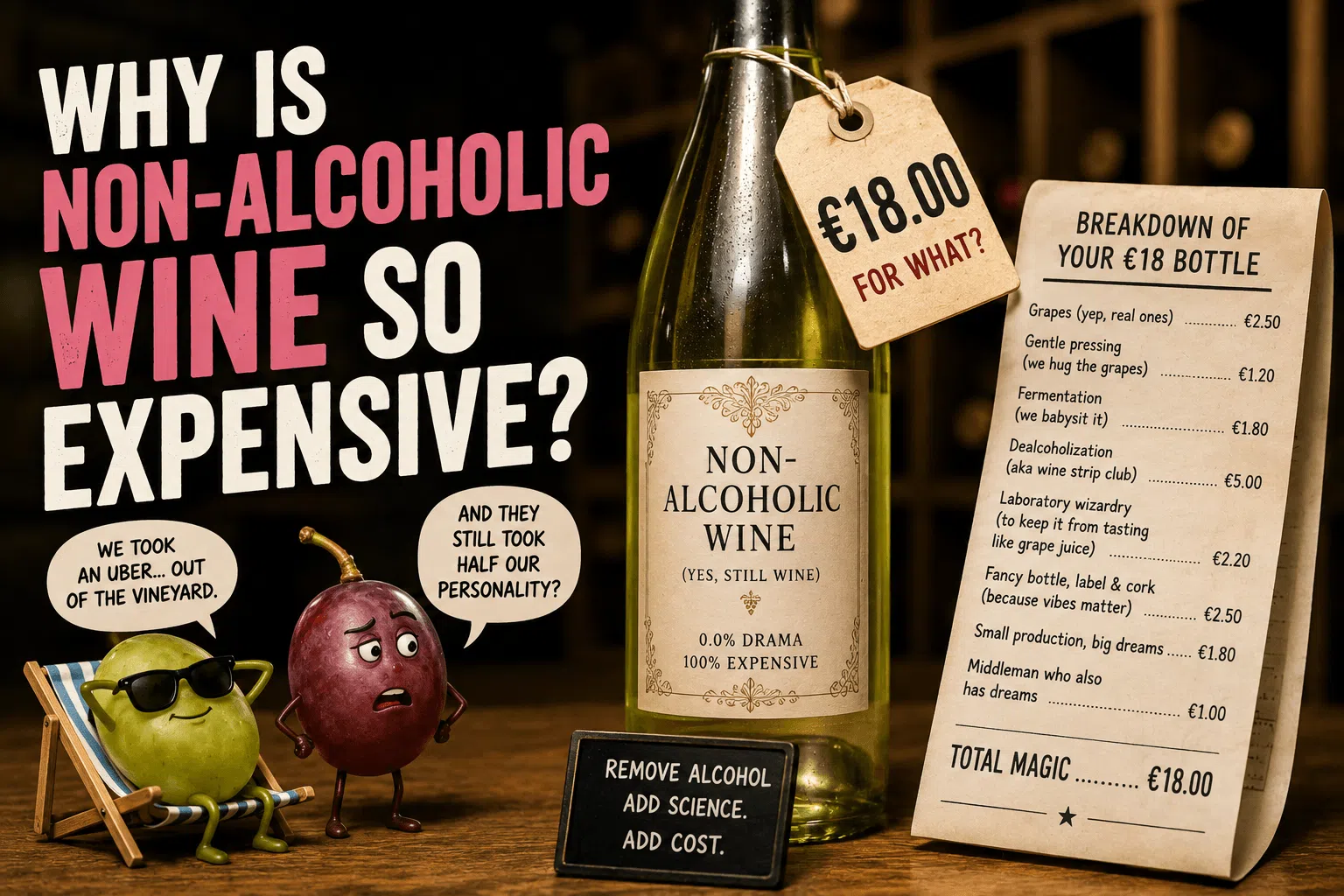
I bought a non-alcoholic Moscato recently. Fifteen euros. For a wine that, with the alcohol left in, usually costs half that.
Moscato has never been a wine that demands respect at the till. It’s cheap, sweet, easy, the wine equivalent of a song you enjoy without needing to defend it. So watching the alcohol-free version cost as much as it did genuinely stopped me in the aisle.
Order a decaf espresso in Italy and you’ll usually pay the same as a regular one, sometimes more, for a coffee that had something taken out of it. Ask a barista why and you’ll mostly get a shrug. Ask a non-alcoholic wine producer the same question, and you’ll get a real answer. It’s just not the one you want to hear at first.
You grew the grapes. You made the wine. Then you removed something from it. Why does the bill go up?
There’s a genuine reason, and it holds up better than I wanted it to when I went looking for it.
I’ve also watched the alcohol-free shelf in Italian supermarkets grow the same way the sparkling water section did a few years back. It started as one sad row near the back. Now it gets real eye-level space, and the prices sitting on it are not shy about asking to be taken seriously.
Nobody Skips the Wine Part
This is the detail that trips people up every time.
Real dealcoholized wine starts as actual wine. Grapes still get grown, harvested, crushed, fermented, the whole process. The winery still pays for equipment, labor, storage, bottles, everything ordinary winemaking already costs.
By the time the alcohol exists in the bottle, the producer has already spent the full price of making wine.
Then, having successfully made that wine, they pay again to take the alcohol back out.
This isn’t wine with a step removed to save money. It’s wine with an extra, expensive step bolted on top. Extra steps come with invoices, and somebody has to pay them before the bottle ever reaches a shelf.
Alcohol Doesn’t Leave Quietly
Alcohol is mixed into wine at a molecular level, which is deeply unhelpful for anyone trying to remove it cleanly.
Producers rely on methods like vacuum distillation, reverse osmosis, or spinning-cone technology. Each one needs specialized equipment, real energy costs, and genuine expertise to run properly. That alone isn’t the hard part, though.
The hard part is getting the alcohol out without taking the wine’s personality with it. Alcohol carries body, warmth, and aroma. Pull it out carelessly and you’ve made expensive, flavorless water with a cork in it. Producers have to rebuild balance and protect delicate aromas through the whole process. That means more handling, more monitoring, and more opportunities for something to go wrong before the wine is finished twice over.
Italy Adds Its Own Line Item to the Bill
Here’s a cost driver most explanations of this topic never mention, and it happens to be specifically Italian.
Until a December 2025 decree, Italian producers weren’t legally allowed to dealcoholize wine on their own soil. A winery that wanted to remove the alcohol from its own bottle had to ship it abroad, usually to Germany or Belgium. Someone else did the process there. Then the finished wine shipped back to Italy to be sold. I’ve gone deeper into that entire regulatory mess separately, including which wines still aren’t allowed to go through the process even now.
Shipping wine across a border and back isn’t a rounding error. That’s transportation, customs handling, and time, all baked into the final price before the bottle ever touched an Italian shelf. Producers here weren’t just paying for dealcoholization. For years, they were paying to outsource it.
You’re Paying for More Work, Not Less Wine
This is the part that finally made the pricing click for me.
Ordinary wine finishes its process and heads to the bottle. Dealcoholized wine finishes that same process and then keeps going. Another technical stage, more equipment, more handling, more chances to damage what you’re trying to sell.
“There’s less in the bottle” isn’t really the right way to think about the price. You’re not being charged by ingredient count. You’re being charged for everything that had to happen to the wine before it reached your glass. That list got longer, not shorter.
So Why Are Some Bottles Cheap
Because dealcoholization was never the only variable setting the price. It’s just the one producers like to lead with.
Grape quality matters. Production volume matters enormously, since a large producer spreads the cost of specialized equipment across far more bottles than a small one ever will. A big brand’s dealcoholization machine might process a hundred times the volume a boutique winery does, on the same equipment, at a fraction of the per-bottle cost. Packaging matters too, and this is where things get a little less noble.
A beautiful bottle. Elegant typography. A name featuring the word Pure, Free, Zero, or Mindful, ideally all four if there’s room on the label. At some point, you’ve left production costs behind entirely and wandered into positioning.
Some of the Price Is Just the Trend
Non-alcoholic drinks are fashionable right now, and fashionable categories get priced like it.
People are actively looking for something more interesting than sparkling water at dinner, and producers know exactly how much demand that creates. Wine has never been priced purely on the cost of grapes. Reputation, scarcity, and marketing have inflated bottles for as long as wine has existed. Non-alcoholic wine simply joined that same party. Ironically, without drinking anything at it.
So when a bottle costs twenty euros, part of that genuinely reflects difficult production and real technology. Part of it might also reflect someone discovering that zero percent looks remarkably expensive printed in gold foil. Both things are allowed to be true on the same label.
Expensive Doesn’t Mean Good
It really doesn’t. This is still wine, and we already know better than to trust price alone.
A twenty-five-euro alcohol-free bottle can disappoint you just as efficiently as a twenty-five-euro regular one. A higher price might mean better grapes and more careful aroma work. It might also mean a very good branding agency and nothing else. I’ve written separately about what happens to the taste once the alcohol comes out. Price has surprisingly little to do with which bottles get that part right.
If the entire pitch on the label is Zero Alcohol, Full Flavor, in large friendly letters, I still have questions. Full flavor has committed a long list of crimes across the food and drink aisle, and this category is not exempt.
As for my fifteen-euro Moscato: it was decent, not remarkable. Somewhere between the real dealcoholization cost and the fact that Moscato drinkers weren’t exactly primed to expect a premium price, I suspect a fair amount of that fifteen euros was the category testing what people would tolerate. I paid it. I’d think twice about the next one.
Quick Answers
Why does non-alcoholic wine cost more than regular wine? Because it goes through the full winemaking process first, then an additional, expensive dealcoholization stage on top. You’re paying for extra production steps, not fewer ingredients.
Is non-alcoholic wine ever overpriced? Yes, sometimes. Branding, trend demand, and packaging can inflate a bottle’s price well beyond its actual production cost, the same way they do with regular wine.
Does a higher price mean better non-alcoholic wine? Not reliably. A higher price can reflect genuinely better grapes and more careful production, or it can reflect marketing alone. Checking the producer and process tells you more than the price tag does.
Why is this especially relevant in Italy? Until a December 2025 legal change, Italian producers couldn’t dealcoholize wine domestically and had to ship it abroad and back, adding real cost that producers elsewhere didn’t have to absorb.
Salute.
Continue Exploring
- Non-Alcoholic Wine Is Finally Legal to Make in Italy. Barolo Still Can’t Join.
- Non-Alcoholic Wine Tastes Like Wine. Just Not Exactly Like It.
- Is Non-Alcoholic Wine Just Grape Juice?
- Can Non-Alcoholic Prosecco Actually Exist?
Enjoy wine without the snobbery?
Make The Finest Italian Wine one of your Preferred Sources on Google.
Add The Finest Italian Wine to Preferred SourcesDiscover more from The Finest Italian Wine
Subscribe to get the latest posts sent to your email.