Non-Alcoholic Wine Tastes Like Wine. Just Not Exactly Like It.
Someone always says the same thing about non-alcoholic wine. You honestly can’t tell the difference.
I want to tell the difference immediately whenever I hear that.
You took a finished wine. You pulled out one of the compounds responsible for its body, its aroma, its whole weight in the mouth. And nothing changed?
The wine just shrugged it off?
I don’t buy it. I also don’t think it’s the right sales pitch in the first place. Bottle it as wine, pour it into a wine glass, charge wine prices for it, and of course I’m comparing it to wine. That’s not an unfair standard. That’s just reading the label you put on the bottle.
The real question isn’t whether I can catch it pretending. It’s whether I’d want to finish the glass.
So Does It Taste Like Wine?
Yes.
Just not exactly.
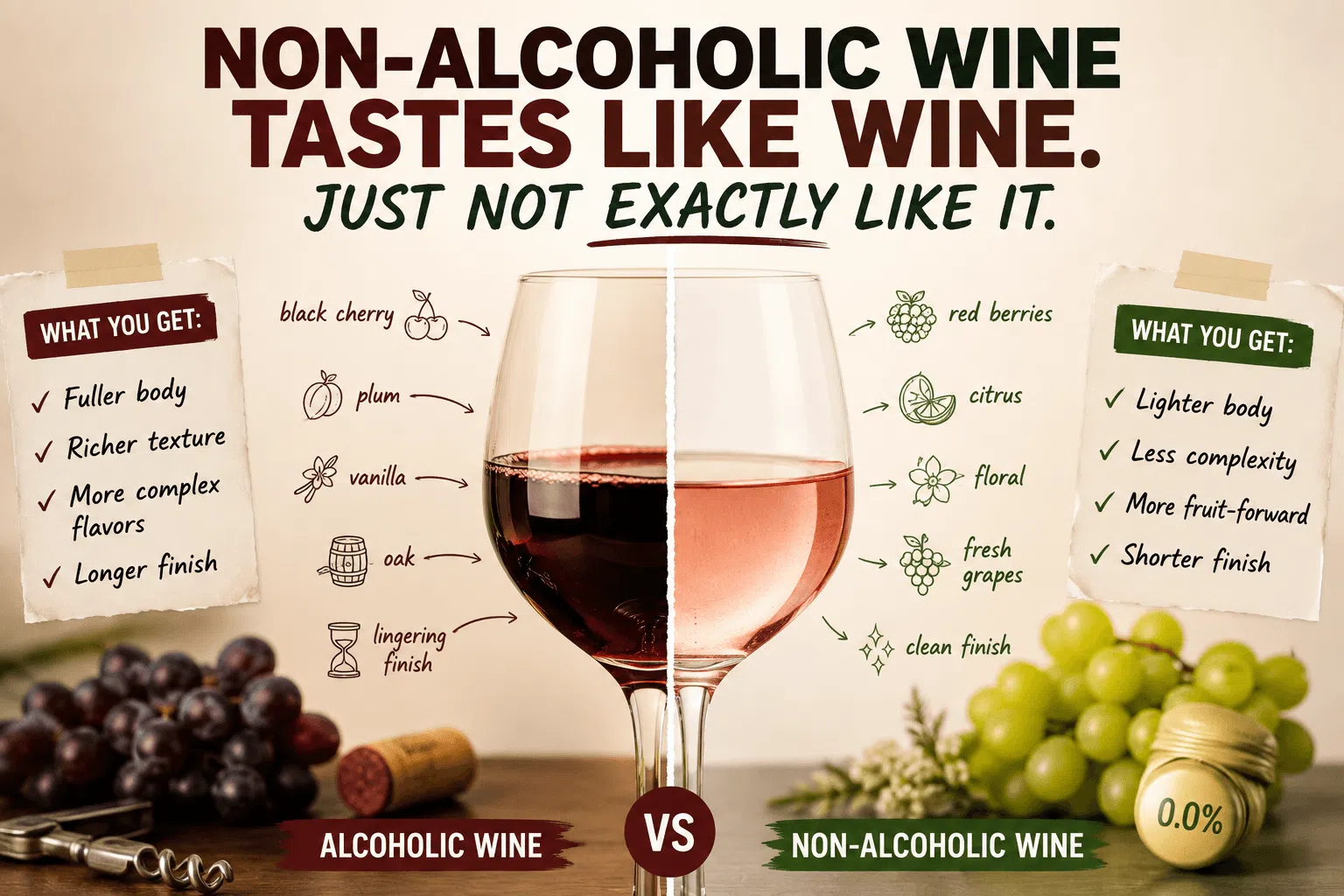
A well-made alcohol-free wine still gives you the things you’d recognize as wine. Fruit. Acidity. Aroma. Sometimes real tannin, real complexity. It shouldn’t taste like grape juice in a costume.
But there’s almost always a gap. You’ll notice it first in the mouth. Body can feel lighter. A red that should carry warmth and weight turns thin. Acidity can feel sharper than it should. The finish can vanish faster than you’re used to.
There’s a reason for that, and it isn’t a manufacturing failure. It’s just what alcohol was doing the whole time.
Alcohol Had a Job, Not Just a Reputation
Alcohol gets blamed for a lot. Mostly the hangover. What it doesn’t get enough credit for is the structural work it does in the glass. Body. Warmth. How sweetness and acidity read on your palate. The sense of weight that separates wine from flavored liquid.
Take it out and you haven’t just removed the buzz. You’ve taken the parmigiano out of a risotto and asked everyone to agree nothing’s missing. Technically still risotto. Everyone at the table will still know.
Producers now have to rebuild balance and texture using everything else available to them. Different removal methods do this with very different success rates. That’s the real reason two bottles both labeled 0.0% can taste like they’re not even in the same category.
Why Some of It Tastes Sweeter Than You Expected
This is usually where a skeptical drinker checks out completely. You buy something that looks like a dry white, take a sip, and wonder who invited the sugar to the party.
Some of that is chemistry. Once alcohol leaves, sweetness and acidity behave differently on the palate than before. Some producers lean on residual sugar specifically to rebuild body and mask what dealcoholization stripped out. That can work. It can also go badly wrong, fast.
Zero alcohol has never meant dry. If sugar matters to you, check the nutrition panel. Not the enormous claim printed across the front of the bottle like it’s the only fact you need.
Bubbles Have an Unfair Advantage Here
If I were introducing someone skeptical to this category, I wouldn’t hand them a red. I’d hand them something sparkling.
Carbonation does real work. It brings its own texture and energy. It keeps your palate busy enough that the missing alcohol doesn’t get much room to announce itself. Good acidity does the rest.
That doesn’t make every alcohol-free sparkling wine good. But the format has tools a still wine simply doesn’t. It’s also part of why I’m genuinely curious what Italian producers do with this, given how seriously this country already takes its bubbles. That’s its own tangled story, wrapped up in exactly which sparkling wines are legally allowed to remove their alcohol and keep their name. I’ve gone into that mess separately.
Red Wine Doesn’t Get the Easy Version of This
Try the same trick with a serious red and the job gets much harder.
A structured red leans on tannin, fruit, acidity, alcohol, and body all pulling together. Remove one and the missing weight is much harder to hide. It’s a boxer fighting with one arm tied behind their back while everyone in the room politely pretends not to notice.
That’s why some alcohol-free reds come across thinner or sweeter than expected. Your brain is looking for a specific depth and warmth, and it just isn’t fully there.
Does that mean a good alcohol-free red is impossible? No. But I’d raise an eyebrow at anyone promising theirs is indistinguishable from a serious conventional one. Tell me your zero-alcohol bottle drinks exactly like Amarone, and I’ll happily taste it.
I’ll also be keeping actual Amarone within reach. Purely for comparison purposes.
Maybe Identical Was Always the Wrong Bar
Here’s where my own thinking shifted while looking into this.
Comparing it to real wine is fair. You called it wine, so I’m allowed to hold it to that standard. But expecting it to be indistinguishable might be the wrong test entirely.
If I drink a crisp, dry, genuinely enjoyable alcohol-free sparkling wine, does it fail because I could spot it in a blind tasting? I don’t think it does. The better question is simpler. Would I pour a second glass? Would I do it because I wanted to, not because I was driving, or doing a dry month, or trying to look virtuous at dinner?
For what it’s worth, I’ve had a few that pass that test easily. Not a consolation prize. Not wine with an asterisk attached. Just a genuinely pleasant glass that happened to have nothing in it.
Don’t Blame the Bottle Before You’ve Served It Properly
There’s an uncomfortable possibility worth raising when someone says their alcohol-free wine tasted terrible. It might have been served badly.
Whites, rosés, and sparkling versions need to be properly cold, more than you’d think. Cooler temperatures sharpen freshness and dial back sweetness that’s already fighting for attention.
Use a real wine glass too. Not a tumbler. Whatever aroma survived the dealcoholization process still needs somewhere to go, and the shape of the glass genuinely changes how much of it reaches your nose. I’ve written before about why the bowl shape and size of a wine glass matters this much, and the logic doesn’t stop applying just because the wine happens to be alcohol-free. Same goes for how you hold the glass. Warm hands ruin a chilled white whether or not there’s alcohol in it.
Nobody pours one disappointing five-euro red down the sink and announces that wine, as a category, doesn’t work. Extend the same patience here before writing off an entire category over one unlucky bottle.
What I’d Start With
Reach for a sparkling wine, a crisp white, or a rosé before you demand your first bottle replace your favorite Barolo. Look for producers who explain their process instead of hiding behind the big zero on the label. Check the sugar if you prefer things dry. Chill it properly. Try it with food.
The category doesn’t need to win by producing a flawless impersonation of ordinary wine. It wins the moment the reaction shifts from “that’s impressive for something with no alcohol” to just “that’s good,” full stop, no asterisk attached.
Some bottles aren’t there yet. A few genuinely are. Italy spent decades insisting decaf espresso wasn’t real coffee. Decent decaf exists anyway, and the world kept turning. I suspect wine is headed toward the same quiet truce, several years behind, the way it usually is with anything that isn’t Barolo.
Quick Answers
Does non-alcoholic wine taste exactly like regular wine? No, and it doesn’t need to. Removing alcohol changes body, texture, and how sweetness and acidity read on the palate. Good dealcoholized wine tastes like a distinct, enjoyable drink in its own right, not a flawless copy of the alcoholic version.
Why does some non-alcoholic wine taste sweet? Producers sometimes add or preserve residual sugar to rebuild the body and mouthfeel that alcohol used to provide. It varies a lot by brand, so check the nutrition label if you prefer dry styles.
Is sparkling non-alcoholic wine better than still? Generally, yes, for taste. Carbonation provides texture and energy that helps compensate for the missing alcohol, which is why sparkling and crisp whites tend to be the most convincing entry points into the category.
Does serving temperature really matter for alcohol-free wine? Yes, more than you’d expect. Serving it properly chilled and in a real wine glass, rather than lukewarm in a tumbler, makes a noticeable difference in how much aroma and freshness comes through.
Salute.
Continue Exploring
- Kalimotxo: A Mixture of Red Wine and Coke
- Can Non-Alcoholic Prosecco Actually Exist?
- Why Is Non-Alcoholic Wine So Expensive?
Enjoy wine without the snobbery?
Make The Finest Italian Wine one of your Preferred Sources on Google.
Add The Finest Italian Wine to Preferred SourcesDiscover more from The Finest Italian Wine
Subscribe to get the latest posts sent to your email.