Would You Let a Restaurant Take the Alcohol Out of Your Wine?
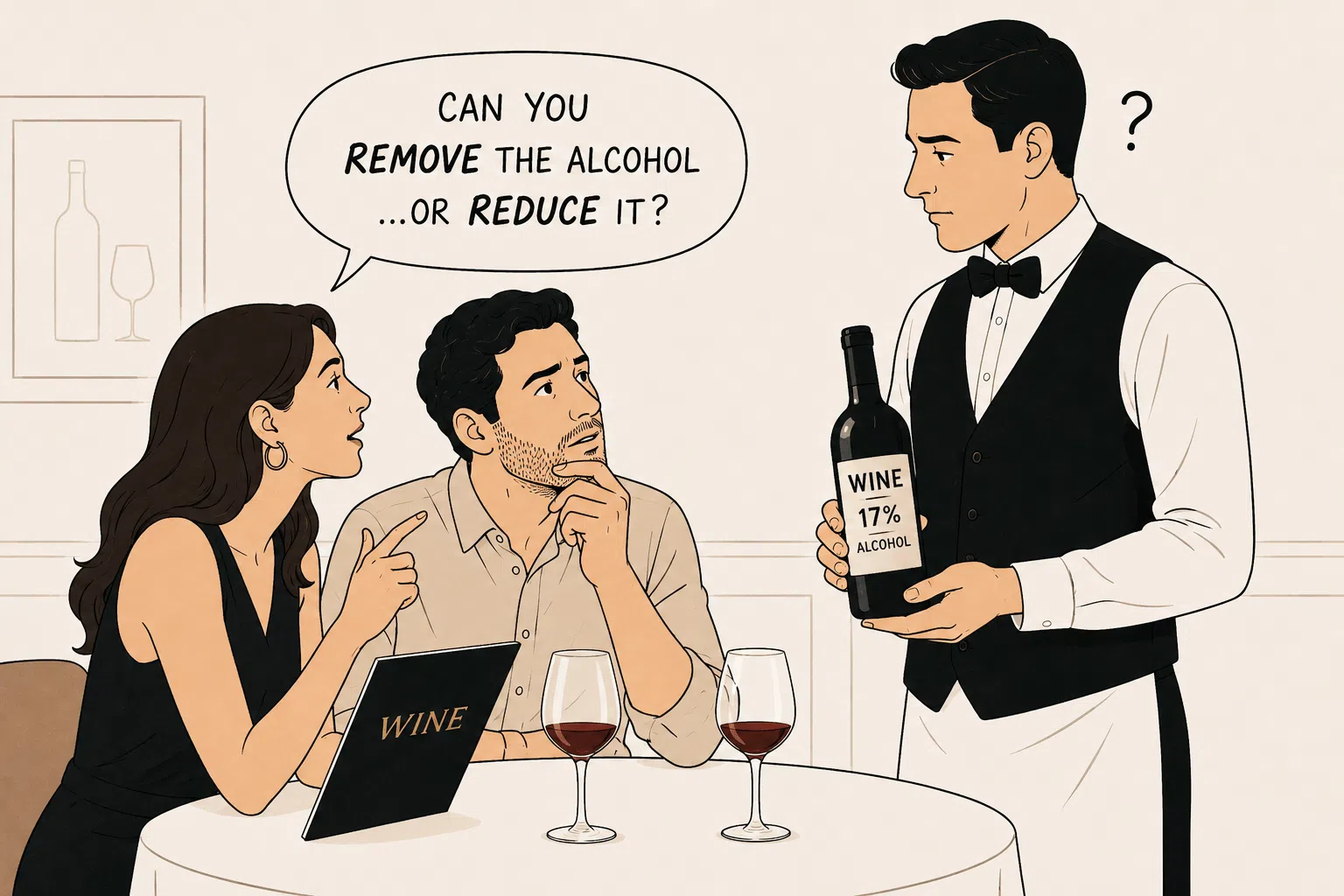
Picture ordering a bottle of wine at a restaurant. The waiter opens it, pours you a taste, you nod your approval. Normal so far.
Then the follow-up question arrives.
“Would you like that at 14%, or shall we take it down a little?”
I’m sorry, what?
We’ve spent years learning to order wine by grape, region, vintage. And how confidently we can point at the second-cheapest bottle on the list without making eye contact. Apparently there’s a new variable coming. How much alcohol would you like left in the glass?
An Italian wine technology company is building a compact machine designed to pull alcohol out of ordinary wine. Not at the winery months before the bottle reaches you. Potentially at your table. And suddenly the whole non-alcoholic wine conversation gets a lot more interesting.
Could a Restaurant Really Do This to My Wine
Potentially, yes. VasonGroup, a Verona company, has spent decades building winery technology. Now it’s developing a smaller dealcoholization machine aimed at restaurants, bars, and even private homes. It’s expected to be ready by the end of 2026, priced somewhere between €5,000 and €7,000.
So no, this isn’t about to sit next to your espresso machine. But for a restaurant, the math starts looking genuinely interesting.
Until now, removing alcohol from wine was mostly a production-stage decision. A winery makes the wine, runs it through specialized equipment, bottles the result. Sells it as a reduced or zero-alcohol product. This machine flips that entirely. Instead of buying a bottle that was built from scratch to be alcohol-free, you’d start with a completely ordinary wine and take some of the alcohol out much closer to the moment you drink it.
A 14% red that feels like a lot tonight? Take it down. Wine with lunch without quite so much punch? Take some out. Driving home later? You can see exactly where this is going. We may be heading toward wine with a volume dial.
The Science, Without the Kettle
This isn’t your Barbera getting boiled on a stovetop.
VasonGroup’s system runs on membrane technology. Wine moves along one side of a microporous, water-repellent membrane while water moves separately along the other. Because the alcohol concentration differs between the two sides, alcohol passes through the membrane as vapor. The wine and water never touch, and critically, nothing gets heated.
That matters more than it sounds. Heat is the enemy of the aromas you paid for in the first place. VasonGroup says its process protects them precisely because the wine stays cool the entire time. I’ve gone deep into how wineries generally remove alcohol from wine if you want the full science. This smaller machine is interesting for a completely different reason: it moves the decision out of the winery and hands it straight to you.
That’s where things get slightly bonkers.
You Don’t Get a Dial. You Get a Taste Test
You might picture pressing a button labeled 14% → 8% and collecting your newly responsible Cabernet twenty minutes later.
Not quite. The compact version won’t precisely measure the final alcohol content. That monitoring hardware exists only on VasonGroup’s industrial systems, the ones priced north of €100,000.
Building the same precision into a €5,000 machine would erase the whole point of it being affordable. So instead, you taste. As the machine works, you sample the wine as it goes. You stop it whenever it tastes right to you.
I have questions. Several of them. Because “I’ll know my wine has hit roughly 8% by tasting it repeatedly” is exactly the kind of experiment that stops being scientific somewhere around attempt six.
But it also asks a genuinely good question underneath the gimmick. Are we chasing a specific number on a label? Or just trying to make a wine feel lighter while keeping enough of what made us order it in the first place? Those aren’t the same goal, and this machine quietly assumes the second one.
Will It Still Taste Like the Wine You Ordered
Here’s where I’d keep the enthusiasm in check.
Alcohol isn’t an unwanted hitchhiker sitting inside your wine waiting to be politely asked to leave. It’s doing real work, shaping body, warmth, texture, and how every other flavor in the glass gets perceived. I’ve gone properly into what happens on the palate when alcohol comes out of a wine, and the same logic applies here. Take enough of it out and something in that balance has to give, no matter how carefully the aromas were protected on the way out.
You can start with an excellent 14% wine, remove most of the alcohol, keep a genuinely impressive share of the aroma. It still might not taste quite like the bottle you started with. That’s not a strike against the technology. It’s the thing that makes the restaurant version more interesting than a straight 0.0% product.
Maybe the useful comparison was never 14% against 0.0%. Maybe it’s 14% against 11%, or 13.5% against 9%. Leave enough alcohol in the glass and the wine keeps most of its original shape while getting genuinely lighter to drink. That’s a far more interesting proposition than pretending a fully dealcoholized version of a powerful red will taste identical to the original, because it won’t.
Step Away From the Champagne
Before anyone wheels this thing toward my Franciacorta, we need to talk about bubbles.
This membrane technology is built for still wine. Sparkling wine creates its own separate problem, because the same membrane that lets alcohol vapor through also lets carbon dioxide through. In plain terms: you might successfully pull the alcohol out of your sparkling wine. You might also successfully pull out the sparkling part along with it. That’s solving one problem by creating a new one, which feels less like innovation and more like a trade you didn’t agree to.
Albano Vason himself has said he wouldn’t run quality Trentodoc, Franciacorta, or Champagne through this process. On that, we’re in complete agreement. You can technically dealcoholize a still wine and carbonate it afterward. But if I ever see someone approach a good bottle of vintage Champagne holding a dealcoholizer in one hand and a home soda machine in the other, I’m leaving the room. I’ve written before about how seriously Italy takes what’s allowed to happen to a protected sparkling wine like Prosecco. Franciacorta and Trentodoc play by the same instinct. Some experiments genuinely don’t need witnesses.
Restaurants Might Be Where This Makes Sense
A €5,000 appliance for your own kitchen sounds like a lot. For the right restaurant, the economics look different entirely. I’ve already gone into why non-alcoholic wine itself carries such a steep price tag, and this machine is really the same economics wearing a different shape, paying upfront for equipment instead of paying it per bottle.
Restaurants are already juggling customers whose drinking habits don’t sort neatly into two categories. Some want zero alcohol. Others don’t want zero, they just want less. Some are driving. Some have an early flight. Some want two glasses with dinner without those two glasses hitting quite as hard as usual. Right now, a restaurant handles all of that by stocking three separate categories of bottle. Regular wine here, low-alcohol wine there, alcohol-free wine somewhere else entirely.
A machine that can adjust a wine a restaurant already stocks changes that math. Instead of a separate product line, you get the same bottle people already recognize, just dialed down. That’s especially relevant for wines whose alcohol has been quietly climbing for years. Warmer growing seasons mean riper grapes, more sugar at harvest, and more potential alcohol after fermentation. Winemakers have been wrestling with that trend long before anyone thought to put a dealcoholizer next to the espresso machine.
There’s a catch worth naming plainly, though. Italy now has a clearer legal framework covering dealcoholized wine production, including rules on authorized premises, excise handling, and record-keeping. That framework was built around producers, not restaurants modifying bottles table-side for commercial service. The technology may be arriving faster than the paperwork that would let a restaurant legally use it. Wine has seen that particular film before.
The Real Idea Isn’t Non-Alcoholic Wine
I think the bigger story here isn’t non-alcoholic wine at all. It’s adjustable-alcohol wine.
The whole NoLo conversation has treated this as two separate worlds: wine, and wine with the alcohol removed. But that’s not how people drink. Plenty of wine lovers don’t want to quit wine and don’t want 0.0% either. They just want less, some of the time. That’s an enormous middle ground nobody’s really built for yet. Wine at 6%, at 8%, at 10%, still recognizably itself rather than a separate product engineered to imitate the original.
If the technology can make that middle ground taste genuinely good, restaurants could end up being the place most people first encounter it. Not because anyone lectured them about drinking less, but because a waiter asked a simple question: the regular version, or something a little lighter?
That’s a completely different pitch than anything the alcohol-free aisle has tried so far.
Would I Let a Restaurant Do This
Yes. With conditions.
Nobody’s touching my Barolo with this thing, and the Champagne stays exactly as God and Épernay intended. But an ordinary bottle of still wine I already know, served next to its dealcoholized twin? I’d taste both without hesitation, and honestly, that’s the real test for this whole technology. Not whether dealcoholized wine counts as “real” wine, we’ve argued that one to death already. Pour the original in one glass and the reduced version in another. Don’t tell me which is which. See what survives once the alcohol leaves the room.
If the lighter glass still smells like the wine, tastes like the wine, and makes me reach for a second sip anyway, the industry may have found something bigger than another alcohol-free category. For centuries, once a winemaker bottled a wine, the big decisions were already finished. They picked the grapes, the fermentation, the aging, the final alcohol. All we did was decide whether to open it.
Now there’s a new decision sitting between the cork and the glass. How much alcohol would you like tonight? I genuinely haven’t decided if that’s brilliant or ridiculous. In wine, that’s usually exactly where the interesting stuff starts.
Quick Answers
Can a restaurant really remove alcohol from wine? The technology to do this on a small scale is currently in development. VasonGroup, an Italian wine-tech company, is building a compact dealcoholization machine aimed partly at restaurants and bars, expected by the end of 2026, though commercial restaurant use would still need to comply with existing wine and alcohol regulations.
Does removing alcohol change how the wine tastes? Yes. Even with technology designed to protect aroma, alcohol shapes a wine’s body, warmth, and how other flavors come across. The more that’s removed, the more noticeable the difference becomes.
Can wine be partially dealcoholized instead of going to zero? Yes, and that’s arguably the more interesting version of this technology. A wine can be brought down from something like 14% to 9% or 11%, keeping more of its original character than a full 0.0% version would.
Can sparkling wine go through this process? Not without real risk. The same membrane that lets alcohol vapor escape also lets carbon dioxide escape, so this technology is currently much better suited to still wine than to Prosecco, Franciacorta, Trentodoc, or Champagne.
Salute.
Continue Exploring
- How Do They Take the Alcohol Out of Wine?
- Non-Alcoholic Wine Tastes Like Wine. Just Not Exactly Like It.
- Why Is Non-Alcoholic Wine So Expensive?
- Can Non-Alcoholic Prosecco Actually Exist?
- Non-Alcoholic Wine Explained: What Exactly Are We Drinking?
Enjoy wine without the snobbery?
Make The Finest Italian Wine one of your Preferred Sources on Google.
Add The Finest Italian Wine to Preferred SourcesDiscover more from The Finest Italian Wine
Subscribe to get the latest posts sent to your email.